R295
Quantum Apex Protocol
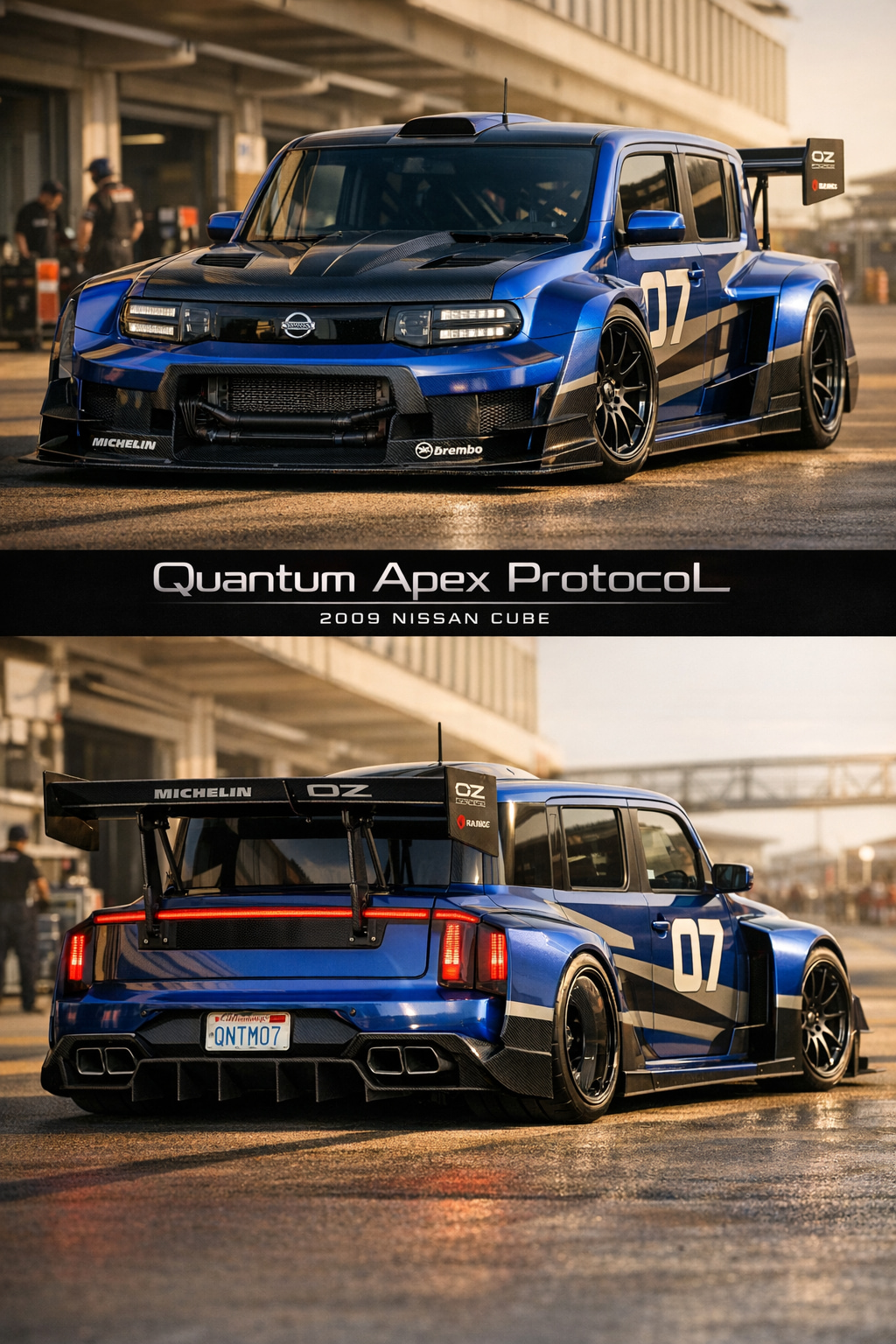
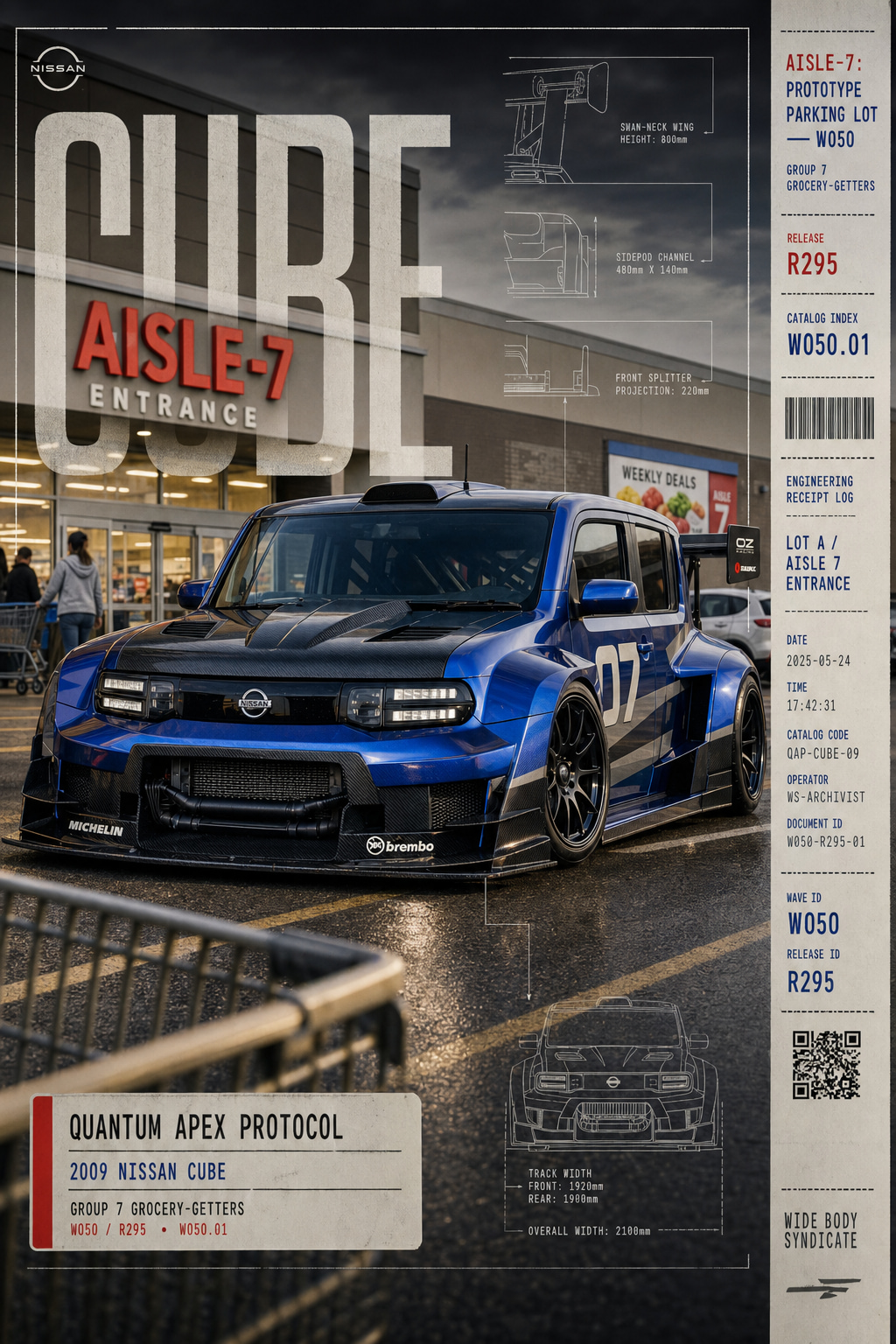
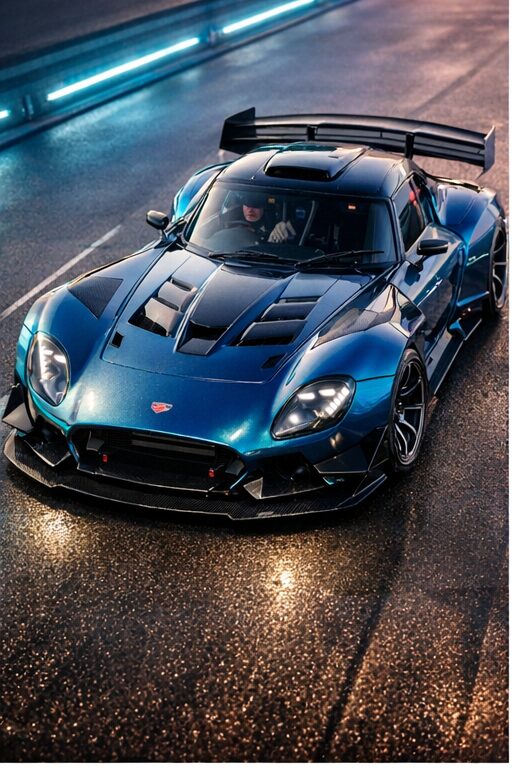
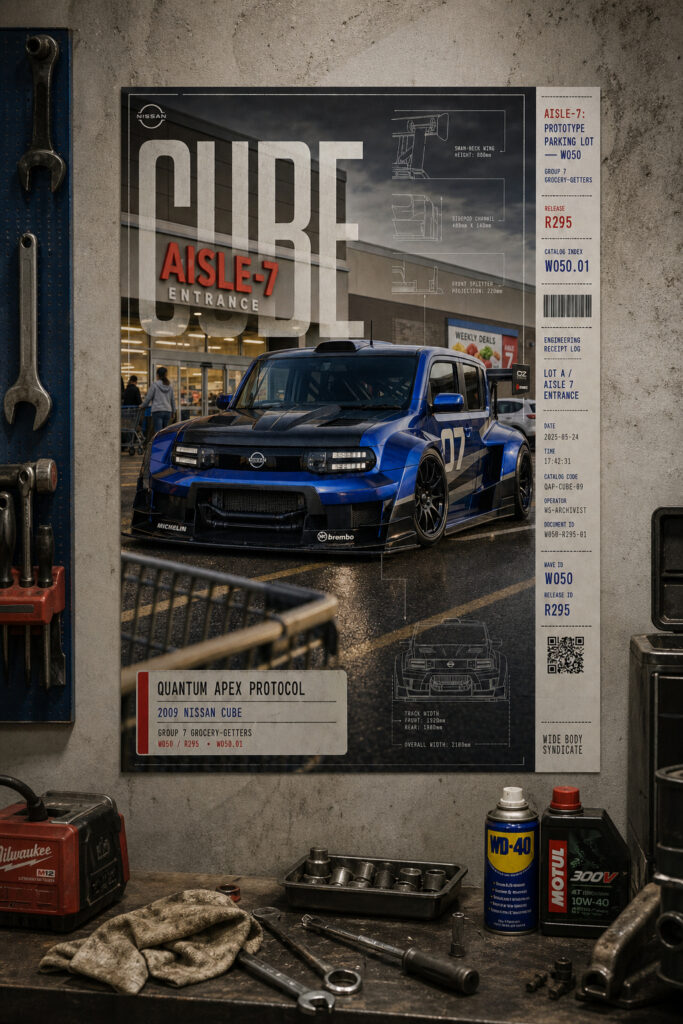
Quantum Apex Protocol takes the 2009 Nissan Cube’s upright, asymmetrical silhouette and treats it like a homologation problem: keep it recognizable, then make everything around it brutally functional. The result is a Cube that reads like an unlimited-class prototype—boxy greenhouse, stretched nose, sidepod volume, and a cantilevered tail that looks engineered for high-speed stability rather than shock value.
Under the skin, the concept is grounded in race-car logic: track width pushed out to meet the aero, cooling moved to where it works, and the mass centralized with a longitudinal mid-engine layout. It’s the kind of build that would live in a design archive because every surface has a job—feed the radiators, seal the floor, manage tire wake, and keep the Cube’s weird charm intact while it tries to set a lap time.
Release Image Studies
Image studies from every angle.
Comparison Shots
Blueprint / Collector Archive
Engineering Artifacts
The technical study and collectible interpretation of one build, preserved together.
A presentation-grade collector artifact created for this release and preserved as part of the Widebody Syndicate archive.
Selected archive goods are available for collectors.
Technical Dossier
Platform
2009 Nissan Cube
The 2009 Nissan Cube is peak late-2000s Japanese urban design: a tall-roof compact built around space efficiency, visibility, and everyday ease rather than speed or status. Its upright greenhouse, short overhangs, and asymmetrical tail (a Cube signature) make it feel more like a clever piece of industrial design than a traditional hatch—friendly, functional, and instantly recognizable in traffic.
Underneath the quirky shape is straightforward Nissan hardware tuned for city life: light controls, a calm ride, and a cabin that prioritizes headroom and usable cargo volume. It’s the kind of platform that became a cultural shorthand for creative commuters and small-crew road trips—practical transport with real personality before “lifestyle car” became a marketing checkbox.
Aero Package
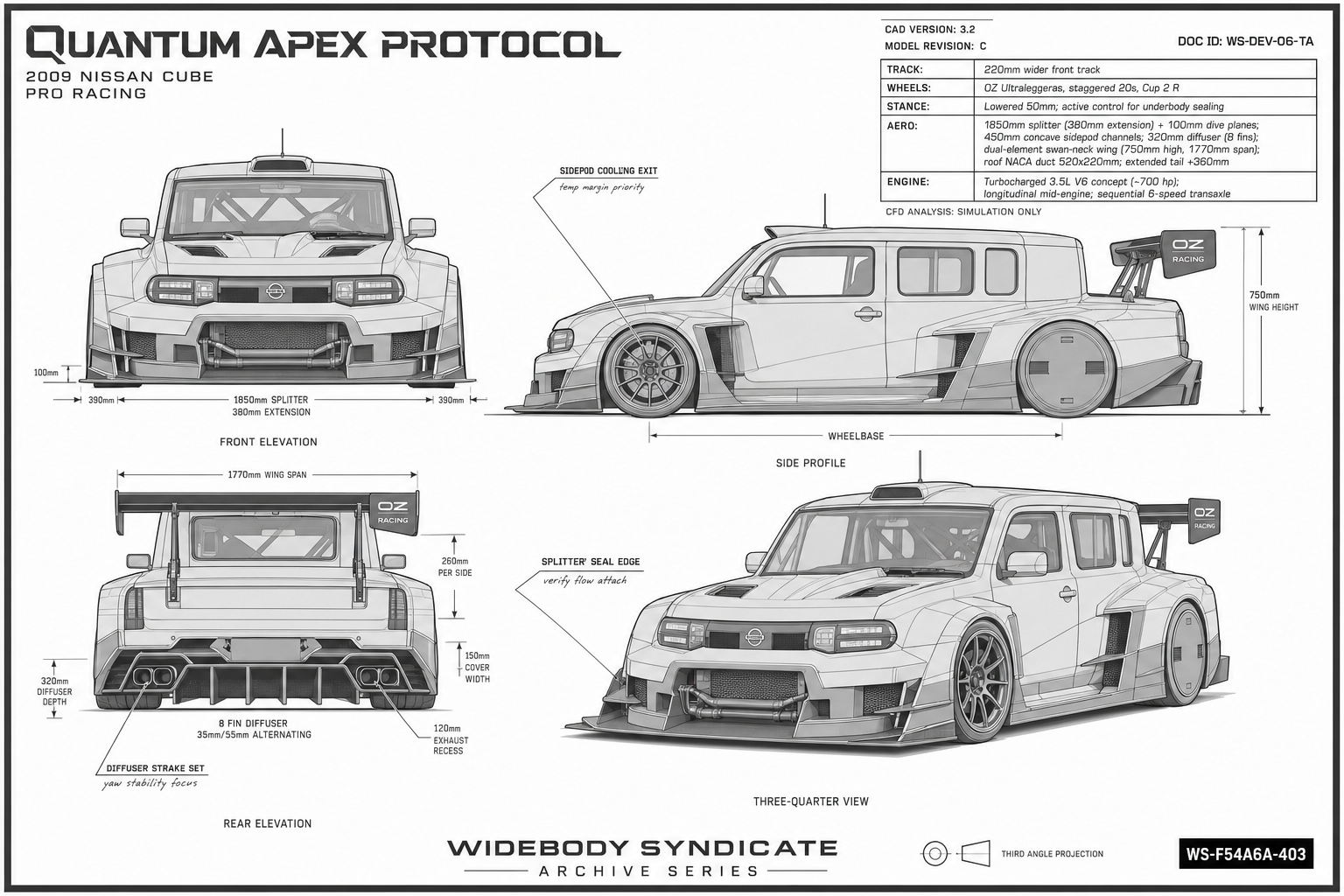
1850mm-wide splitter extending ~380mm with paired vertical dive planes and integrated air curtains
Sidepod ducting fed by fender channels, with mesh-exposed cooling exits behind the front wheels
320mm-deep rear diffuser with eight strakes and recessed dual exhaust outlets
Tall swan-neck dual-element rear wing with adjustable flap and extended roofline flow support
Chassis
This is an unlimited-class time-attack/prototype interpretation built for modern circuits where high-speed aero efficiency matters as much as braking stability. The long splitter, sealed floor, and multi-strake diffuser are there to keep the platform calm through fast direction changes and heavy braking zones.
Wheels & Tires
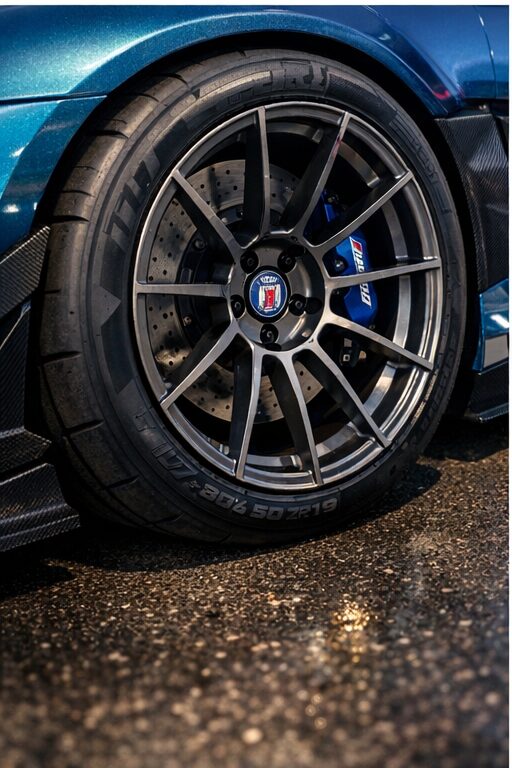
Forged OZ Racing Ultraleggera: 20x10 ET+15 front, 20x13 ET+8 rear
Michelin Pilot Sport Cup 2 R: 295/30R20 front, 355/30R20 rear
Prototype-style ride height with active control to protect floor sealing and diffuser performance
Powertrain
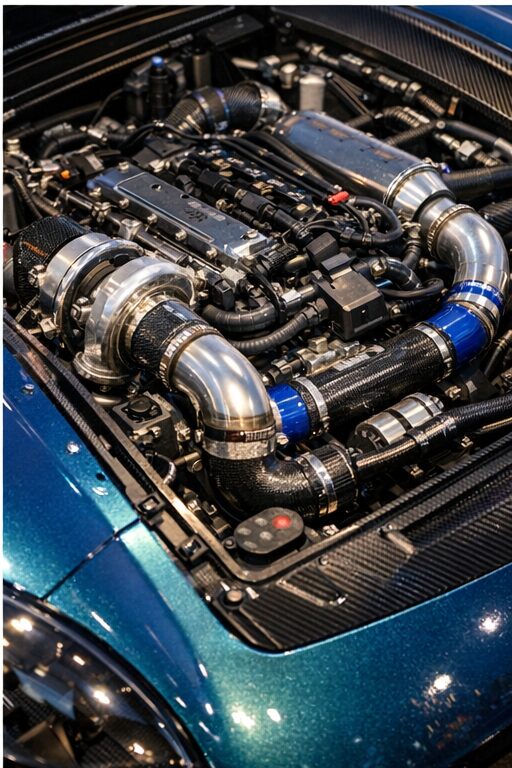
Longitudinal mid-engine turbocharged 3.5L V6 targeting ~700 hp with endurance-focused thermal headroom
6-speed sequential transaxle with paddle shift and motorsport LSD
Dual sidepod radiators with dedicated ducting and controlled extraction paths
Front-mounted oil/water cooling supplemented by hood extraction to manage pressure and heat soak
Fabrication Notes
Composite widebody and sidepods bonded to a reinforced structure with serviceable fasteners at high-heat zones
Underfloor and diffuser built as a flat-floor system with sealed edges and accessible inspection points
Custom subframes and bulkhead work to support mid-engine packaging and transaxle mounts
Ducting designed as continuous paths (inlet → core → exit) to avoid dead zones and recirculation
Design Philosophy
Quantum Apex Protocol takes the 2009 Nissan Cube’s upright, asymmetrical silhouette and treats it like a homologation problem: keep it recognizable, then make everything around it brutally functional. The result is a Cube that reads like an unlimited-class prototype—boxy greenhouse, stretched nose, sidepod volume, and a cantilevered tail that looks engineered for high-speed stability rather than shock value.
Under the skin, the concept is grounded in race-car logic: track width pushed out to meet the aero, cooling moved to where it works, and the mass centralized with a longitudinal mid-engine layout. It’s the kind of build that would live in a design archive because every surface has a job—feed the radiators, seal the floor, manage tire wake, and keep the Cube’s weird charm intact while it tries to set a lap time.
▧Platform+
2009 Nissan Cube
The 2009 Nissan Cube is peak late-2000s Japanese urban design: a tall-roof compact built around space efficiency, visibility, and everyday ease rather than speed or status. Its upright greenhouse, short overhangs, and asymmetrical tail (a Cube signature) make it feel more like a clever piece of industrial design than a traditional hatch—friendly, functional, and instantly recognizable in traffic.
Underneath the quirky shape is straightforward Nissan hardware tuned for city life: light controls, a calm ride, and a cabin that prioritizes headroom and usable cargo volume. It’s the kind of platform that became a cultural shorthand for creative commuters and small-crew road trips—practical transport with real personality before “lifestyle car” became a marketing checkbox.
⌘Aero Package+
1850mm-wide splitter extending ~380mm with paired vertical dive planes and integrated air curtains
Sidepod ducting fed by fender channels, with mesh-exposed cooling exits behind the front wheels
320mm-deep rear diffuser with eight strakes and recessed dual exhaust outlets
Tall swan-neck dual-element rear wing with adjustable flap and extended roofline flow support
⟡Chassis+
This is an unlimited-class time-attack/prototype interpretation built for modern circuits where high-speed aero efficiency matters as much as braking stability. The long splitter, sealed floor, and multi-strake diffuser are there to keep the platform calm through fast direction changes and heavy braking zones.
◎Wheels & Tires+
Forged OZ Racing Ultraleggera: 20x10 ET+15 front, 20x13 ET+8 rear
Michelin Pilot Sport Cup 2 R: 295/30R20 front, 355/30R20 rear
Prototype-style ride height with active control to protect floor sealing and diffuser performance
▤Powertrain+
Longitudinal mid-engine turbocharged 3.5L V6 targeting ~700 hp with endurance-focused thermal headroom
6-speed sequential transaxle with paddle shift and motorsport LSD
Dual sidepod radiators with dedicated ducting and controlled extraction paths
Front-mounted oil/water cooling supplemented by hood extraction to manage pressure and heat soak
△Fabrication Notes+
Composite widebody and sidepods bonded to a reinforced structure with serviceable fasteners at high-heat zones
Underfloor and diffuser built as a flat-floor system with sealed edges and accessible inspection points
Custom subframes and bulkhead work to support mid-engine packaging and transaxle mounts
Ducting designed as continuous paths (inlet → core → exit) to avoid dead zones and recirculation
×Design Philosophy+
Quantum Apex Protocol takes the 2009 Nissan Cube’s upright, asymmetrical silhouette and treats it like a homologation problem: keep it recognizable, then make everything around it brutally functional. The result is a Cube that reads like an unlimited-class prototype—boxy greenhouse, stretched nose, sidepod volume, and a cantilevered tail that looks engineered for high-speed stability rather than shock value.
Under the skin, the concept is grounded in race-car logic: track width pushed out to meet the aero, cooling moved to where it works, and the mass centralized with a longitudinal mid-engine layout. It’s the kind of build that would live in a design archive because every surface has a job—feed the radiators, seal the floor, manage tire wake, and keep the Cube’s weird charm intact while it tries to set a lap time.
Part of
Wave 50
Group 7 Grocery-Getters
We got tired of watching the same halo cars hog all the pit lane attention, so we did the only reasonable thing: we turned the background traffic into the main event. This release is our love letter to the cars you ignore in the parking lot, now wearing full open-rule prototype hardware like they were born with it.
Explore Wave 50 → 6 BuildsKeep Exploring
The archive is always growing. New releases, waves, and blueprints added regularly.