

R103
Raptor Vector Program
1955 Chevrolet Apache
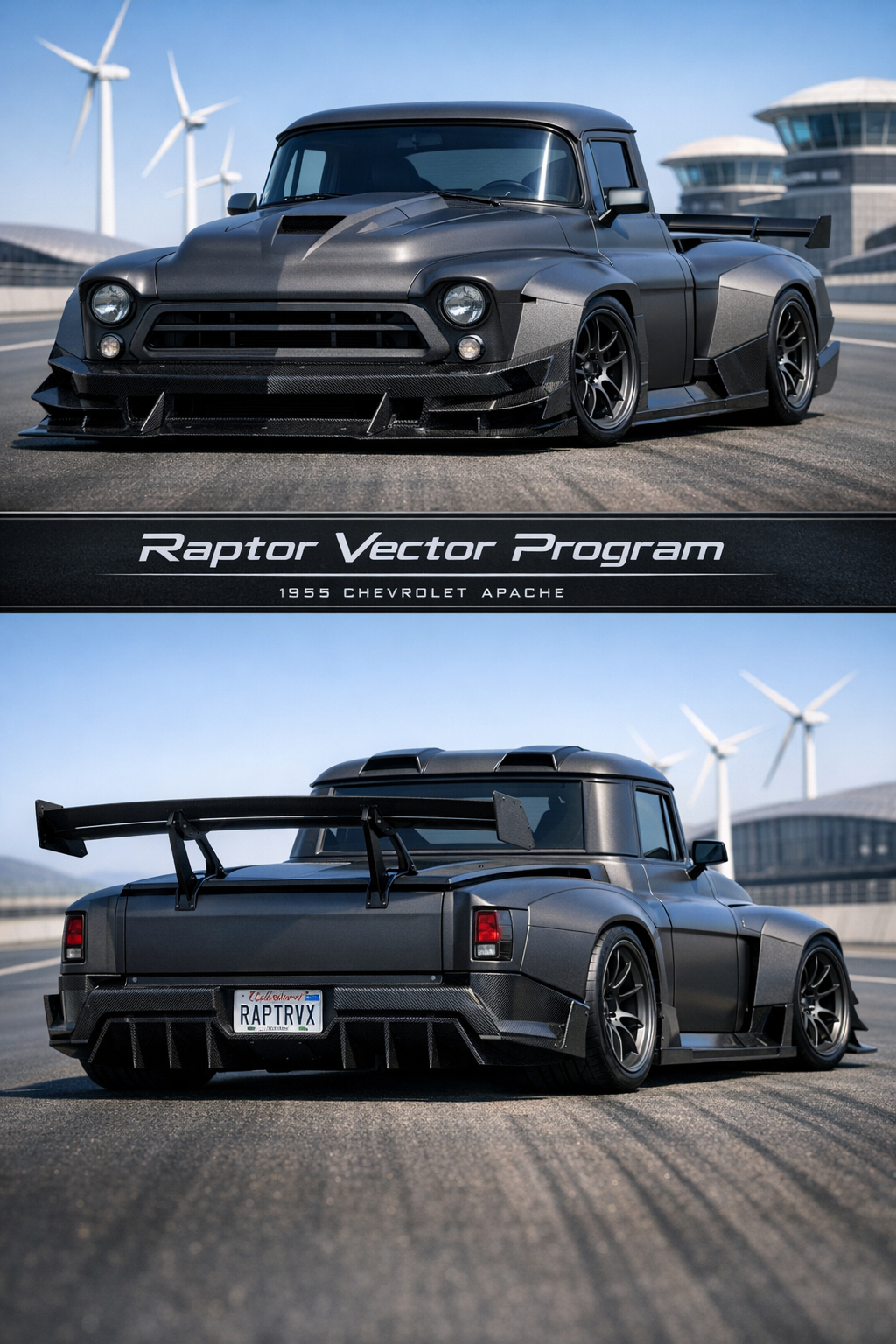
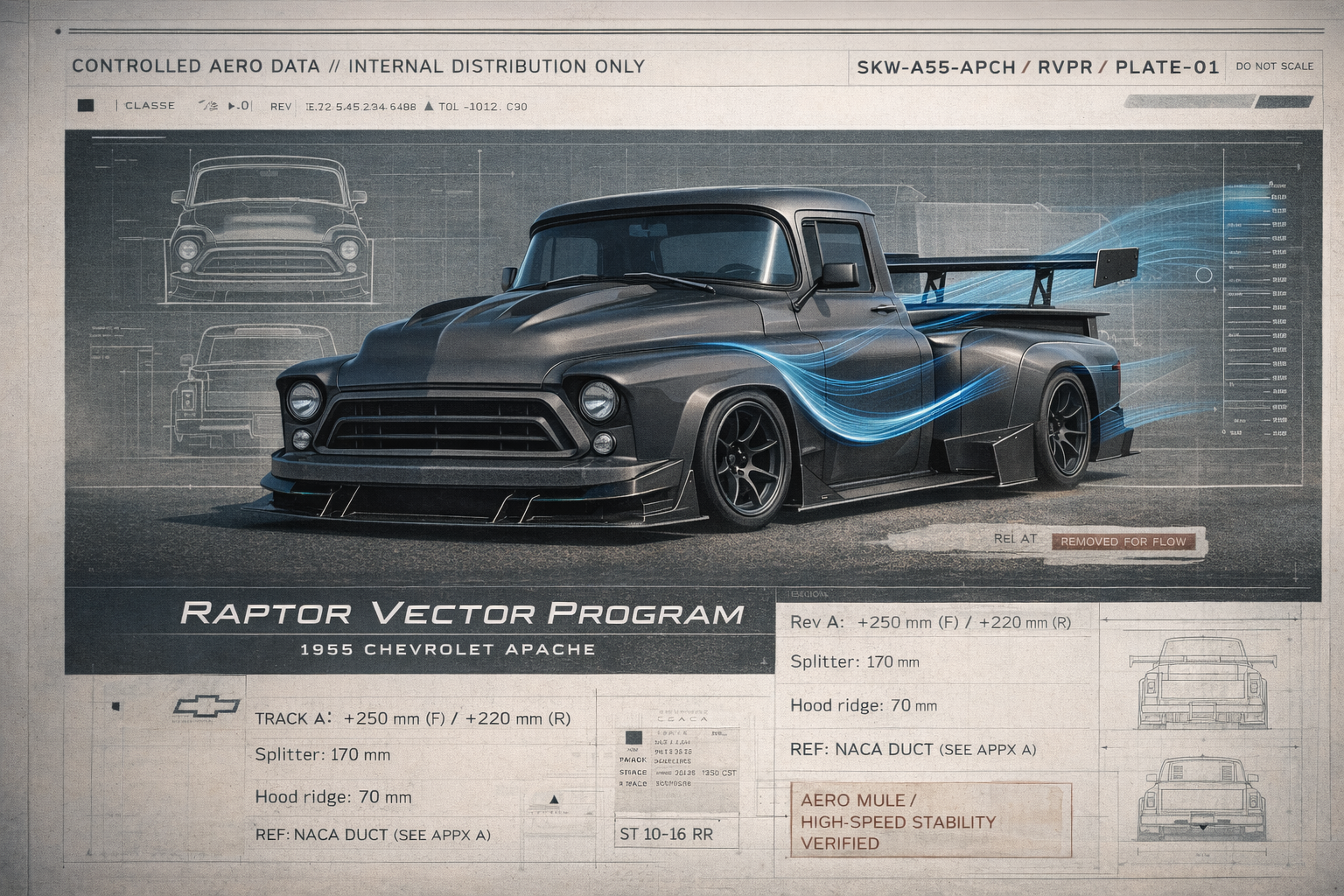
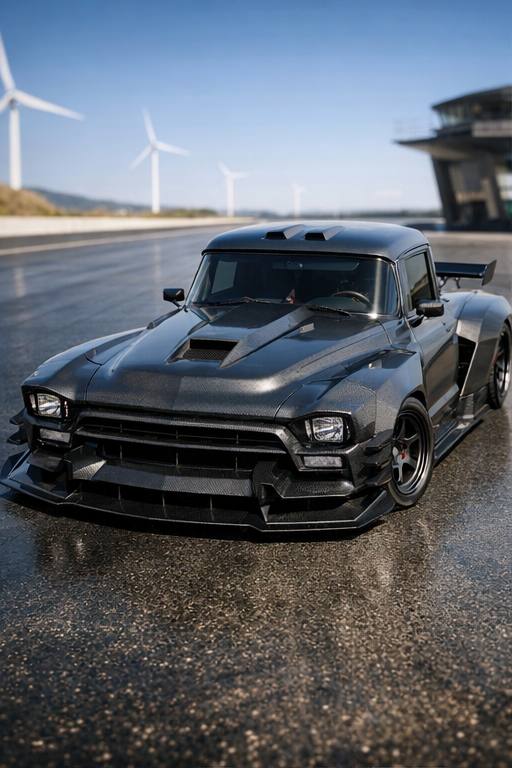
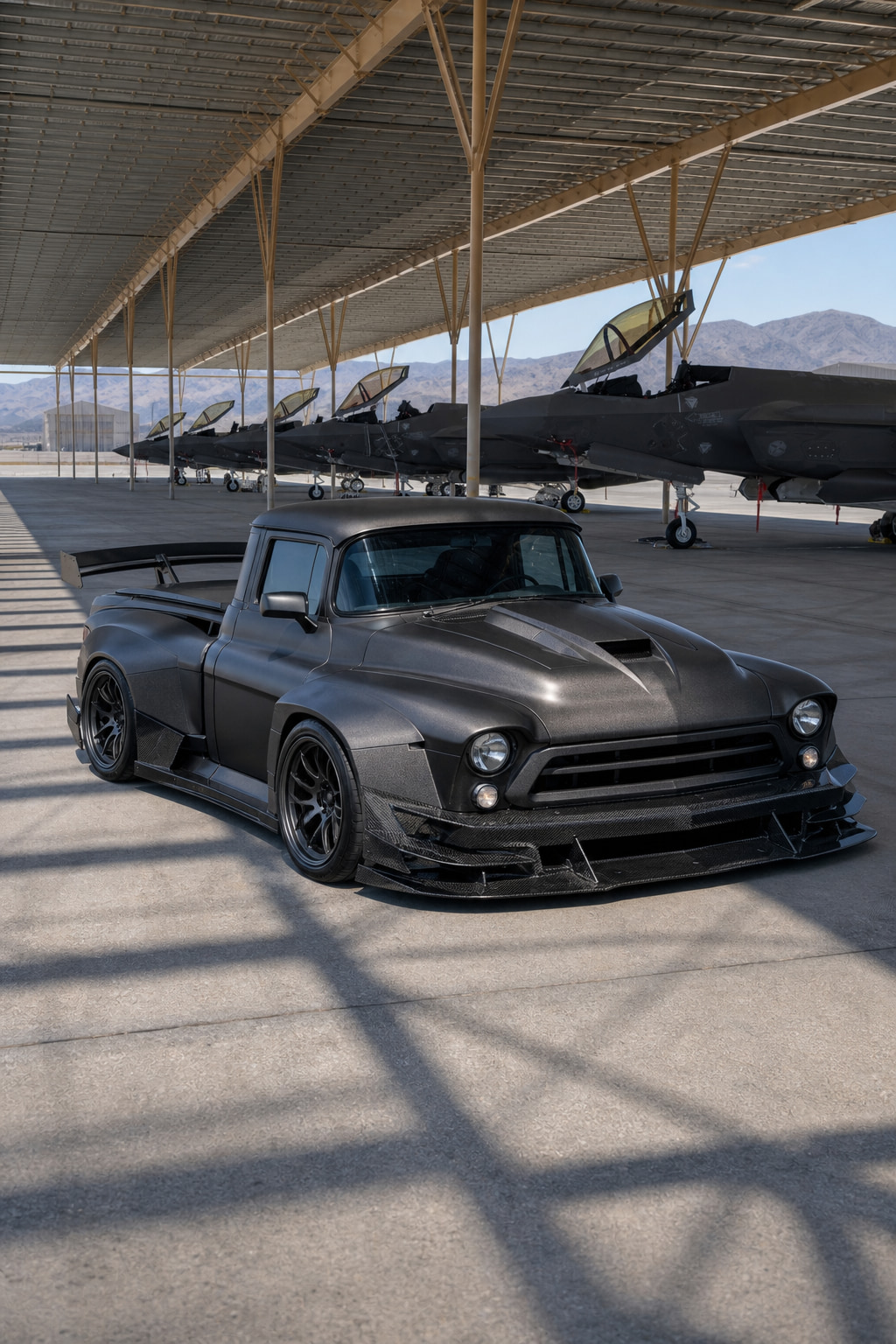
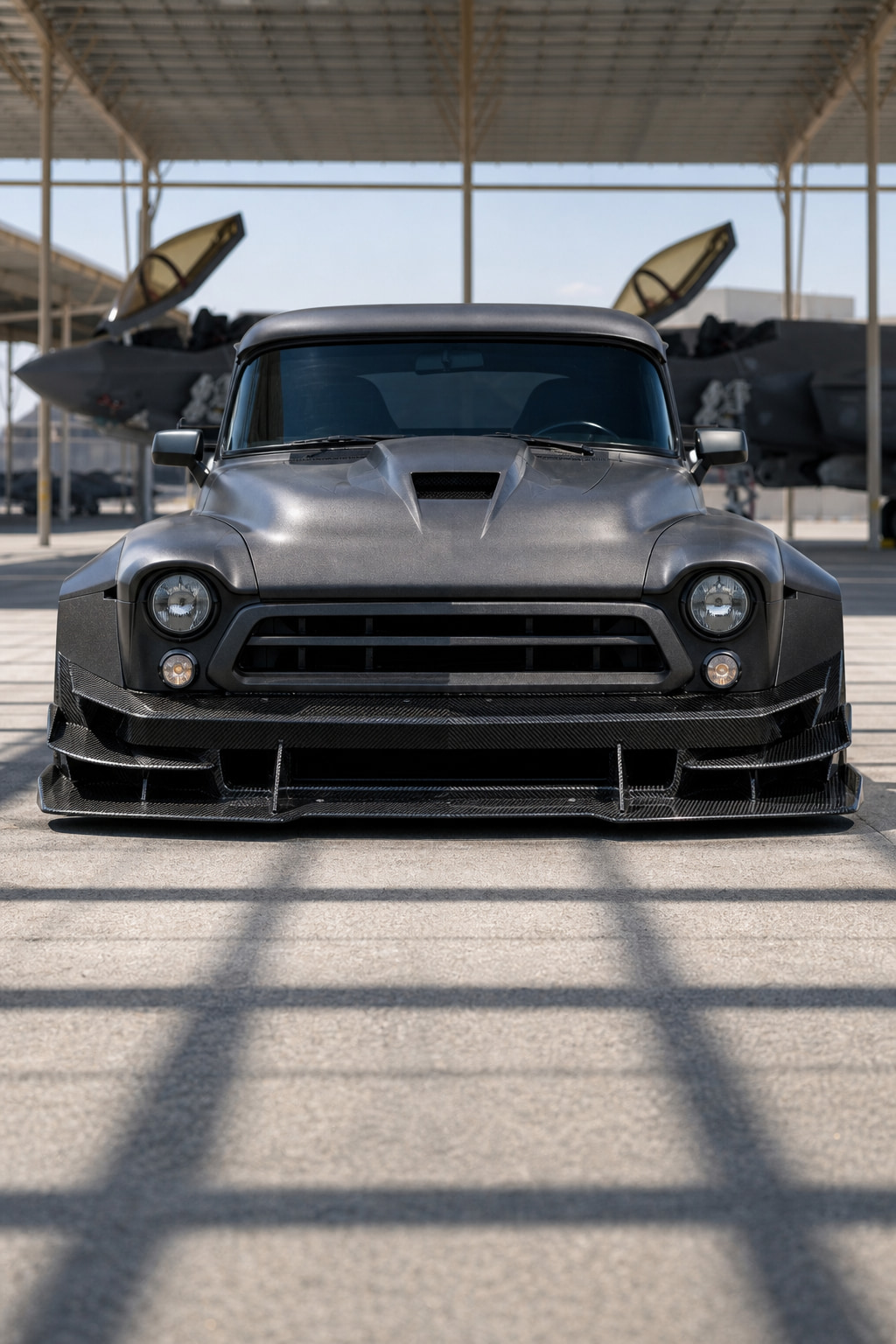
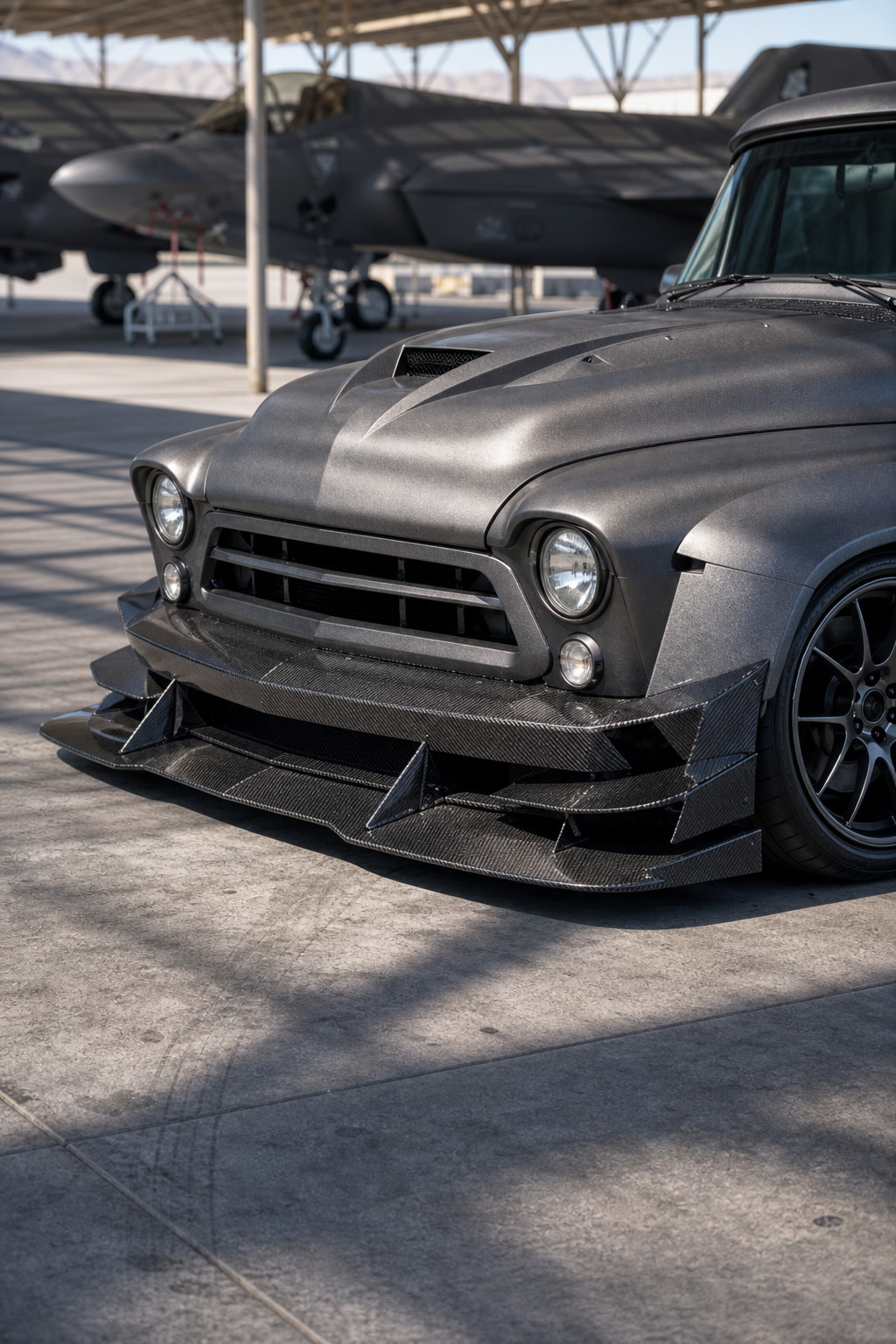
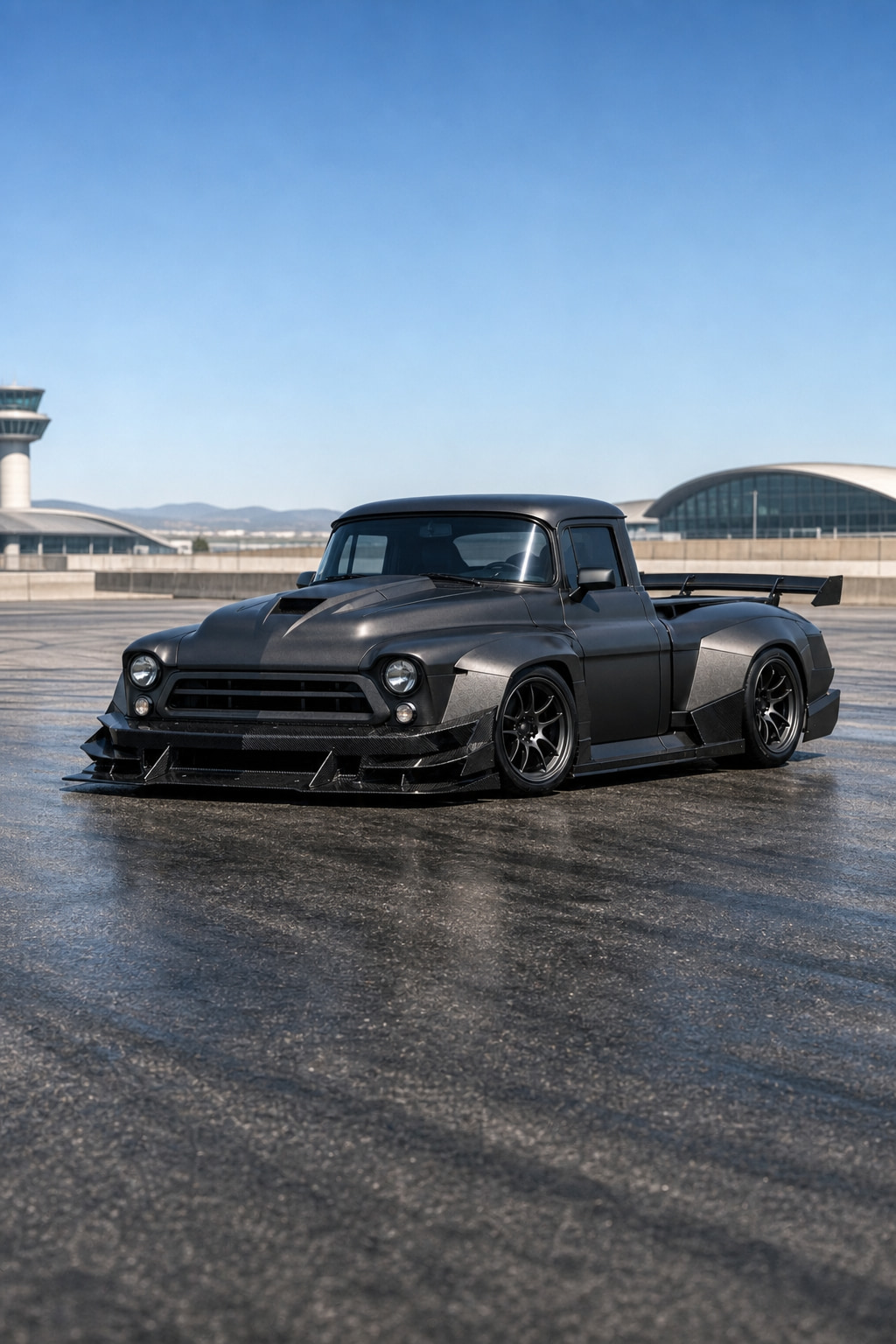
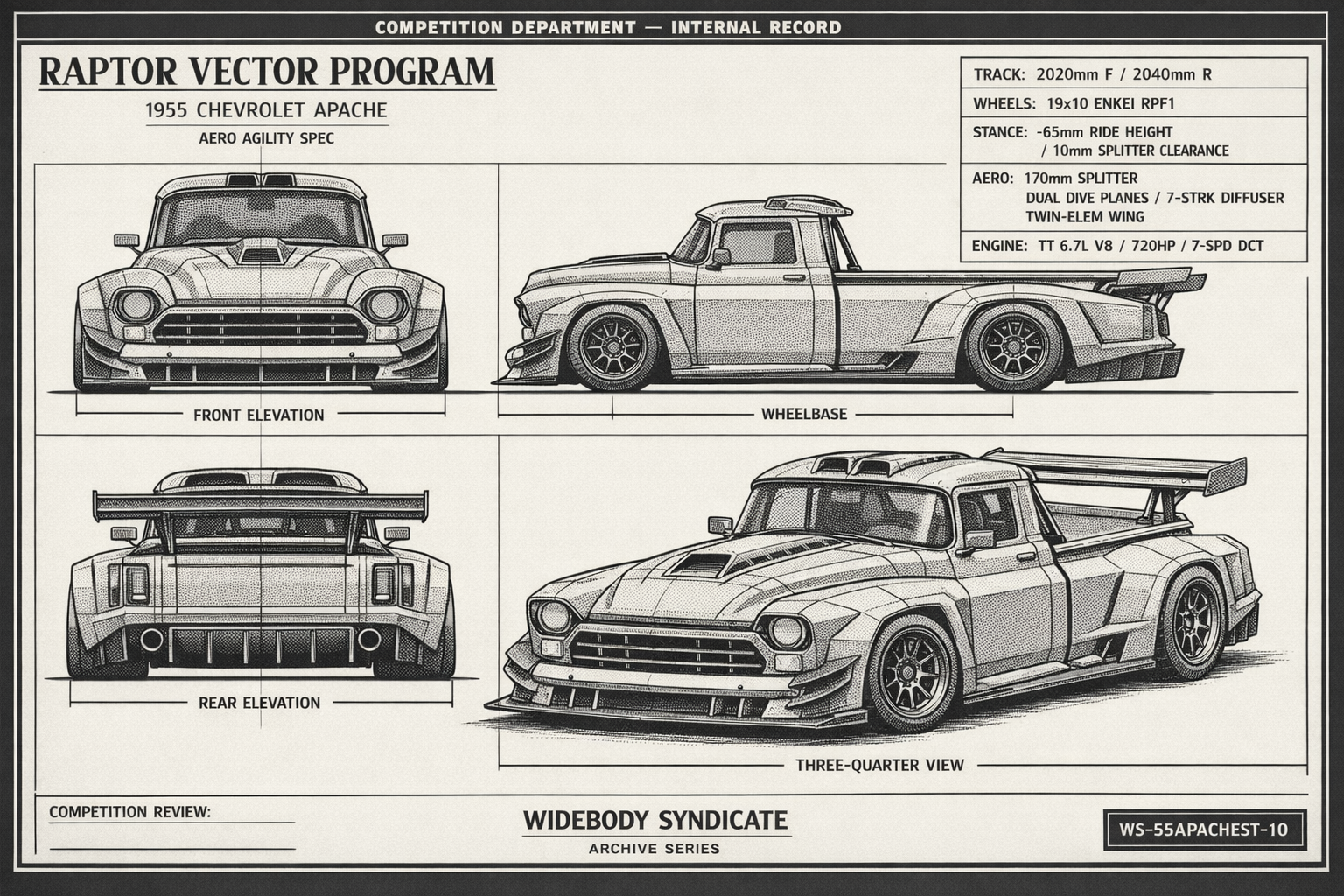
Raptor Vector Program takes a ’55 Chevrolet Apache—one of the sacred shapes—and treats it like an aero mule. The stock charm stays in the roofline and cab proportions, but everything below the beltline turns into faceted composite: a 250mm wider front track, trapezoidal arches, and a splitter package that looks severe because it’s doing real work managing underbody pressure and front-end lift.
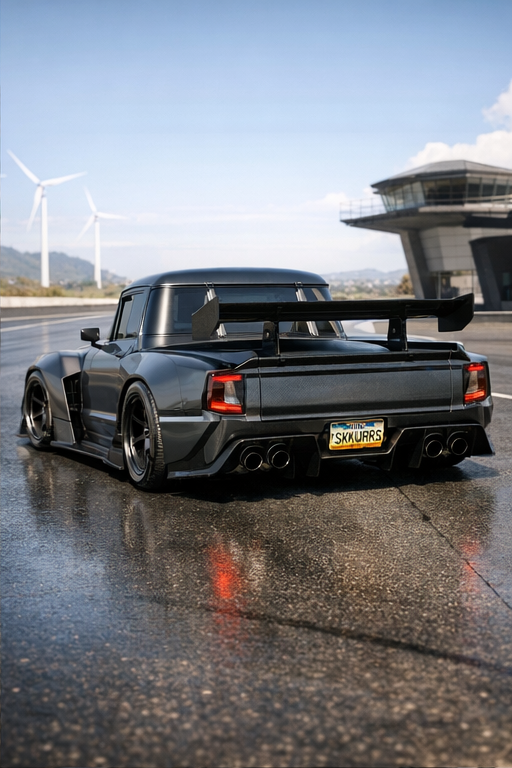
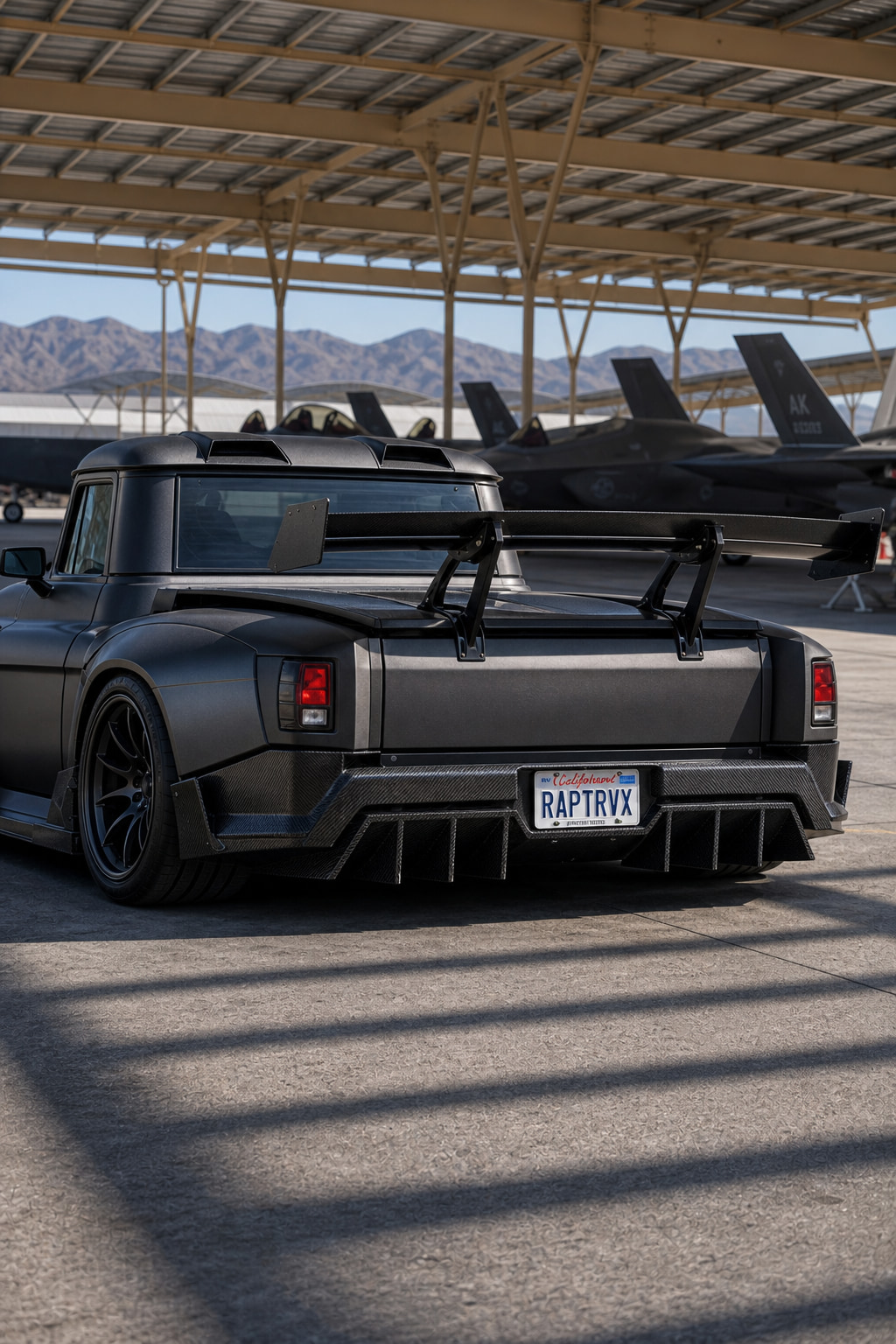
The pickup bed is deleted in favor of a tapered rear deck, a deep straked diffuser, and a tall swan-neck twin-element wing that finally gives the bluff old truck a reason to be stable at speed. It’s an experimental track-width monster built around cooling, airflow control, and repeatable high-speed balance—less nostalgia, more data logging.
Release Image Studies
Platform transformation, examined from every angle.
Comparison Shots
Blueprint / Collector Archive
Engineering record. Exhibition artifact.
The technical study and collectible interpretation of one build, preserved together.
Technical Dossier
Platform
1955 Chevrolet Apache
The 1955 Chevrolet Apache represents a cornerstone of mid-century American pickup evolution, blending rugged utility with emerging post-war design cues. Its unmistakable silhouette, marked by a robust yet refined cab and smooth, rounded fenders, set a new standard for reliability and style in the light truck segment. Underneath, a sturdy ladder-frame chassis and proven mechanicals provide a solid foundation that has inspired countless restorations and custom builds, making the Apache a timeless icon in truck culture and automotive history.
Aero Package
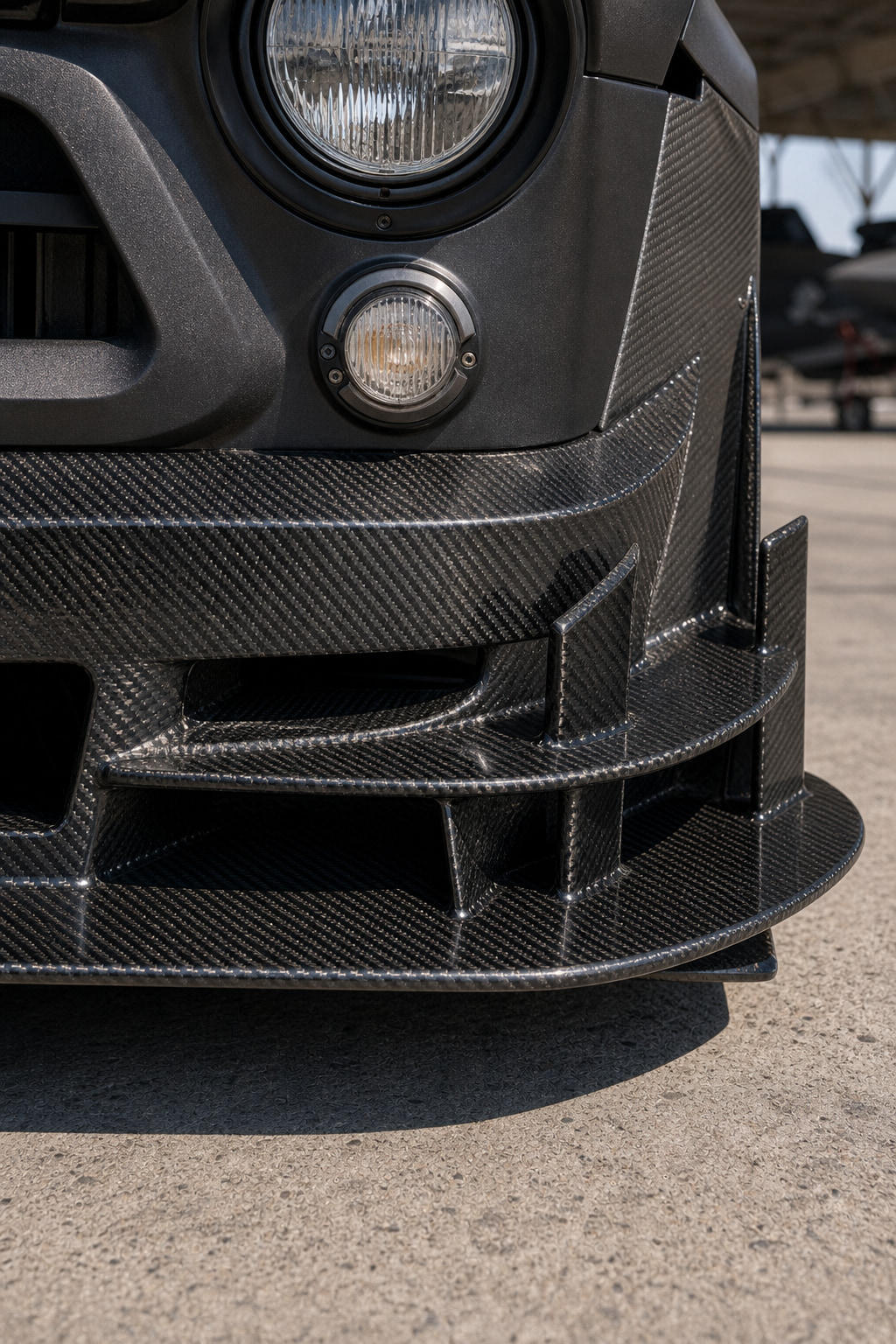
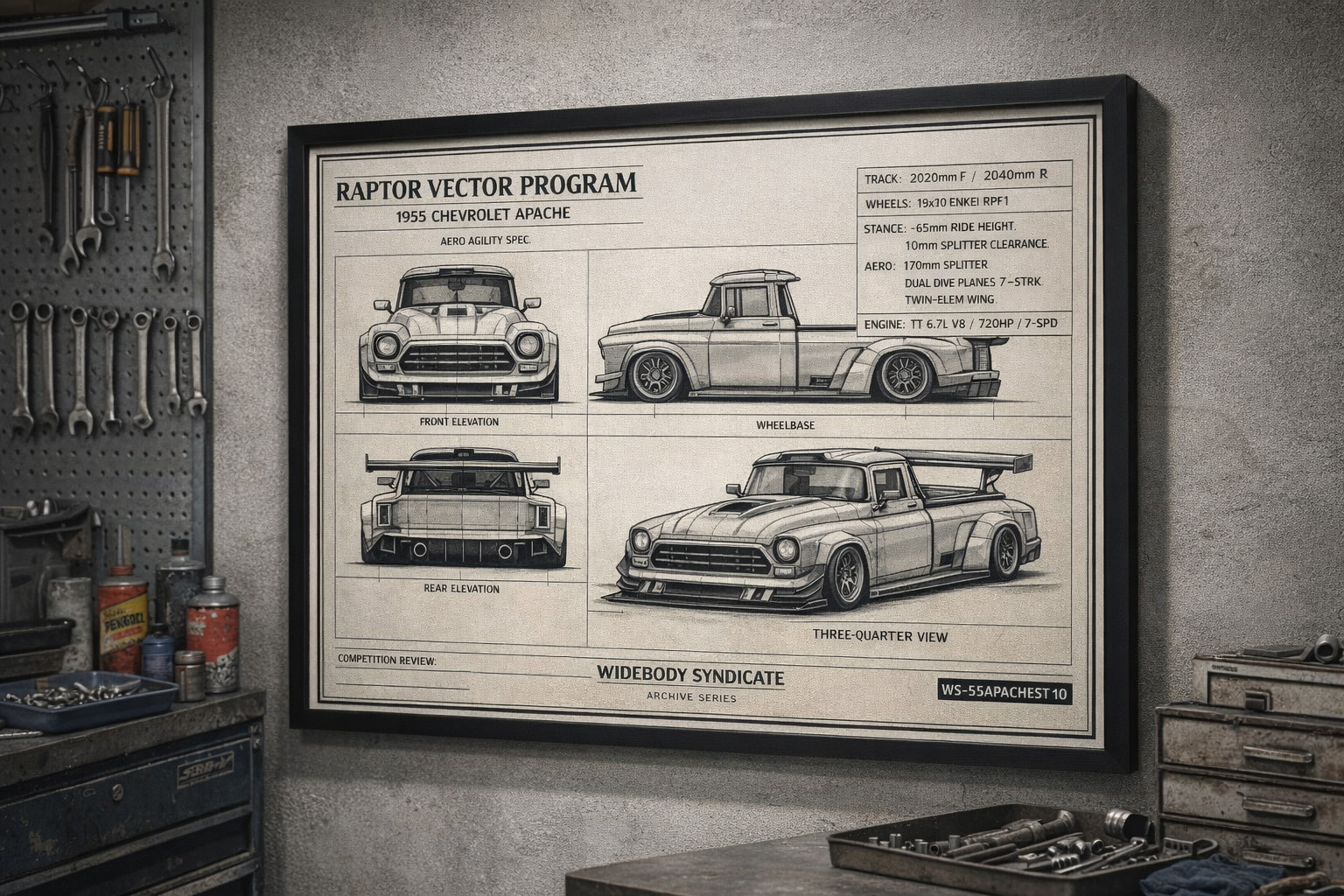
170mm forward-projection carbon splitter with precision edge work and underfloor feed strategy
Stacked dive planes with small vertical vortex generators to manage front tire wake and underbody flow
Recessed horizontal cooling inlets with internal vanes directing airflow to lateral heat exchangers
220mm-deep rear diffuser with seven vertical strakes for wake control and underfloor stability
1700mm twin-element rear wing on swan-neck pylons with adjustable incidence for balance tuning
Chassis
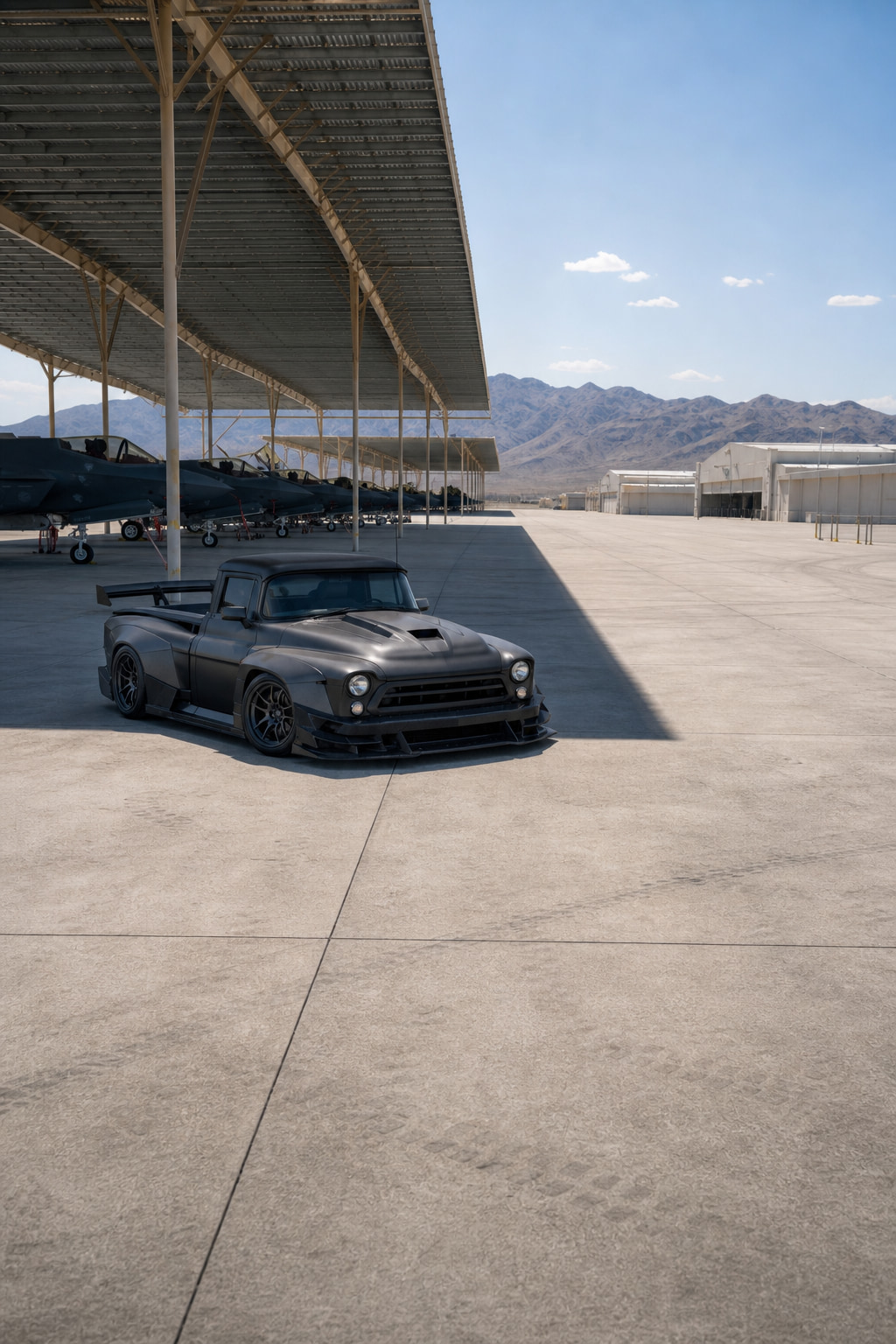
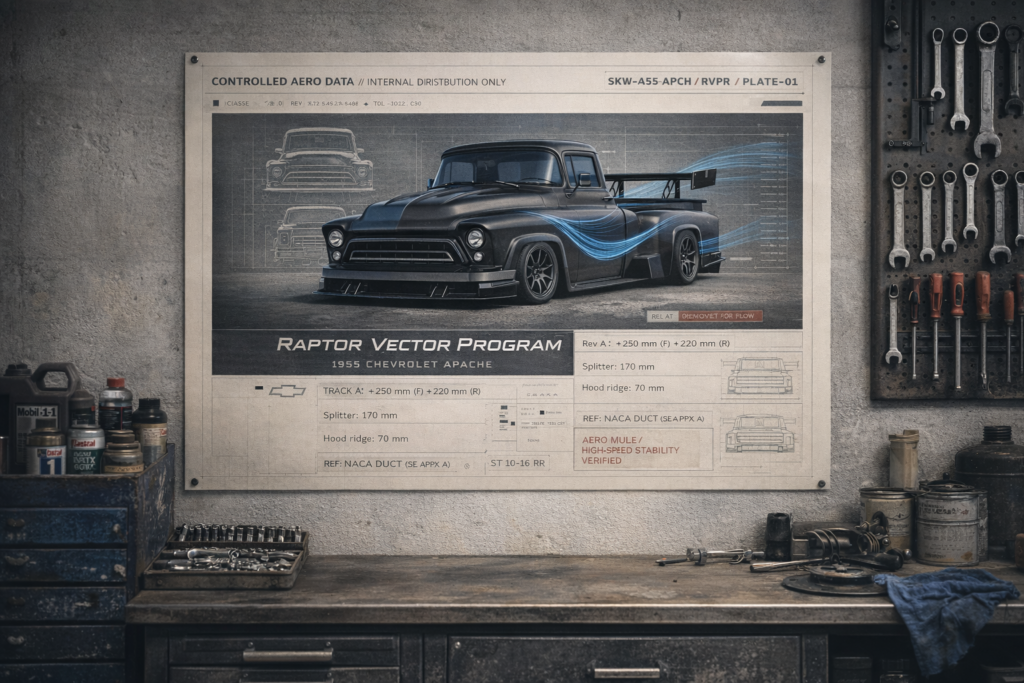
Shot on a modern aerodynamics test track: reflective smooth asphalt, clear noon sun, and hard shadows that underline every chamfer and plane break in the bodywork. The scene reads like a facility day—wind turbines and carbon-paneled towers in the distance, the Apache staged as a rolling development program.
Wheels & Tires
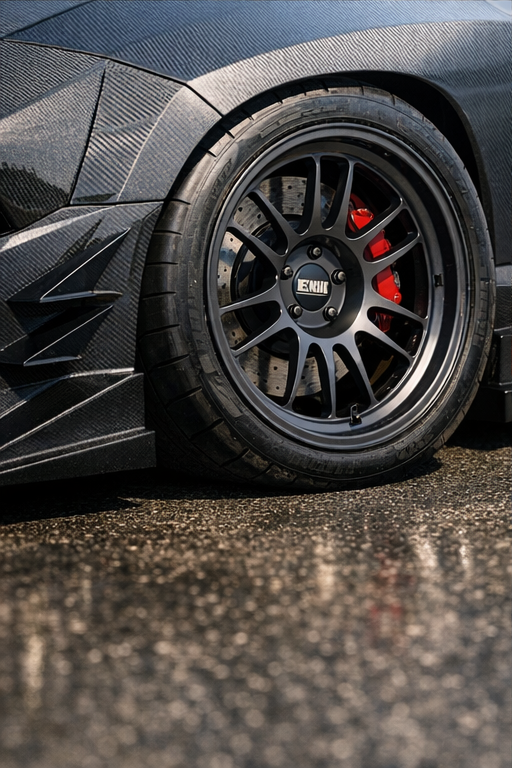
19x10 forged Enkei RPF1 in matte gunmetal
315/30-19 performance radials front and rear with clearance engineered into the new arches
Reduced ride height (~65mm) while maintaining ~110mm minimum splitter-tip clearance
Wide track stance: ~2020mm front / ~2040mm rear for lateral stability and response
Powertrain
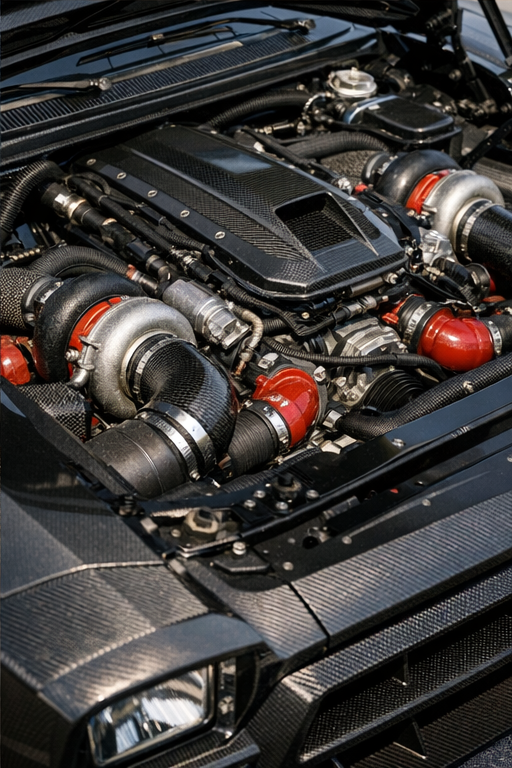
Twin-turbo 6.7L V8 targeting ~720 hp with lightweight rotating assembly emphasis
7-speed dual-clutch with paddle control for consistent shift timing under load
Front-mid placement via ~85mm engine setback to improve polar moment and turn-in
Multi-zone cooling: side-mounted heat exchangers plus roof-fed auxiliary cooling behind the cab
Fabrication Notes
Composite widebody panels indexed to a reinforced chassis structure for repeatable panel alignment at speed
Splitter, dive planes, and diffuser built as serviceable modules to allow track-side iteration
Roof NACA duct integration requires careful roof skin reinforcement and water management
Rear deck and wing mounts tied into hard points designed to carry real downforce loads, not just styling
Design Philosophy
Raptor Vector Program takes a ’55 Chevrolet Apache—one of the sacred shapes—and treats it like an aero mule. The stock charm stays in the roofline and cab proportions, but everything below the beltline turns into faceted composite: a 250mm wider front track, trapezoidal arches, and a splitter package that looks severe because it’s doing real work managing underbody pressure and front-end lift.
The pickup bed is deleted in favor of a tapered rear deck, a deep straked diffuser, and a tall swan-neck twin-element wing that finally gives the bluff old truck a reason to be stable at speed. It’s an experimental track-width monster built around cooling, airflow control, and repeatable high-speed balance—less nostalgia, more data logging.
▧Platform+
1955 Chevrolet Apache
The 1955 Chevrolet Apache represents a cornerstone of mid-century American pickup evolution, blending rugged utility with emerging post-war design cues. Its unmistakable silhouette, marked by a robust yet refined cab and smooth, rounded fenders, set a new standard for reliability and style in the light truck segment. Underneath, a sturdy ladder-frame chassis and proven mechanicals provide a solid foundation that has inspired countless restorations and custom builds, making the Apache a timeless icon in truck culture and automotive history.
⌘Aero Package+
170mm forward-projection carbon splitter with precision edge work and underfloor feed strategy
Stacked dive planes with small vertical vortex generators to manage front tire wake and underbody flow
Recessed horizontal cooling inlets with internal vanes directing airflow to lateral heat exchangers
220mm-deep rear diffuser with seven vertical strakes for wake control and underfloor stability
1700mm twin-element rear wing on swan-neck pylons with adjustable incidence for balance tuning
⟡Chassis+
Shot on a modern aerodynamics test track: reflective smooth asphalt, clear noon sun, and hard shadows that underline every chamfer and plane break in the bodywork. The scene reads like a facility day—wind turbines and carbon-paneled towers in the distance, the Apache staged as a rolling development program.
◎Wheels & Tires+
19x10 forged Enkei RPF1 in matte gunmetal
315/30-19 performance radials front and rear with clearance engineered into the new arches
Reduced ride height (~65mm) while maintaining ~110mm minimum splitter-tip clearance
Wide track stance: ~2020mm front / ~2040mm rear for lateral stability and response
▤Powertrain+
Twin-turbo 6.7L V8 targeting ~720 hp with lightweight rotating assembly emphasis
7-speed dual-clutch with paddle control for consistent shift timing under load
Front-mid placement via ~85mm engine setback to improve polar moment and turn-in
Multi-zone cooling: side-mounted heat exchangers plus roof-fed auxiliary cooling behind the cab
△Fabrication Notes+
Composite widebody panels indexed to a reinforced chassis structure for repeatable panel alignment at speed
Splitter, dive planes, and diffuser built as serviceable modules to allow track-side iteration
Roof NACA duct integration requires careful roof skin reinforcement and water management
Rear deck and wing mounts tied into hard points designed to carry real downforce loads, not just styling
×Design Philosophy+
Raptor Vector Program takes a ’55 Chevrolet Apache—one of the sacred shapes—and treats it like an aero mule. The stock charm stays in the roofline and cab proportions, but everything below the beltline turns into faceted composite: a 250mm wider front track, trapezoidal arches, and a splitter package that looks severe because it’s doing real work managing underbody pressure and front-end lift.
The pickup bed is deleted in favor of a tapered rear deck, a deep straked diffuser, and a tall swan-neck twin-element wing that finally gives the bluff old truck a reason to be stable at speed. It’s an experimental track-width monster built around cooling, airflow control, and repeatable high-speed balance—less nostalgia, more data logging.
Part of
Wave 18
Skunkworks
We just jammed a fighter jet’s DNA into everything that even remotely resembles a pickup or SUV. Our builds aren’t just widebodies—they’re aerodynamic missiles masquerading as street-legal speed demons.
Explore Wave 18 → 5 BuildsKeep Exploring
The archive is always growing. New releases, waves, and blueprints added regularly.