




R242
Project Neon Stallion
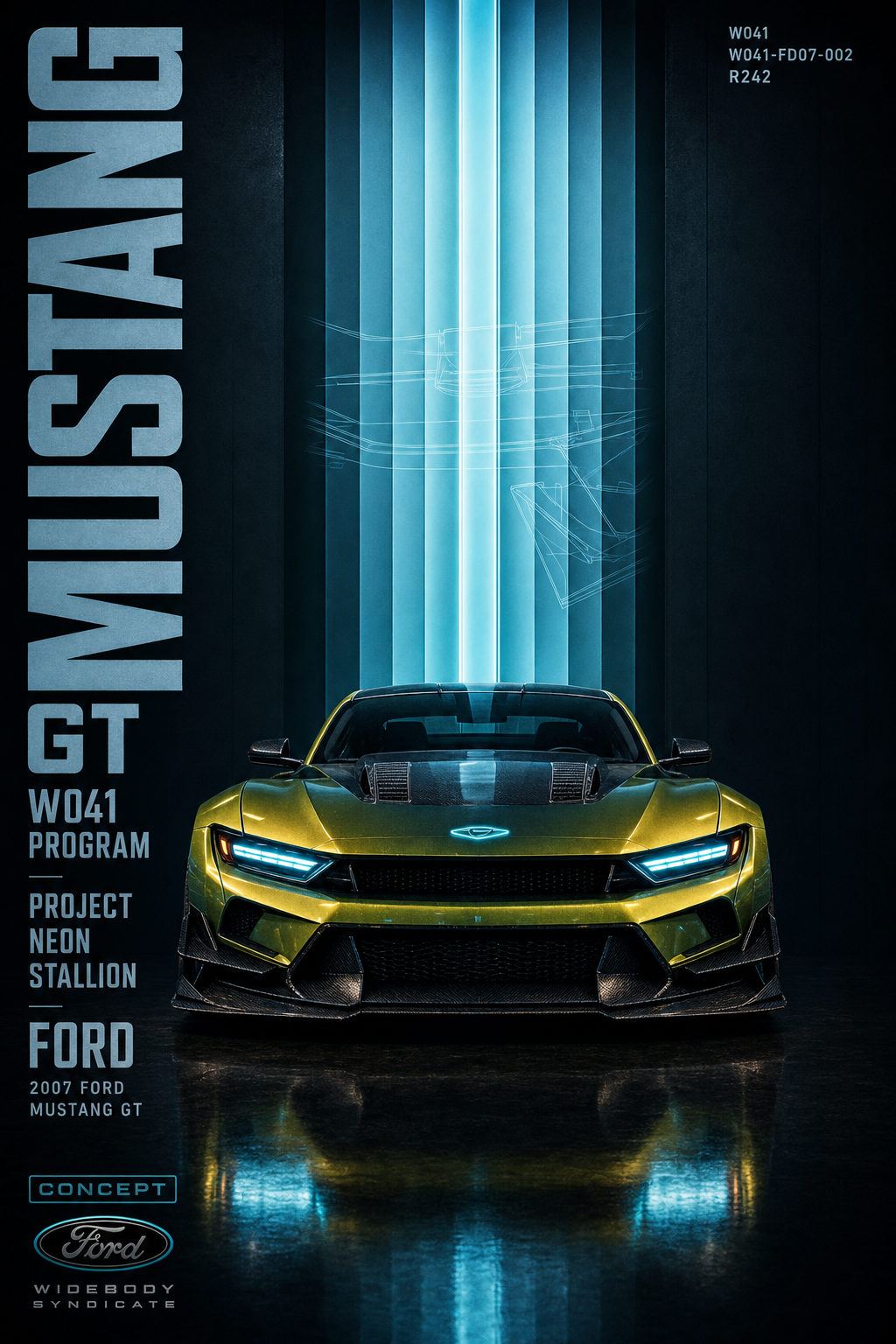
Project Neon Stallion takes the S197 Mustang GT—one of the last truly simple, long-hood muscle silhouettes—and drags it into a wind-tunnel-first future without losing the weight-on-the-rear-axle attitude. The 300mm total track expansion isn’t cosplay widebody; it’s packaging for real cooling, real tire, and a floor that can actually work, with the fenders and rockers shaped as airflow devices instead of add-ons.
The headline is active aero and integrated lighting done like an engineer would tolerate: splitter and venturi up front, a proper underfloor, functional wheelhouse management, and a swan-neck wing that earns its height. It still reads as Mustang from 50 feet—fastback mass, blunt shoulders, big hips—just sharpened into a neon-lit, carbon-skinned aero study.
Release Image Studies
Image studies from every angle.
Comparison Shots
Blueprint / Collector Archive
Engineering Artifacts
The technical study and collectible interpretation of one build, preserved together.
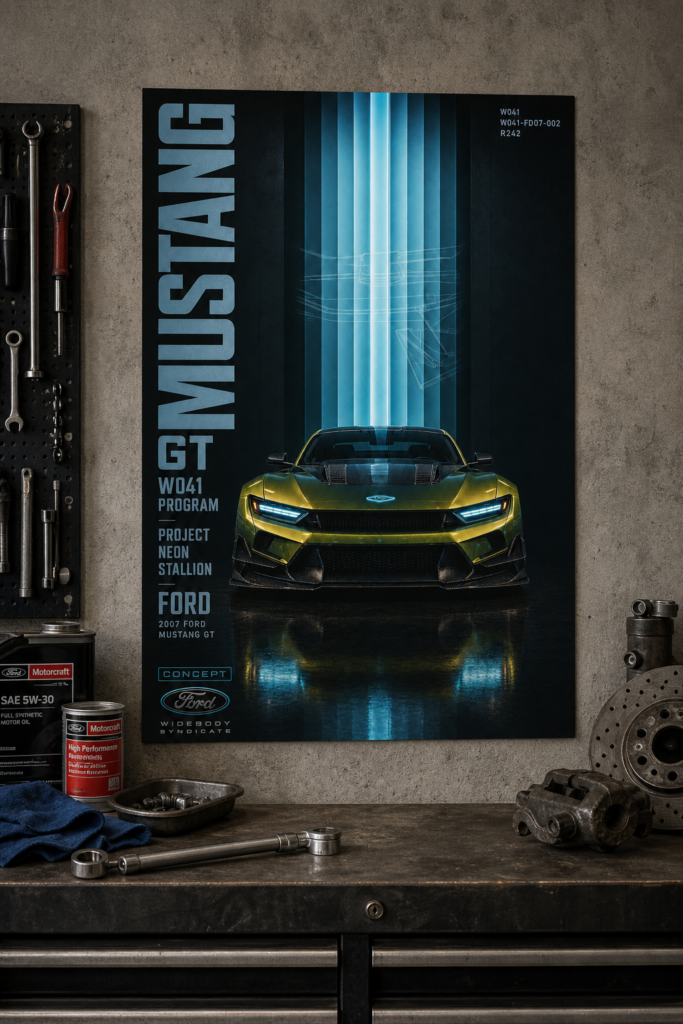
A presentation-grade collector artifact created for this release and preserved as part of the Widebody Syndicate archive.
Selected archive goods are available for collectors.
Technical Dossier
Platform
2007 Ford Mustang GT
The 2007 Ford Mustang GT stands as a pivotal chapter in the storied pony car saga, bridging classic muscle car heritage with modern performance engineering. Built on the Fox platform’s evolved architecture, its robust 4.6-liter V8 heart delivers a raw, throaty soundtrack that's both a nod to tradition and a promise of aggressive street presence. This platform balances a purposeful, muscular stance with refined suspension tuning, offering drivers a visceral connection to the road without sacrificing everyday usability. It’s the kind of car that resonates deeply within American car culture, embodying the spirit of rebellion and speed in a package that’s as approachable as it is iconic.
Aero Package
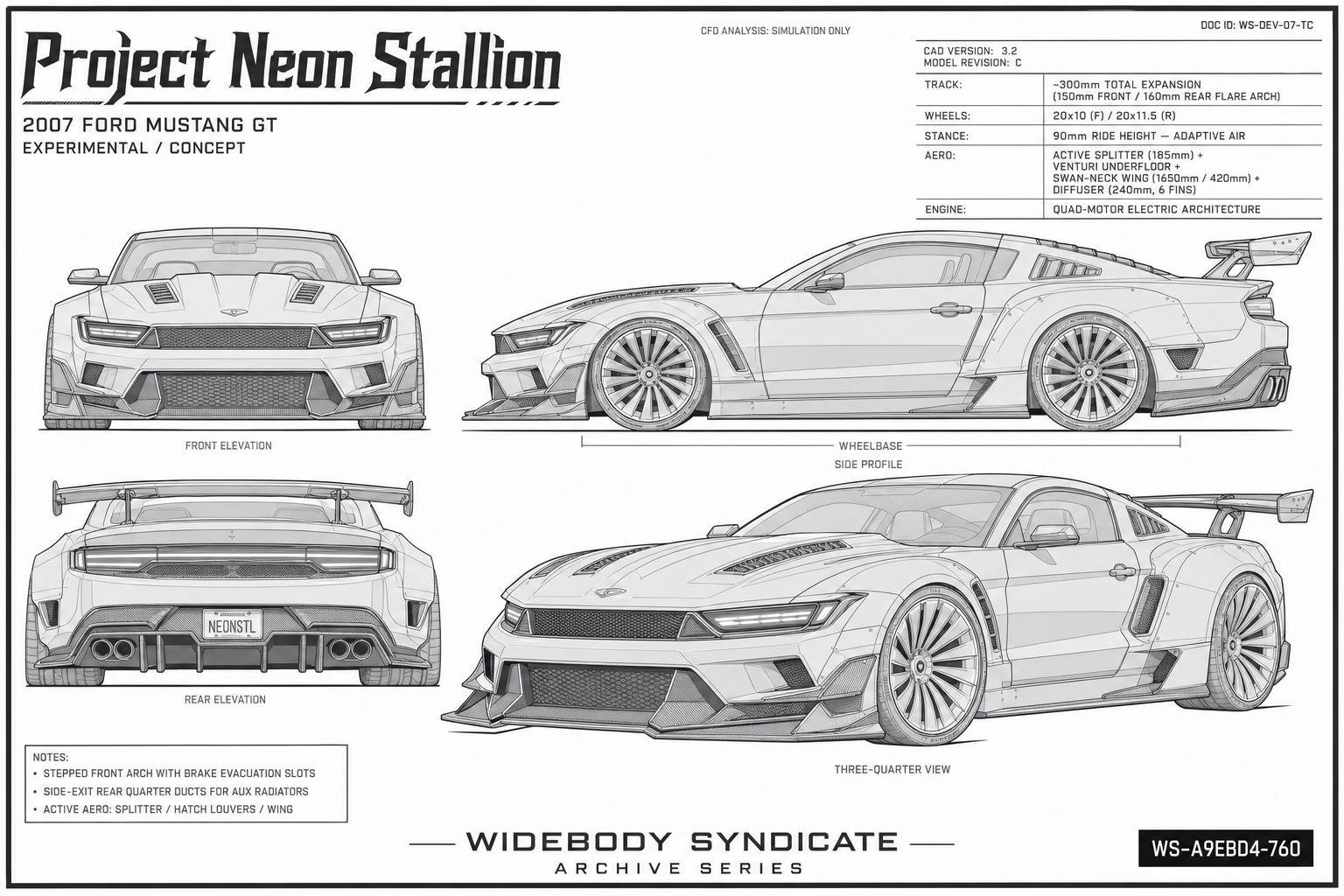
Active front splitter (185mm projection) with paired dive planes and full-width venturi inlet
Flat underfloor with pressure-control surfaces and edge vortex management
Rear diffuser extension with multi-fin array and central tunnel
Deployable swan-neck rear wing with multi-element active camber/twist
Active rear hatch louvers to vent trapped pressure at speed
Chassis
Built around a widened footprint and corrected suspension geometry, Neon Stallion is imagined as a high-speed stability car: long sweepers, heavy braking zones, and repeatable lap-to-lap thermal control. The active aero and underfloor are there to make the platform calm at speed, not just dramatic in photos.
Wheels & Tires
20x10 front / 20x11.5 rear 3D-printed magnesium-composite aero wheels
275/30ZR20 front and 315/30ZR20 rear high-load performance tires
Turbine-style spoke geometry tuned for brake airflow and reduced drag
Integrated TPMS/thermal sensing for tire and brake temperature logging
Powertrain
Quad-motor EV layout targeting ~1100 hp with per-wheel torque vectoring
Sidepod intercooler/radiator strategy with rear auxiliary heat exchangers
Liquid-cooled high-voltage routing integrated through widened sill structures
Drive-by-wire integration to coordinate aero states with torque delivery
Fabrication Notes
Front clip and widebody executed as bonded composite modules to keep shut lines tight and serviceable
Double-wishbone front conversion requires new pickup points
reinforced towers
and corrected roll center for the wider track
Underfloor and diffuser designed as a continuous plane with removable sections for drivetrain and cooling access
Swan-neck wing mounts tied into rear structure with load paths designed for downforce
not just aesthetics
Design Philosophy
Project Neon Stallion takes the S197 Mustang GT—one of the last truly simple, long-hood muscle silhouettes—and drags it into a wind-tunnel-first future without losing the weight-on-the-rear-axle attitude. The 300mm total track expansion isn’t cosplay widebody; it’s packaging for real cooling, real tire, and a floor that can actually work, with the fenders and rockers shaped as airflow devices instead of add-ons.
The headline is active aero and integrated lighting done like an engineer would tolerate: splitter and venturi up front, a proper underfloor, functional wheelhouse management, and a swan-neck wing that earns its height. It still reads as Mustang from 50 feet—fastback mass, blunt shoulders, big hips—just sharpened into a neon-lit, carbon-skinned aero study.
▧Platform+
2007 Ford Mustang GT
The 2007 Ford Mustang GT stands as a pivotal chapter in the storied pony car saga, bridging classic muscle car heritage with modern performance engineering. Built on the Fox platform’s evolved architecture, its robust 4.6-liter V8 heart delivers a raw, throaty soundtrack that's both a nod to tradition and a promise of aggressive street presence. This platform balances a purposeful, muscular stance with refined suspension tuning, offering drivers a visceral connection to the road without sacrificing everyday usability. It’s the kind of car that resonates deeply within American car culture, embodying the spirit of rebellion and speed in a package that’s as approachable as it is iconic.
⌘Aero Package+
Active front splitter (185mm projection) with paired dive planes and full-width venturi inlet
Flat underfloor with pressure-control surfaces and edge vortex management
Rear diffuser extension with multi-fin array and central tunnel
Deployable swan-neck rear wing with multi-element active camber/twist
Active rear hatch louvers to vent trapped pressure at speed
⟡Chassis+
Built around a widened footprint and corrected suspension geometry, Neon Stallion is imagined as a high-speed stability car: long sweepers, heavy braking zones, and repeatable lap-to-lap thermal control. The active aero and underfloor are there to make the platform calm at speed, not just dramatic in photos.
◎Wheels & Tires+
20x10 front / 20x11.5 rear 3D-printed magnesium-composite aero wheels
275/30ZR20 front and 315/30ZR20 rear high-load performance tires
Turbine-style spoke geometry tuned for brake airflow and reduced drag
Integrated TPMS/thermal sensing for tire and brake temperature logging
▤Powertrain+
Quad-motor EV layout targeting ~1100 hp with per-wheel torque vectoring
Sidepod intercooler/radiator strategy with rear auxiliary heat exchangers
Liquid-cooled high-voltage routing integrated through widened sill structures
Drive-by-wire integration to coordinate aero states with torque delivery
△Fabrication Notes+
Front clip and widebody executed as bonded composite modules to keep shut lines tight and serviceable
Double-wishbone front conversion requires new pickup points
reinforced towers
and corrected roll center for the wider track
Underfloor and diffuser designed as a continuous plane with removable sections for drivetrain and cooling access
Swan-neck wing mounts tied into rear structure with load paths designed for downforce
not just aesthetics
×Design Philosophy+
Project Neon Stallion takes the S197 Mustang GT—one of the last truly simple, long-hood muscle silhouettes—and drags it into a wind-tunnel-first future without losing the weight-on-the-rear-axle attitude. The 300mm total track expansion isn’t cosplay widebody; it’s packaging for real cooling, real tire, and a floor that can actually work, with the fenders and rockers shaped as airflow devices instead of add-ons.
The headline is active aero and integrated lighting done like an engineer would tolerate: splitter and venturi up front, a proper underfloor, functional wheelhouse management, and a swan-neck wing that earns its height. It still reads as Mustang from 50 feet—fastback mass, blunt shoulders, big hips—just sharpened into a neon-lit, carbon-skinned aero study.
Part of
Wave 41
2045 Redevelopment Platforms
We just finished bolting tomorrow onto yesterday, and yeah, it’s as ridiculous as it sounds. This drop is our 2045 halo-car fever dream where the usual heroes get company from the vehicles everyone ignores in the parking lot.
Explore Wave 41 → 6 BuildsKeep Exploring
The archive is always growing. New releases, waves, and blueprints added regularly.