




WS Widebody Syndicate
Imperial Zephyr Program

R224

Imperial Zephyr Program

1999 Nissan Skyline GT-R R34

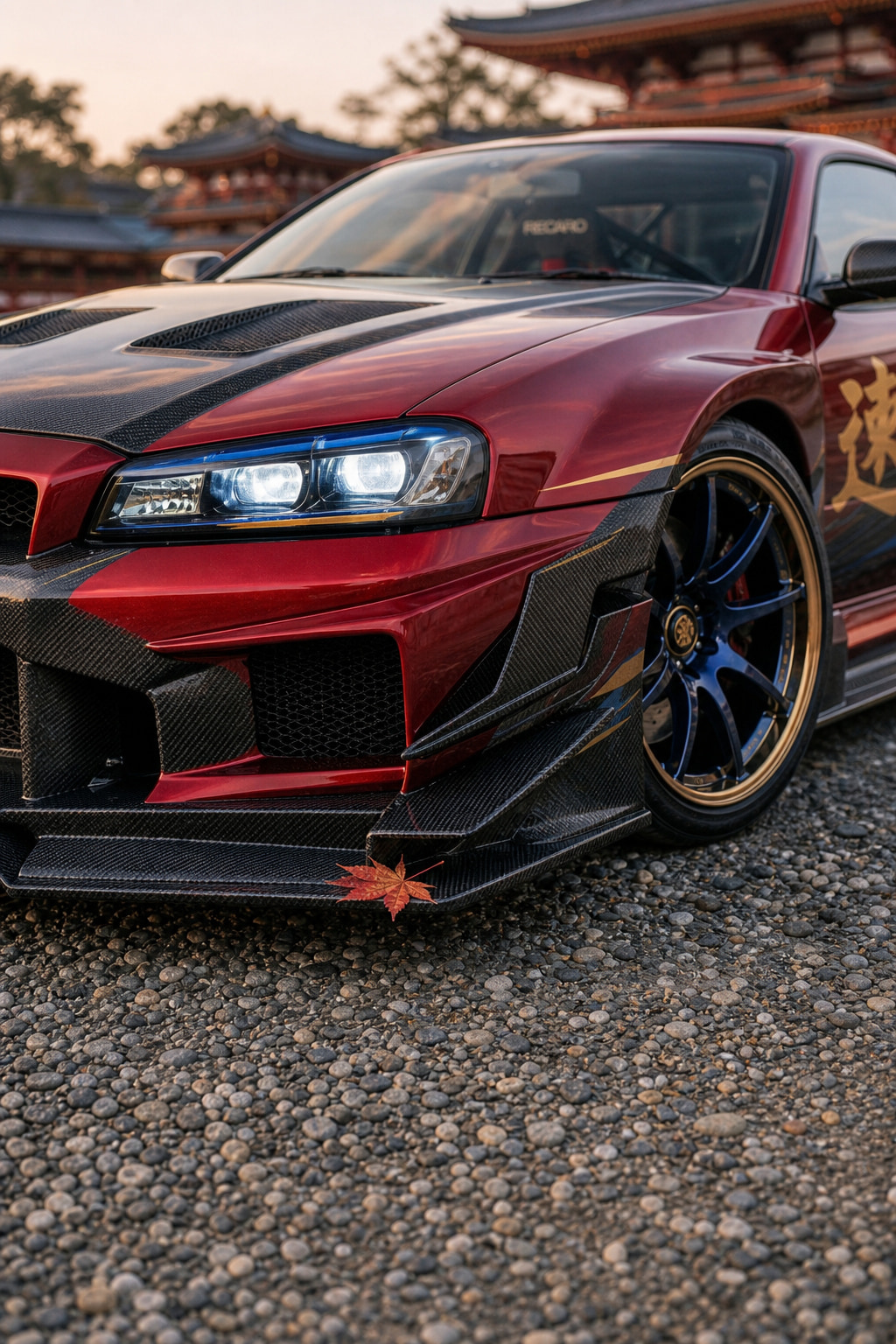
Imperial Zephyr Program treats the R34 like a GT500 silhouette car that never had to answer to a rulebook—only to airflow. The stock proportions stay readable, but everything around the wheels is rewritten: 120mm front and 150mm rear quarters with hard-edged arches, pressure-relief vents, and a front splitter that sits out in clean air like a proper race car. It’s an R34 you recognize on approach, then realize you’ve never actually seen before.

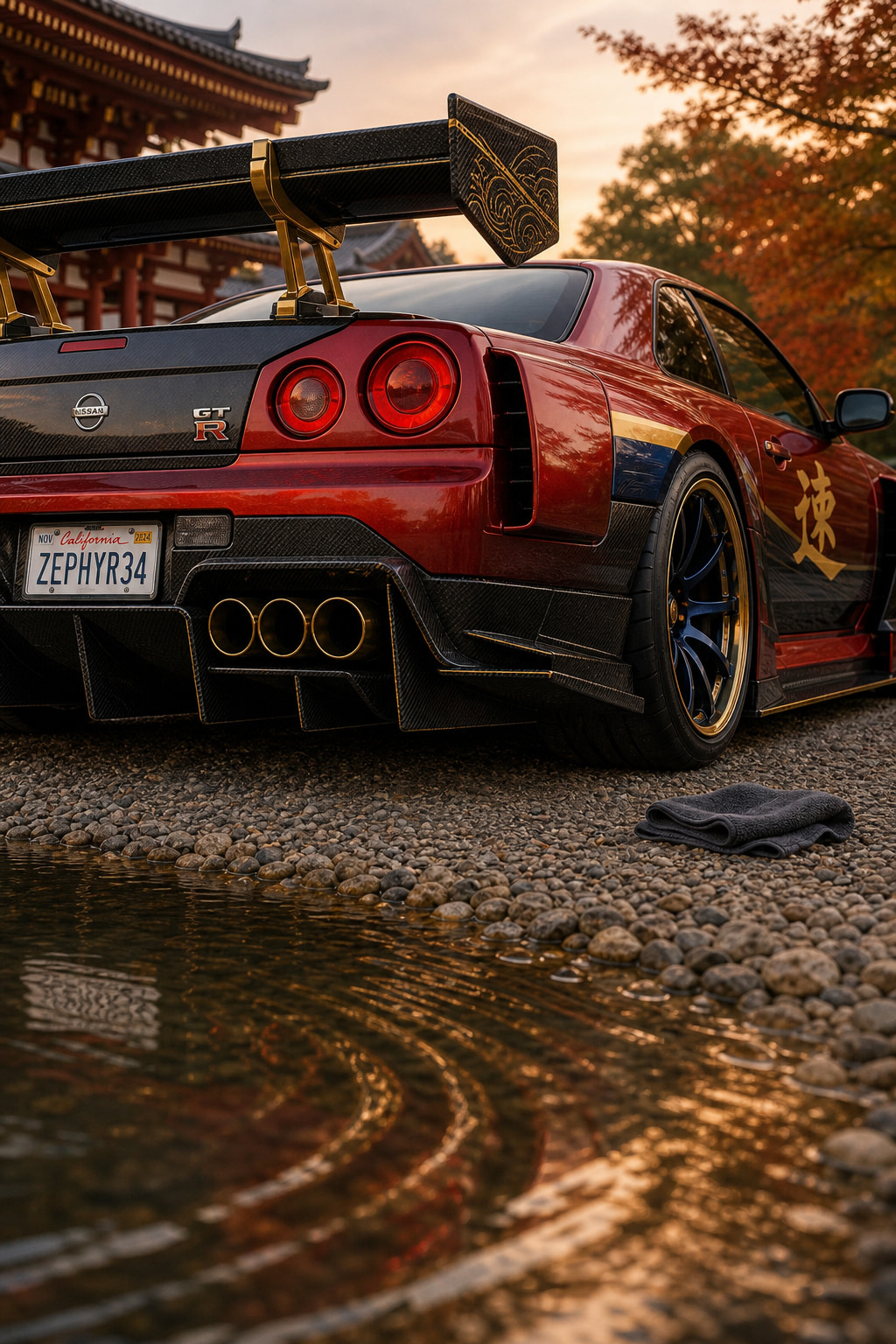
Under the lacquered crimson and ukiyo-e wind graphics is a packaging exercise you’d expect from a serious aero demo: sidepod-fed cooling, a sealed underfloor feeding a five-strake diffuser, and a high-mount dual-element wing on swan necks to keep the deck clean. The Wind God theme isn’t cosplay—it’s surface language that follows the same logic as the aero: sharp leading edges, controlled channels, and deliberate places for pressure to go.
Share Release X FB

Image studies from every angle.

6 curated frames · swipe / tap to inspect

Comparison Shots

Engineering Artifacts

The technical study and collectible interpretation of one build, preserved together.

01
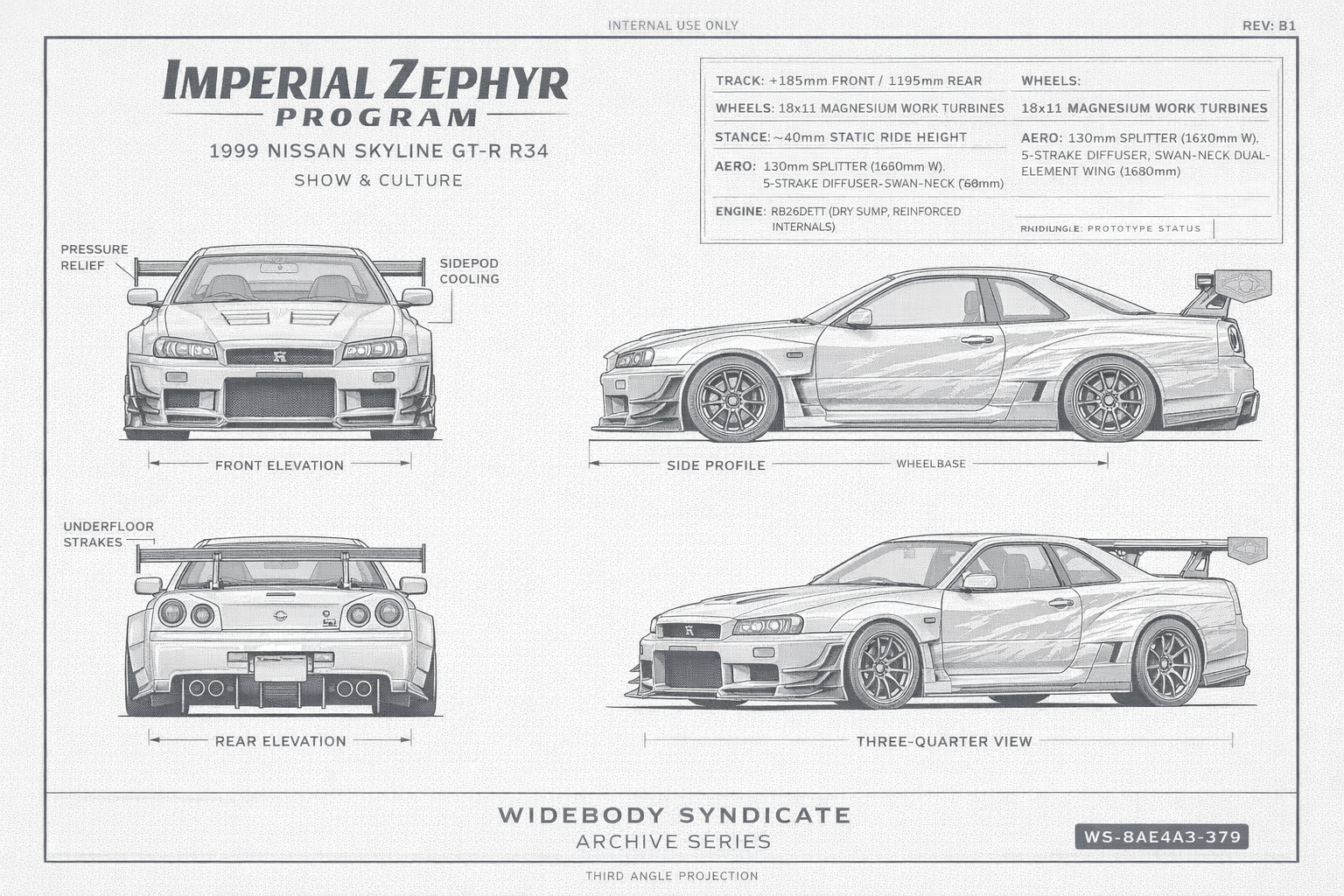
Technical DrawingBlueprint archive
Imperial Zephyr Program blueprint
02
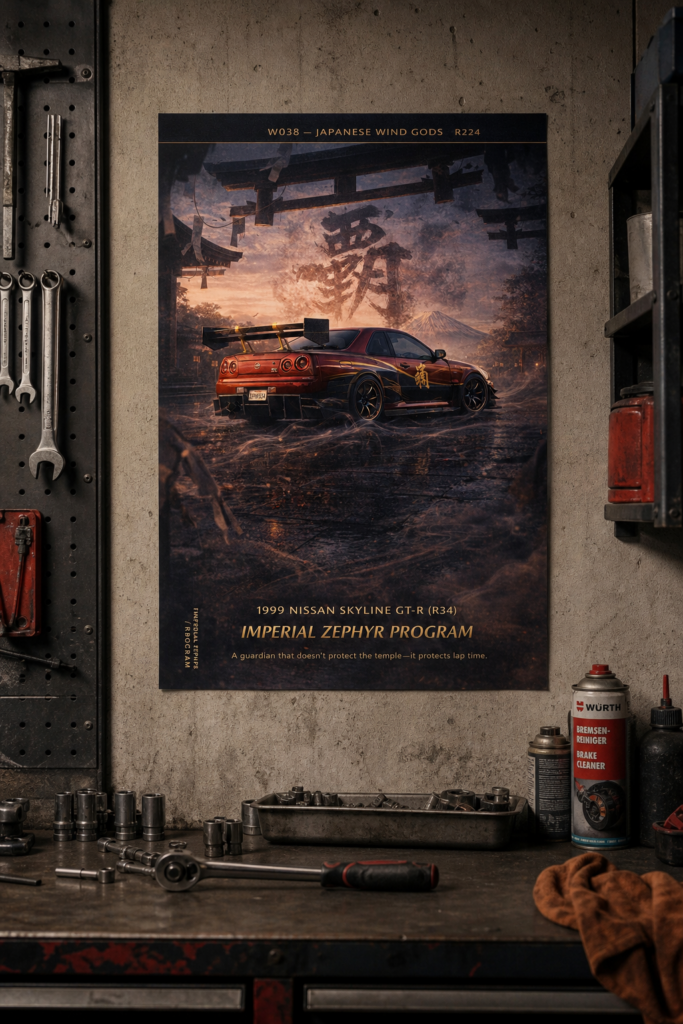
Imperial Zephyr Program Collector EditionCollector artifact
Imperial Zephyr Program Collector Edition

A presentation-grade collector artifact created for this release and preserved as part of the Widebody Syndicate archive.

Platform

1999 Nissan Skyline GT-R R34

1999 Nissan Skyline GT-R R34

The 1999 Nissan Skyline GT-R R34 is the zenith of Japanese performance engineering from the golden era of the late '90s. With the iconic RB26DETT twin-turbocharged inline-six engine under the hood, it delivers a blend of raw power and precise control, thanks to its advanced ATTESA E-TS all-wheel-drive system and Super-HICAS four-wheel steering. The R34's aggressive yet functional design has become a cultural icon, setting the standard for precision, performance, and tunability that still resonates deeply within the tuner and motorsport communities worldwide.

NissanSkyline GT-R R341999
View Platform

Aero Package

130mm-forward carbon splitter (1630mm wide) with twin pronged dive planes to manage wheel wake
Vented carbon hood with twin trapezoidal extractors to evacuate intercooler/radiator heat
70mm-deep side skirt shelves with layered lower vanes to support underfloor sealing
280mm-deep rear diffuser with five strakes and a cut-plane exit shelf
Dual-element GT500-style rear wing (1680mm span) on swan-neck pylons with adjustable gurneys

Chassis

This is a high-speed prototype mindset aimed at long, loaded corners and repeated braking—where stability is earned through pressure relief, cooling capacity, and underbody efficiency. The aero package is designed to work as a system: splitter and fender management up front, sealed floor through the middle, and a diffuser/wing pairing that keeps balance consistent as speed climbs.

Wheels & Tires

18x11 forged magnesium Work Wheels
turbine-spoke design with indigo spokes and gold edge detailing
Bridgestone RE-12D semi-slicks: 295/30ZR18 front
335/30ZR18 rear
Front track +185mm total / rear track +195mm total to match aero load and tire width
Ride height set ~40mm static with rebound-focused damping for platform control

Powertrain

RB26DETT with reinforced bottom end and dry-sump oiling for sustained lateral load
Upgraded twin ceramic ball-bearing turbos tuned for broad midrange rather than peak-only power
Twin intercooler array with heat management via hood extraction and sealed ducting
Sidepod-mounted radiators with roofline exit vents to reduce nose congestion

Fabrication Notes

Internal ductwork ties fender inlets to brake cooling and hood-side extraction slits to prevent pressure stacking
Widebody surfacing built around hard leading edges and controlled concave channels to keep flow attached
Underfloor sealing and diffuser strake spacing designed to balance stability with yaw tolerance
Wing pylons and mounts machined for stiffness to maintain angle-of-attack under load
×

Design Philosophy

Imperial Zephyr Program treats the R34 like a GT500 silhouette car that never had to answer to a rulebook—only to airflow. The stock proportions stay readable, but everything around the wheels is rewritten: 120mm front and 150mm rear quarters with hard-edged arches, pressure-relief vents, and a front splitter that sits out in clean air like a proper race car. It’s an R34 you recognize on approach, then realize you’ve never actually seen before.

Under the lacquered crimson and ukiyo-e wind graphics is a packaging exercise you’d expect from a serious aero demo: sidepod-fed cooling, a sealed underfloor feeding a five-strake diffuser, and a high-mount dual-element wing on swan necks to keep the deck clean. The Wind God theme isn’t cosplay—it’s surface language that follows the same logic as the aero: sharp leading edges, controlled channels, and deliberate places for pressure to go.

Platform+
1999 Nissan Skyline GT-R R34

1999 Nissan Skyline GT-R R34

The 1999 Nissan Skyline GT-R R34 is the zenith of Japanese performance engineering from the golden era of the late '90s. With the iconic RB26DETT twin-turbocharged inline-six engine under the hood, it delivers a blend of raw power and precise control, thanks to its advanced ATTESA E-TS all-wheel-drive system and Super-HICAS four-wheel steering. The R34's aggressive yet functional design has become a cultural icon, setting the standard for precision, performance, and tunability that still resonates deeply within the tuner and motorsport communities worldwide.

NissanSkyline GT-R R341999
View Platform
Aero Package+

130mm-forward carbon splitter (1630mm wide) with twin pronged dive planes to manage wheel wake
Vented carbon hood with twin trapezoidal extractors to evacuate intercooler/radiator heat
70mm-deep side skirt shelves with layered lower vanes to support underfloor sealing
280mm-deep rear diffuser with five strakes and a cut-plane exit shelf
Dual-element GT500-style rear wing (1680mm span) on swan-neck pylons with adjustable gurneys

Chassis+

This is a high-speed prototype mindset aimed at long, loaded corners and repeated braking—where stability is earned through pressure relief, cooling capacity, and underbody efficiency. The aero package is designed to work as a system: splitter and fender management up front, sealed floor through the middle, and a diffuser/wing pairing that keeps balance consistent as speed climbs.

Wheels & Tires+

18x11 forged magnesium Work Wheels
turbine-spoke design with indigo spokes and gold edge detailing
Bridgestone RE-12D semi-slicks: 295/30ZR18 front
335/30ZR18 rear
Front track +185mm total / rear track +195mm total to match aero load and tire width
Ride height set ~40mm static with rebound-focused damping for platform control

Powertrain+

RB26DETT with reinforced bottom end and dry-sump oiling for sustained lateral load
Upgraded twin ceramic ball-bearing turbos tuned for broad midrange rather than peak-only power
Twin intercooler array with heat management via hood extraction and sealed ducting
Sidepod-mounted radiators with roofline exit vents to reduce nose congestion

Fabrication Notes+

Internal ductwork ties fender inlets to brake cooling and hood-side extraction slits to prevent pressure stacking
Widebody surfacing built around hard leading edges and controlled concave channels to keep flow attached
Underfloor sealing and diffuser strake spacing designed to balance stability with yaw tolerance
Wing pylons and mounts machined for stiffness to maintain angle-of-attack under load

×Design Philosophy+

Imperial Zephyr Program treats the R34 like a GT500 silhouette car that never had to answer to a rulebook—only to airflow. The stock proportions stay readable, but everything around the wheels is rewritten: 120mm front and 150mm rear quarters with hard-edged arches, pressure-relief vents, and a front splitter that sits out in clean air like a proper race car. It’s an R34 you recognize on approach, then realize you’ve never actually seen before.

Under the lacquered crimson and ukiyo-e wind graphics is a packaging exercise you’d expect from a serious aero demo: sidepod-fed cooling, a sealed underfloor feeding a five-strake diffuser, and a high-mount dual-element wing on swan necks to keep the deck clean. The Wind God theme isn’t cosplay—it’s surface language that follows the same logic as the aero: sharp leading edges, controlled channels, and deliberate places for pressure to go.

Part of
Wave 38

Japanese Wind Gods

We just finished a little temple-courtyard science experiment: take the legends, the heroes, and the weirdos of JDM history and run them through a Wind God filter until the bodywork starts speaking in vortices. Same silhouette rules, same recognizable faces, but now every fender is a blade, every vent is a confession, and every swan-neck wing is basically a shrine that also happens to make downforce.

Explore Wave 38 → 6 Builds

Keep Exploring

The archive is always growing. New releases, waves, and blueprints added regularly.