R223
Zephyr Sovereign Program
Zephyr Sovereign Program treats the 2000GT like a works car that never got the chance to exist—one that keeps the long-hood, fastback silhouette intact while turning every surface into an airflow decision. The widened track and hard-edged carbon overfenders aren’t cosplay; they’re packaging for tire, brake cooling, and stability at GT500 speeds, with extractor geometry that actually has somewhere to duct and dump.
Up front, the splitter and dive planes set the tone: a front end built to make downforce without smothering the radiators. Out back, the swan-neck wing and deep diffuser do the heavy lifting, while the livery stays disciplined—matte imperial crimson and indigo/gold accents that read like craftsmanship, not noise. It’s reverence, expressed through function.
Release Image Studies
Image studies from every angle.
Comparison Shots
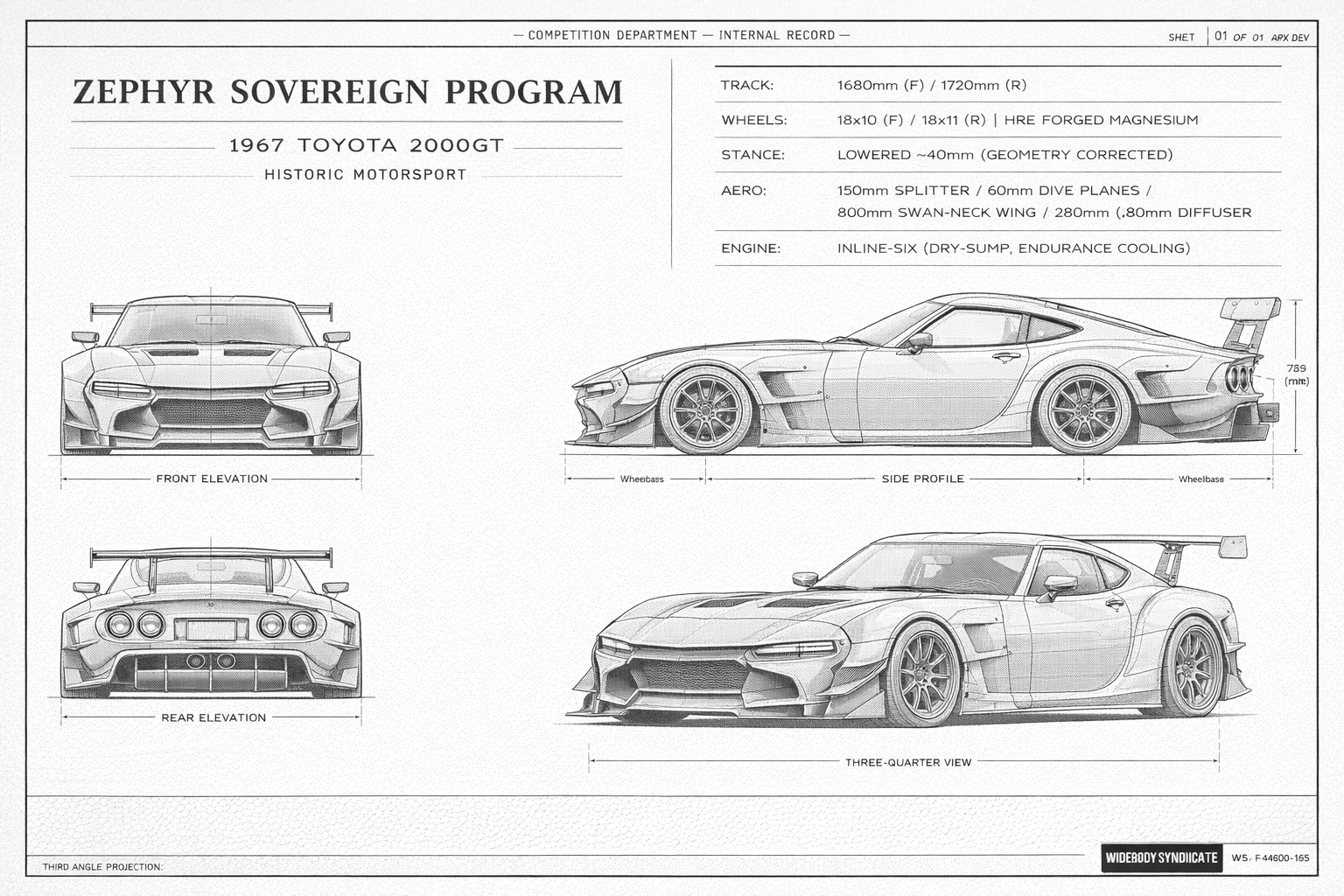
Blueprint / Collector Archive
Engineering Artifacts
The technical study and collectible interpretation of one build, preserved together.
A presentation-grade collector artifact created for this release and preserved as part of the Widebody Syndicate archive.
Selected archive goods are available for collectors.
Technical Dossier
Platform
1967 Toyota 2000GT
The 1967 Toyota 2000GT stands as a seminal icon in Japanese automotive history, merging sleek grand touring elegance with precise engineering. Its long, flowing lines and low-slung profile embody a timeless balance of form and function, powered by a robust inline-six that delivers a spirited yet refined driving experience. Revered for introducing Japan to the world as a serious sports car contender, the 2000GT’s chassis and suspension layout offer nimble handling that belies its grand tourer status, making it a foundational platform for enthusiasts and builders alike.
Aero Package
150mm forward front splitter with corner dive planes rising 60mm for front axle load and yaw stability
Fender leading-edge extractors (320mm x 140mm) ducted for brake and wheelhouse pressure relief
Triple hood vents (400mm x 80mm) for radiator heat extraction and underhood pressure management
Swan-neck dual-element rear wing (1650mm span
~800mm stanchion height) for clean upper-surface flow
280mm-deep rear diffuser with four vertical strakes and centralized exhaust exit management
Chassis
Built around GT500-style priorities: tire support, brake temperature control, and aero that stays stable in yaw. The widened tracks and pressure-relief venting are there to keep the car planted through fast sweepers and calm under hard braking, not just to fill a render.
Wheels & Tires
HRE forged magnesium 18x10 front with 275/40R18 Yokohama ADVAN semi-slicks
HRE forged magnesium 18x11 rear with 305/40R18 Yokohama ADVAN semi-slicks
Track-focused alignment baseline: increased negative camber and reduced toe change through travel
Lowered ride height ~40mm with corrected roll center and bump steer
Powertrain
Front-mid mounted inline-six retained in spirit
rebuilt for sustained high-rpm endurance duty
Triple-radiator front cooling pack with sealed ducting and dedicated hood extraction
High-flow exhaust routed to central quad outlets to keep diffuser tunnels clean and symmetrical
Motorsport ECU
dry-sump oiling
and track-spec baffling to survive long lateral load
Fabrication Notes
Carbon widebody and fascia designed around service access: brake ducts
rad pack
and quick-change panels
Internal ducting ties fender extractors to wheelhouse and brake cooling paths—no dead vents
Wing pylons and rear structure reinforced to distribute load into chassis hard points
not thin skin
Underbody sealing and diffuser transition managed for attachment
with heat shielding around exhaust exits
Design Philosophy
Zephyr Sovereign Program treats the 2000GT like a works car that never got the chance to exist—one that keeps the long-hood, fastback silhouette intact while turning every surface into an airflow decision. The widened track and hard-edged carbon overfenders aren’t cosplay; they’re packaging for tire, brake cooling, and stability at GT500 speeds, with extractor geometry that actually has somewhere to duct and dump.
Up front, the splitter and dive planes set the tone: a front end built to make downforce without smothering the radiators. Out back, the swan-neck wing and deep diffuser do the heavy lifting, while the livery stays disciplined—matte imperial crimson and indigo/gold accents that read like craftsmanship, not noise. It’s reverence, expressed through function.
▧Platform+
1967 Toyota 2000GT
The 1967 Toyota 2000GT stands as a seminal icon in Japanese automotive history, merging sleek grand touring elegance with precise engineering. Its long, flowing lines and low-slung profile embody a timeless balance of form and function, powered by a robust inline-six that delivers a spirited yet refined driving experience. Revered for introducing Japan to the world as a serious sports car contender, the 2000GT’s chassis and suspension layout offer nimble handling that belies its grand tourer status, making it a foundational platform for enthusiasts and builders alike.
⌘Aero Package+
150mm forward front splitter with corner dive planes rising 60mm for front axle load and yaw stability
Fender leading-edge extractors (320mm x 140mm) ducted for brake and wheelhouse pressure relief
Triple hood vents (400mm x 80mm) for radiator heat extraction and underhood pressure management
Swan-neck dual-element rear wing (1650mm span
~800mm stanchion height) for clean upper-surface flow
280mm-deep rear diffuser with four vertical strakes and centralized exhaust exit management
⟡Chassis+
Built around GT500-style priorities: tire support, brake temperature control, and aero that stays stable in yaw. The widened tracks and pressure-relief venting are there to keep the car planted through fast sweepers and calm under hard braking, not just to fill a render.
◎Wheels & Tires+
HRE forged magnesium 18x10 front with 275/40R18 Yokohama ADVAN semi-slicks
HRE forged magnesium 18x11 rear with 305/40R18 Yokohama ADVAN semi-slicks
Track-focused alignment baseline: increased negative camber and reduced toe change through travel
Lowered ride height ~40mm with corrected roll center and bump steer
▤Powertrain+
Front-mid mounted inline-six retained in spirit
rebuilt for sustained high-rpm endurance duty
Triple-radiator front cooling pack with sealed ducting and dedicated hood extraction
High-flow exhaust routed to central quad outlets to keep diffuser tunnels clean and symmetrical
Motorsport ECU
dry-sump oiling
and track-spec baffling to survive long lateral load
△Fabrication Notes+
Carbon widebody and fascia designed around service access: brake ducts
rad pack
and quick-change panels
Internal ducting ties fender extractors to wheelhouse and brake cooling paths—no dead vents
Wing pylons and rear structure reinforced to distribute load into chassis hard points
not thin skin
Underbody sealing and diffuser transition managed for attachment
with heat shielding around exhaust exits
×Design Philosophy+
Zephyr Sovereign Program treats the 2000GT like a works car that never got the chance to exist—one that keeps the long-hood, fastback silhouette intact while turning every surface into an airflow decision. The widened track and hard-edged carbon overfenders aren’t cosplay; they’re packaging for tire, brake cooling, and stability at GT500 speeds, with extractor geometry that actually has somewhere to duct and dump.
Up front, the splitter and dive planes set the tone: a front end built to make downforce without smothering the radiators. Out back, the swan-neck wing and deep diffuser do the heavy lifting, while the livery stays disciplined—matte imperial crimson and indigo/gold accents that read like craftsmanship, not noise. It’s reverence, expressed through function.
Part of
Wave 38
Japanese Wind Gods
We just finished a little temple-courtyard science experiment: take the legends, the heroes, and the weirdos of JDM history and run them through a Wind God filter until the bodywork starts speaking in vortices. Same silhouette rules, same recognizable faces, but now every fender is a blade, every vent is a confession, and every swan-neck wing is basically a shrine that also happens to make downforce.
Explore Wave 38 → 6 BuildsKeep Exploring
The archive is always growing. New releases, waves, and blueprints added regularly.