







Continue this wave

1999 Nissan Skyline GT-R R34
8 photos
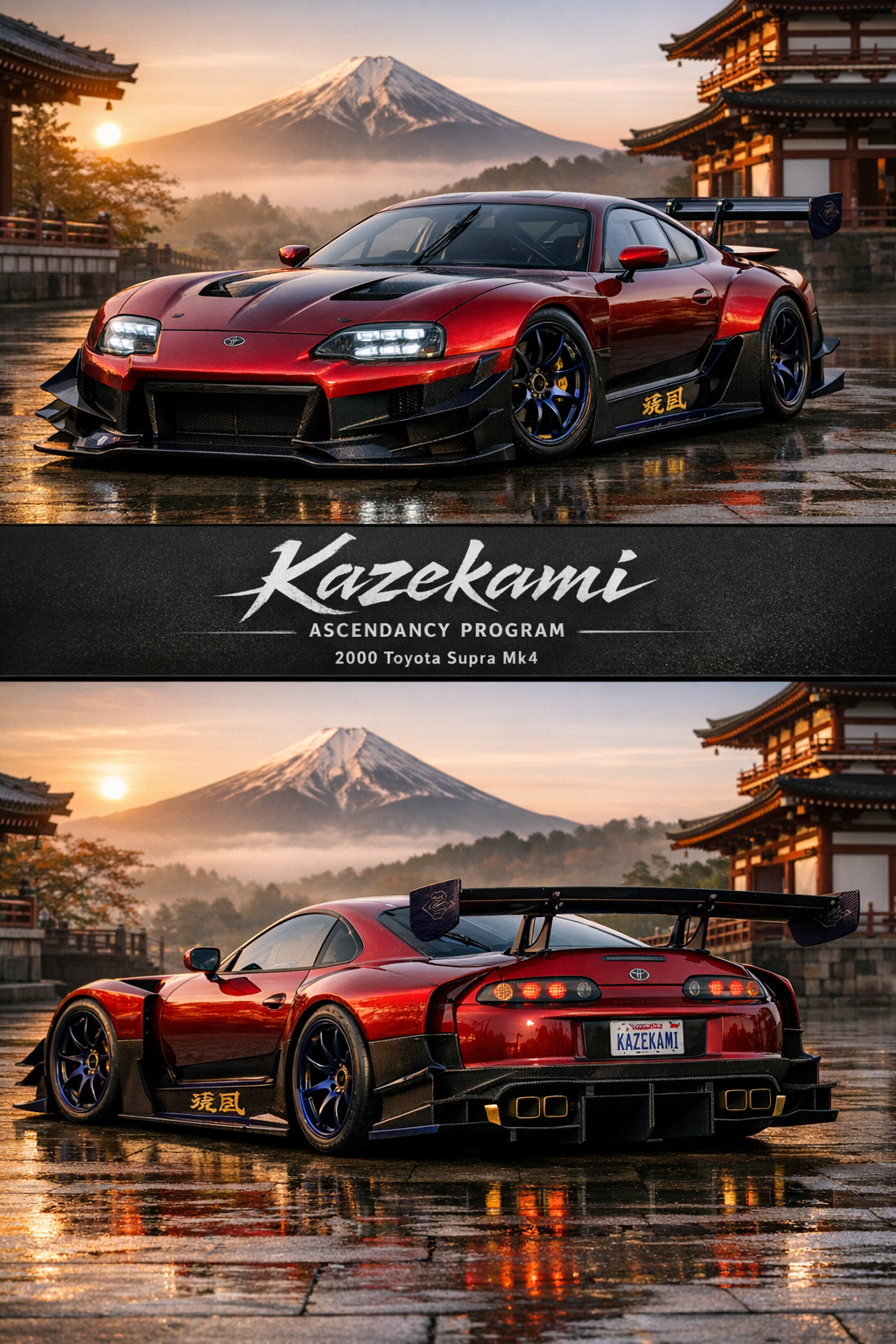
Kazekami Ascendancy Program treats the Mk4 Supra like a homologation problem, not a nostalgia piece—an extreme GT500-style silhouette where every surface is there to manage pressure, heat, and yaw stability. The iconic roofline and hatch arc stay readable, but everything around them is re-architected in carbon: trapezoidal front arches with real extraction, a deep side shelf to seal the floor, and a rear quarter that feeds a diffuser inlet like it’s the car’s main engine.
The cultural cues are restrained and purposeful—mask-like surfacing, torii geometry in the diffuser and exhaust, indigo lacquer accents—because the car’s story is told at speed. Wide track, low ride height, and a tall swan-neck wing build the kind of high-speed confidence you’d expect on Fuji’s long straight, with the 2JZ-GTE reworked around endurance priorities: dry sump, serious charge cooling, and packaging that assumes hours, not pulls.
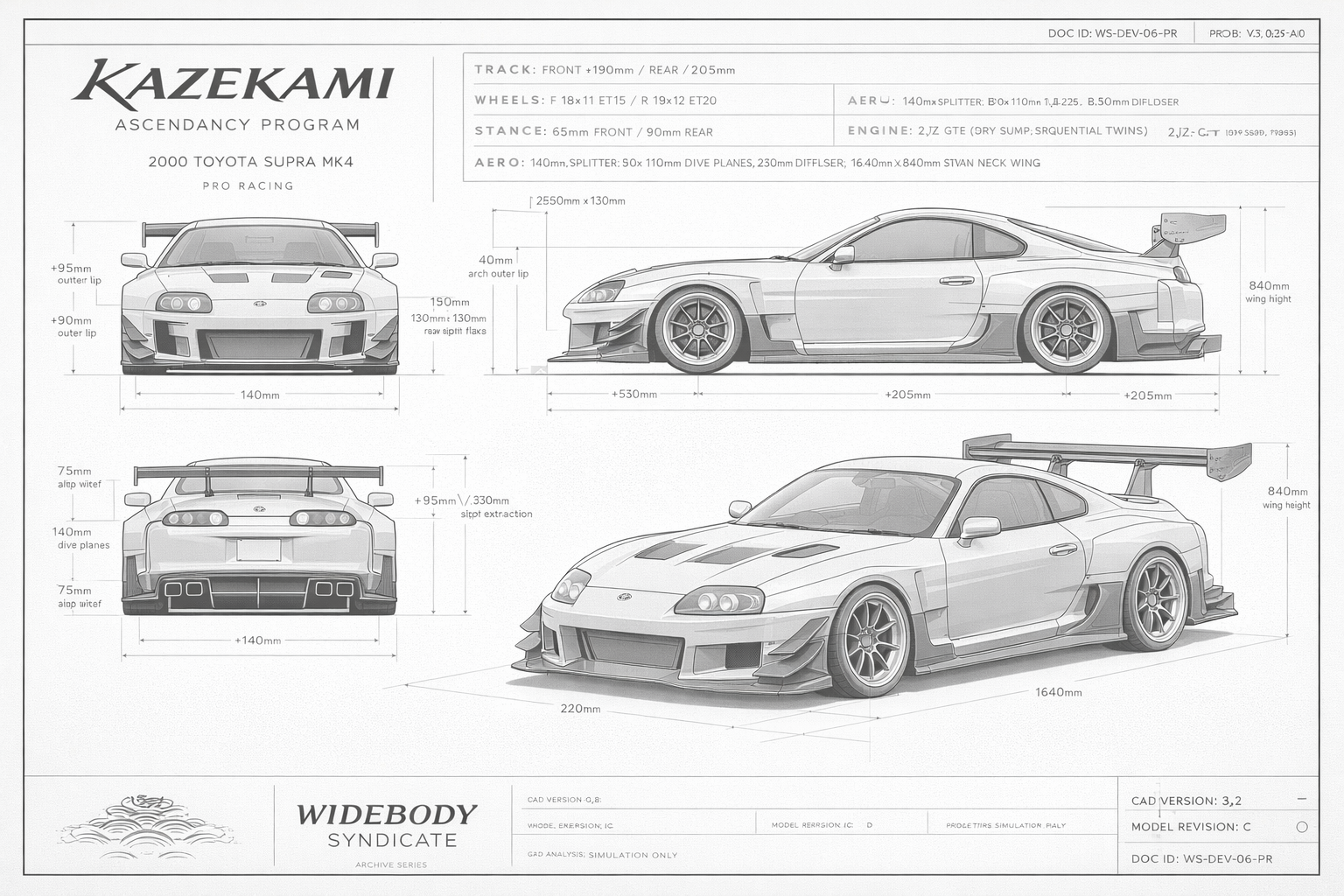 Inspect drawing ↗Open blueprint study →
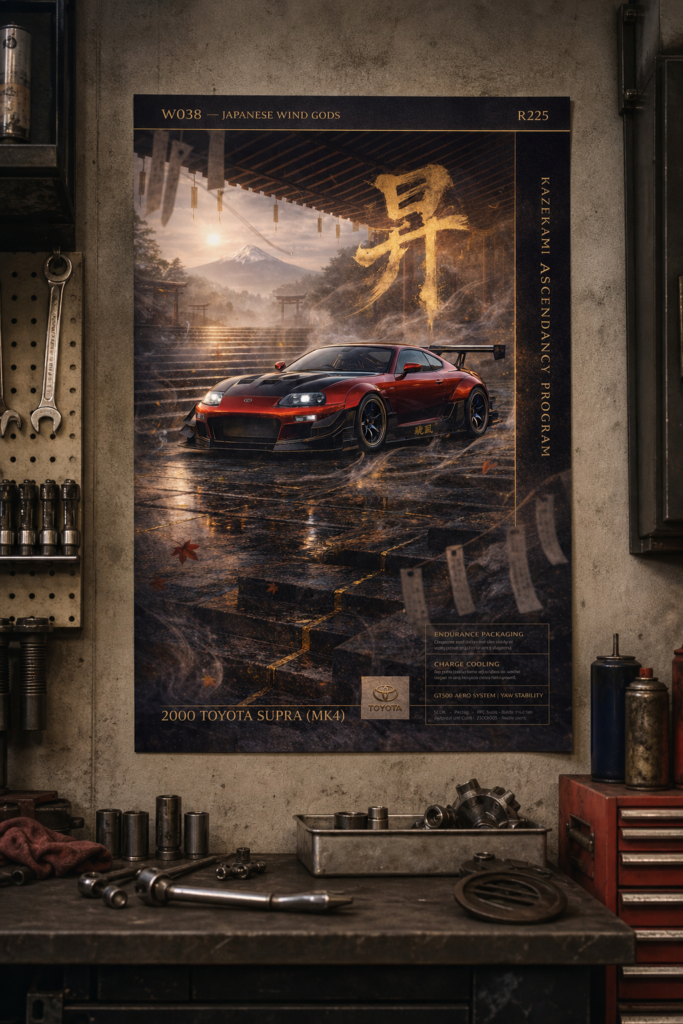
 Inspect poster ↗
Fictional engineering concept
2000 Toyota Supra Mk4
2JZ-GTE retained with endurance-focused rebuild: forged rotating assembly
head sealing
and sustained EGT management
Sequential twin-turbo strategy prioritized for corner-exit response and midrange rather than peak dyno numbers
Dry-sump lubrication to survive sustained lateral load and high-speed braking zones
Top-mount intercooler ducting integrated with hood vent shelves for pressure-driven heat extraction
140mm front splitter with dual 90mm vertical dive planes for yaw stability and front axle load
390mm x 130mm front fender extraction vents to evacuate wheel-well pressure and improve brake cooling
220mm-deep rear diffuser exit with tri-plane ‘torii’ geometry to balance wing load and underfloor expansion
Dual-element swan-neck rear wing (1640mm span
840mm deck height) with endplate detailing and micro-VGs for wake control
2000 Toyota Supra Mk4
18x11 ET15 forged magnesium front wheels with deep concavity and turbine-inspired spoke layout
18x12 ET20 forged magnesium rear wheels to match expanded rear track and diffuser-fed stability
310/30-18 front and 330/30-18 rear semi-slick fitment for GT-style footprint and sidewall control
Ride height target: 65mm front / 80mm rear to maintain rake and diffuser efficiency
Widebody surfaces built as multi-piece carbon assemblies for serviceability (fender/arch sections
vent frames
skirt shelves)
Wheel-well venting tied to inner-liner ducting to prevent turbulent re-ingestion and keep extraction effective
Splitter and undertray mounted with reinforced hardpoints to handle aero load without flex-induced ride-height change
Rear diffuser and exhaust surround heat-shielded with titanium and composite isolation to protect resin systems
Choose an available edition, then select its size and finish.
Continue this wave
1999 Nissan Skyline GT-R R34
Different origins. Sacred Cars

1970 Chevrolet Chevelle SS 454
 Continue the exhibitionJapanese Wind GodsWe just finished a little temple-courtyard science experiment: take the legends, the heroes, and the weirdos of JDM history and run them through a Wind God filter until the bodywork starts speaking in vortices.Build 4 of 6↗