


R208
Project Neon Anomaly
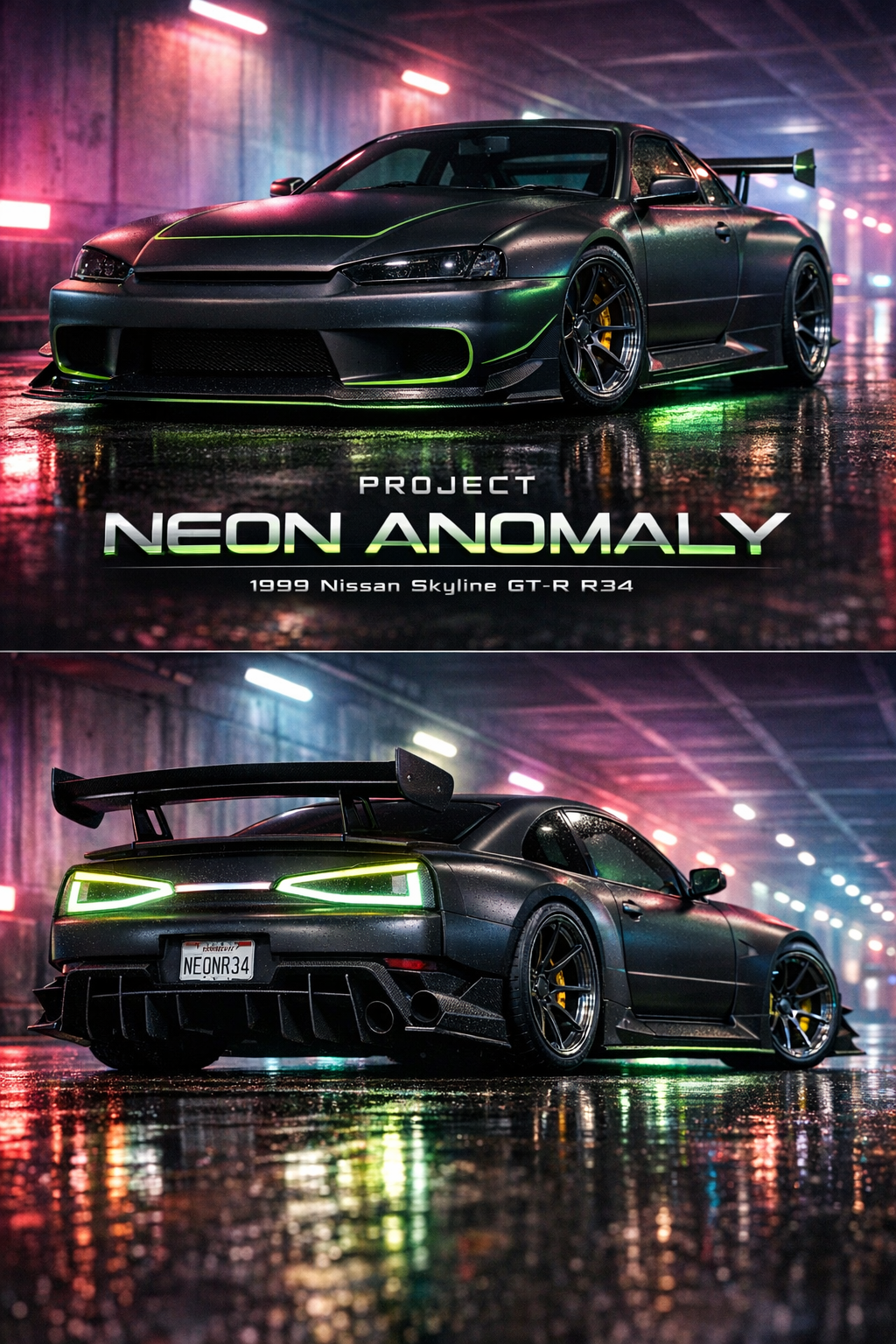
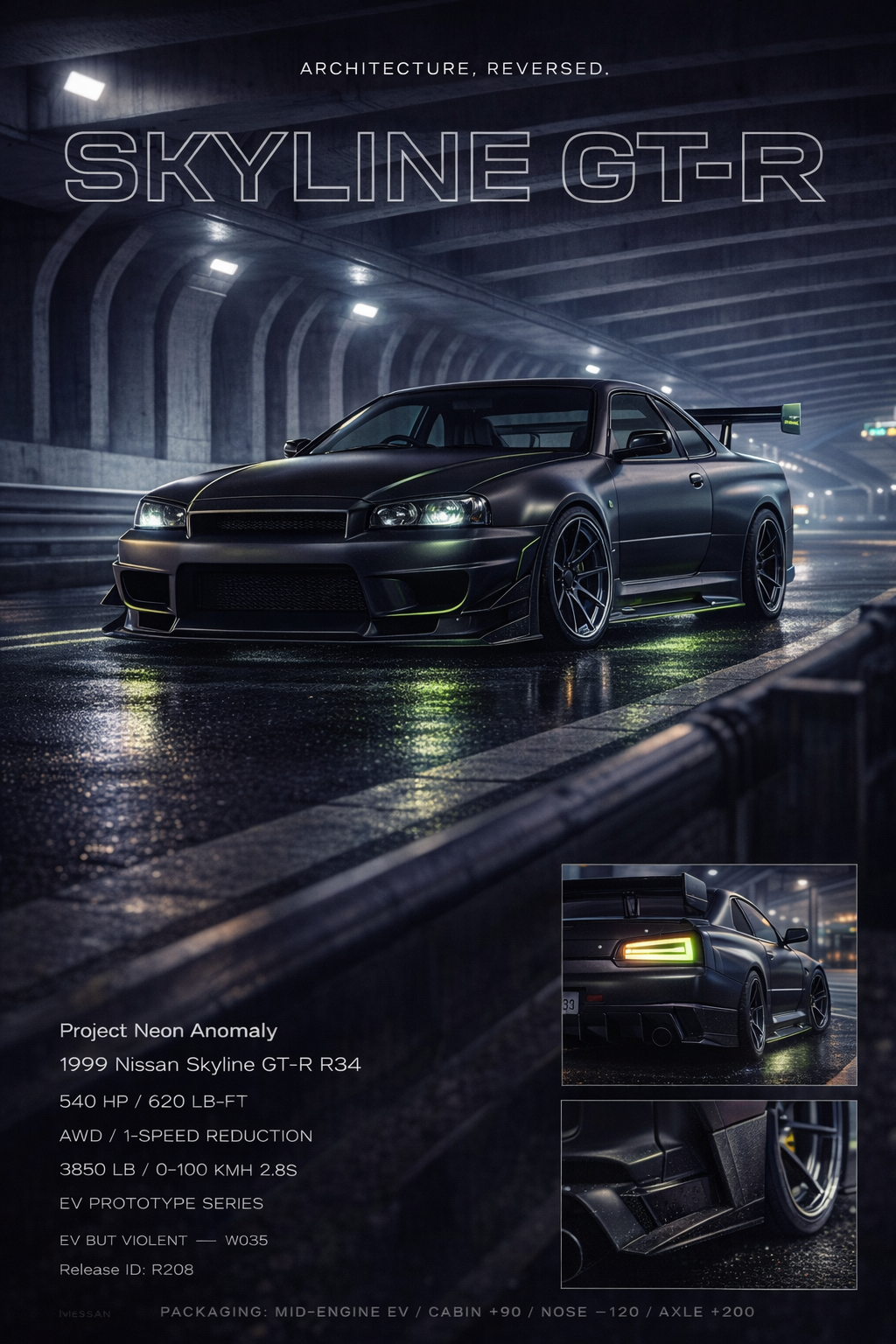
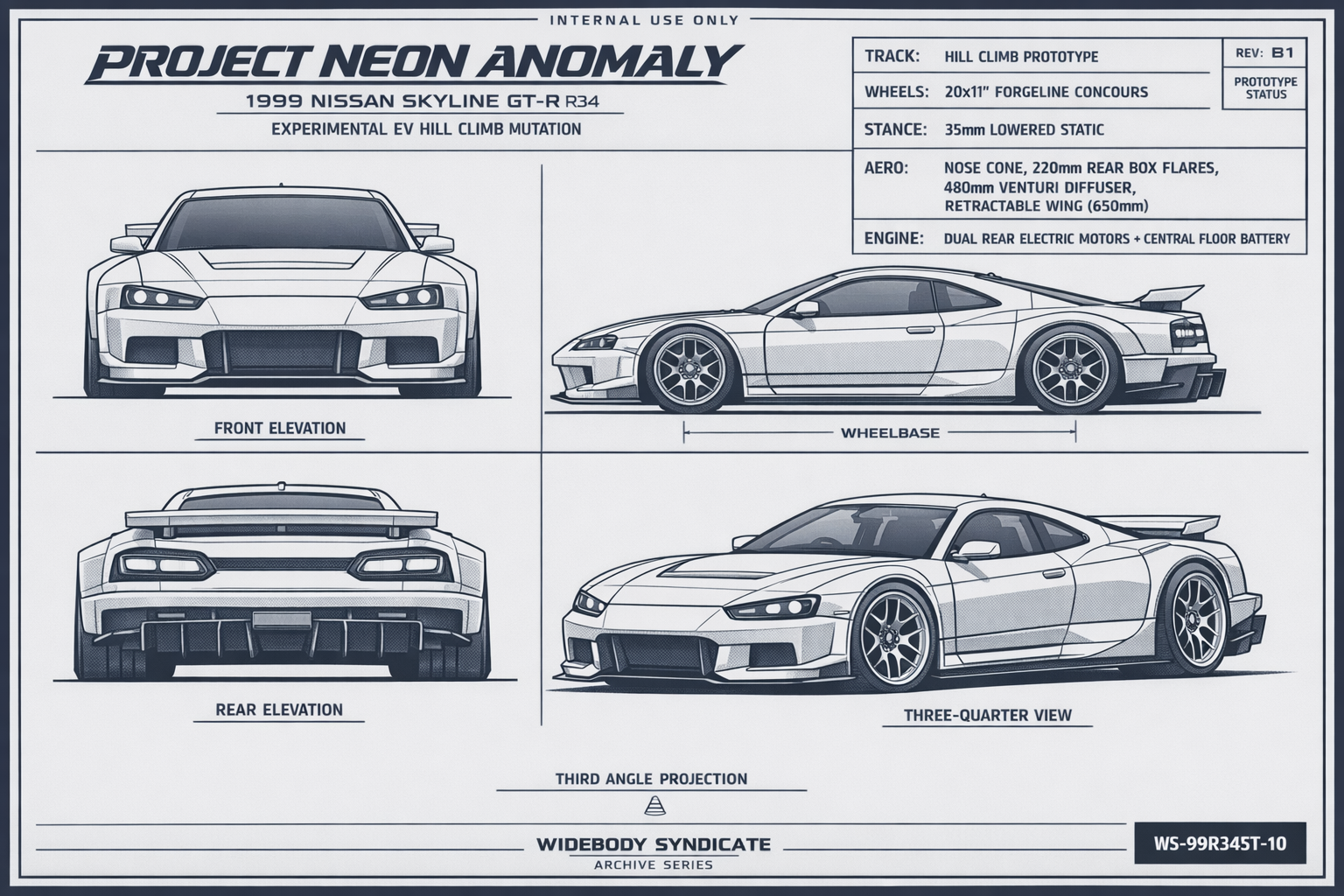
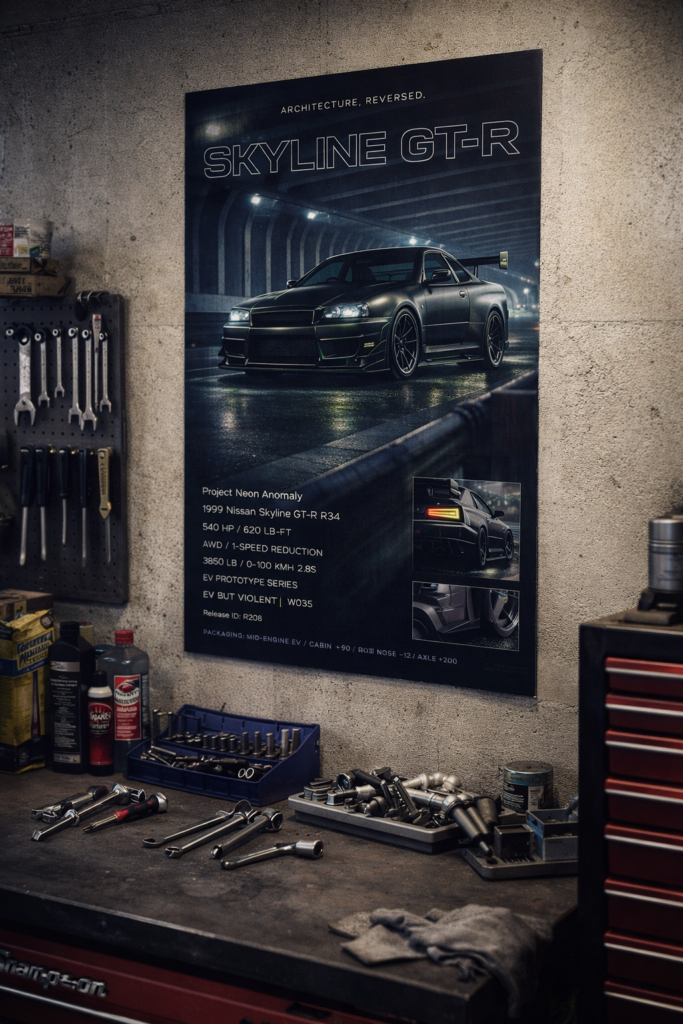
Project Neon Anomaly starts with a sacred-car premise and then commits the unthinkable: the RB26 era silhouette is kept as a reference point, but the packaging is flipped into a mid-engine EV. The cabin nudges forward 90mm, the nose is cut back 120mm, and the rear axle is pushed 200mm to make room for the hardware that actually matters—mass centralized low, motors behind the seats, and cooling paths that don’t pretend this is still a front-engined GT car.
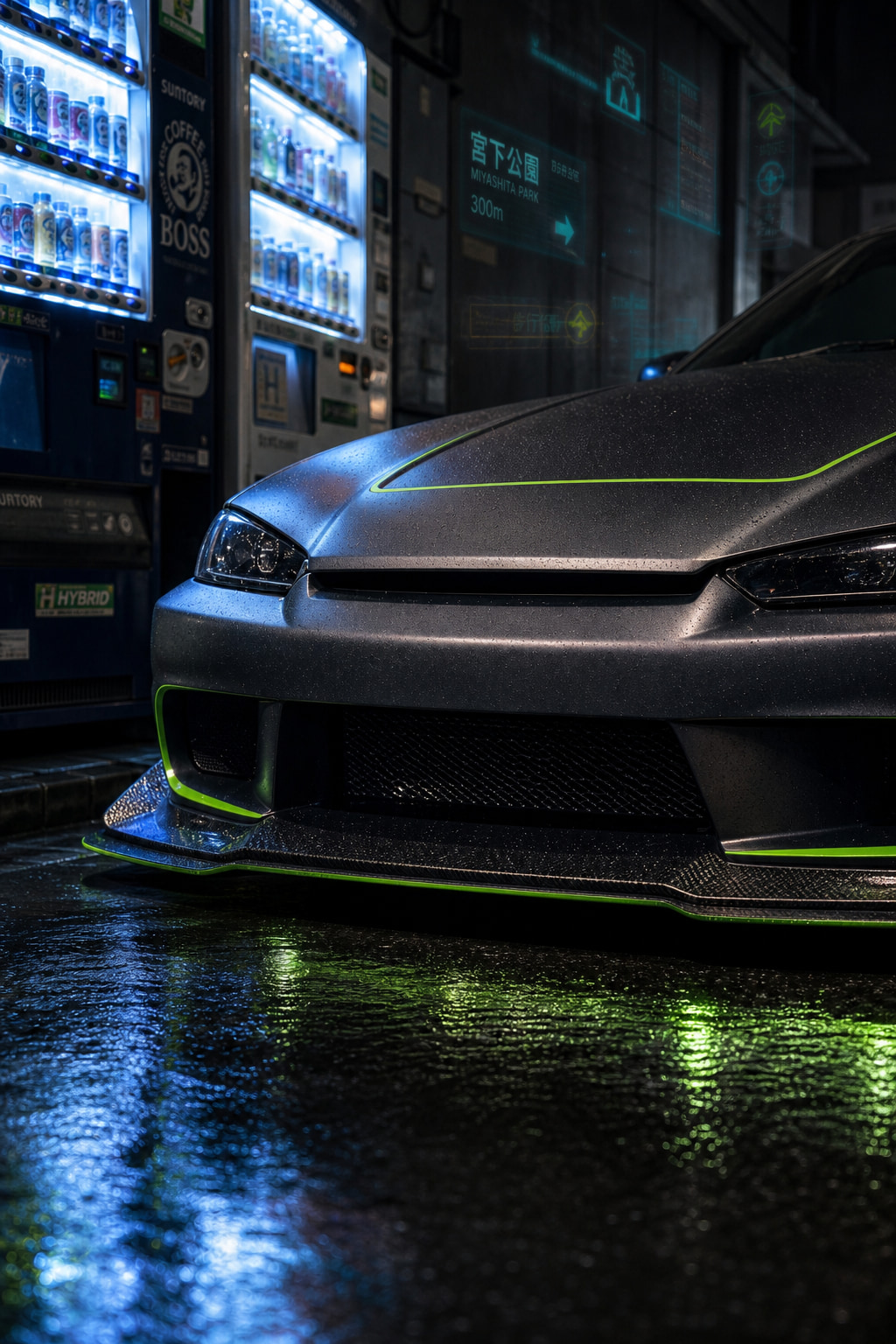
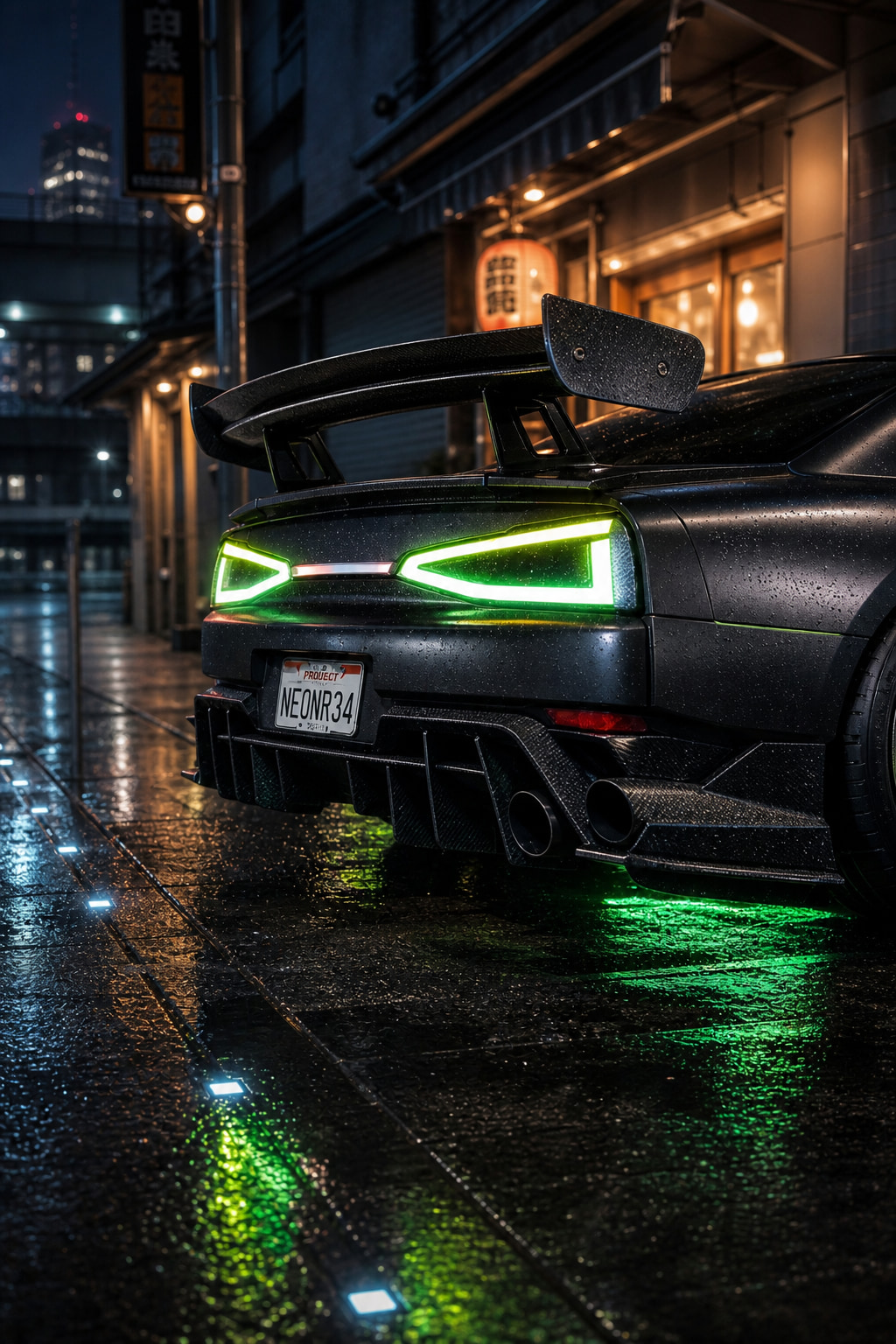
Visually it reads like an R34 that’s been pulled through a wind tunnel and a street meet at the same time. The front arches are pared down to tight ovals that double as brake-cooling inlets, while the rear quarters explode outward with layered box flares that turn into functional diffuser shelves. Satin black keeps it restrained until the neon-green underlayer catches concave surfaces, edges, and the tunnel lights—then the whole car looks like it’s moving even when it’s parked.
Release Image Studies
Image studies from every angle.
Comparison Shots
Blueprint / Collector Archive
Engineering Artifacts
The technical study and collectible interpretation of one build, preserved together.
A presentation-grade collector artifact created for this release and preserved as part of the Widebody Syndicate archive.
Selected archive goods are available for collectors.
Technical Dossier
Platform
1999 Nissan Skyline GT-R R34
The 1999 Nissan Skyline GT-R R34 is the zenith of Japanese performance engineering from the golden era of the late '90s. With the iconic RB26DETT twin-turbocharged inline-six engine under the hood, it delivers a blend of raw power and precise control, thanks to its advanced ATTESA E-TS all-wheel-drive system and Super-HICAS four-wheel steering. The R34's aggressive yet functional design has become a cultural icon, setting the standard for precision, performance, and tunability that still resonates deeply within the tuner and motorsport communities worldwide.
Aero Package
60mm-deep front aero shelf spanning ~1400mm to stabilize front flow and add front load
Reduced 45mm front arches shaped as oval brake-cooling inlets with controlled exit paths
Integrated 60mm horizontal diffuser shelves within the rear quarters to manage sidewash
Extended venturi tunnel + multi-plane diffuser complex projecting 480mm beyond rear axle
Hydraulic retractable single-element rear wing with 650mm rise for high-speed balance
Chassis
This is aimed at the kind of environment where aero and thermal management show up fast: short, violent acceleration zones, hard braking, and high-speed stability demands—think hillclimb pace notes and tunnel-to-tunnel street photo runs. The long diffuser, controlled front inlets, and deployable wing are there to make the car calmer the faster it goes.
Wheels & Tires
Forgeline Concours 20x11 wheels
Michelin Pilot Sport Cup 2 in 305/30ZR20
Static ride height set ~35mm for show stance with functional underfloor clearance management
Track-width-forward fitment tuned to match the 220mm-per-side rear architecture
Powertrain
Dual rear electric motors mounted behind the cabin for mid-engine mass placement
Centralized battery pack under the cabin floor for low CG and yaw stability
Rear cradle designed around motor cooling and half-shaft geometry under high torque
Brake and thermal systems prioritized for repeated short
high-load hillclimb-style pulls
Fabrication Notes
Structure reinforced from B-pillars rearward to carry new rear cradle loads and aero mounting points
Rear floor and tunnel area reworked to package venturi tunnels and diffuser expansion length
Composite quarter construction uses layered sections to integrate flare volume with diffuser shelves
Front trunk enclosure and nose cone built to maintain stiffness while controlling airflow separation
Wing actuation hardpoints tied into tail structure to prevent deflection at deployment height
Design Philosophy
Project Neon Anomaly starts with a sacred-car premise and then commits the unthinkable: the RB26 era silhouette is kept as a reference point, but the packaging is flipped into a mid-engine EV. The cabin nudges forward 90mm, the nose is cut back 120mm, and the rear axle is pushed 200mm to make room for the hardware that actually matters—mass centralized low, motors behind the seats, and cooling paths that don’t pretend this is still a front-engined GT car.
Visually it reads like an R34 that’s been pulled through a wind tunnel and a street meet at the same time. The front arches are pared down to tight ovals that double as brake-cooling inlets, while the rear quarters explode outward with layered box flares that turn into functional diffuser shelves. Satin black keeps it restrained until the neon-green underlayer catches concave surfaces, edges, and the tunnel lights—then the whole car looks like it’s moving even when it’s parked.
▧Platform+
1999 Nissan Skyline GT-R R34
The 1999 Nissan Skyline GT-R R34 is the zenith of Japanese performance engineering from the golden era of the late '90s. With the iconic RB26DETT twin-turbocharged inline-six engine under the hood, it delivers a blend of raw power and precise control, thanks to its advanced ATTESA E-TS all-wheel-drive system and Super-HICAS four-wheel steering. The R34's aggressive yet functional design has become a cultural icon, setting the standard for precision, performance, and tunability that still resonates deeply within the tuner and motorsport communities worldwide.
⌘Aero Package+
60mm-deep front aero shelf spanning ~1400mm to stabilize front flow and add front load
Reduced 45mm front arches shaped as oval brake-cooling inlets with controlled exit paths
Integrated 60mm horizontal diffuser shelves within the rear quarters to manage sidewash
Extended venturi tunnel + multi-plane diffuser complex projecting 480mm beyond rear axle
Hydraulic retractable single-element rear wing with 650mm rise for high-speed balance
⟡Chassis+
This is aimed at the kind of environment where aero and thermal management show up fast: short, violent acceleration zones, hard braking, and high-speed stability demands—think hillclimb pace notes and tunnel-to-tunnel street photo runs. The long diffuser, controlled front inlets, and deployable wing are there to make the car calmer the faster it goes.
◎Wheels & Tires+
Forgeline Concours 20x11 wheels
Michelin Pilot Sport Cup 2 in 305/30ZR20
Static ride height set ~35mm for show stance with functional underfloor clearance management
Track-width-forward fitment tuned to match the 220mm-per-side rear architecture
▤Powertrain+
Dual rear electric motors mounted behind the cabin for mid-engine mass placement
Centralized battery pack under the cabin floor for low CG and yaw stability
Rear cradle designed around motor cooling and half-shaft geometry under high torque
Brake and thermal systems prioritized for repeated short
high-load hillclimb-style pulls
△Fabrication Notes+
Structure reinforced from B-pillars rearward to carry new rear cradle loads and aero mounting points
Rear floor and tunnel area reworked to package venturi tunnels and diffuser expansion length
Composite quarter construction uses layered sections to integrate flare volume with diffuser shelves
Front trunk enclosure and nose cone built to maintain stiffness while controlling airflow separation
Wing actuation hardpoints tied into tail structure to prevent deflection at deployment height
×Design Philosophy+
Project Neon Anomaly starts with a sacred-car premise and then commits the unthinkable: the RB26 era silhouette is kept as a reference point, but the packaging is flipped into a mid-engine EV. The cabin nudges forward 90mm, the nose is cut back 120mm, and the rear axle is pushed 200mm to make room for the hardware that actually matters—mass centralized low, motors behind the seats, and cooling paths that don’t pretend this is still a front-engined GT car.
Visually it reads like an R34 that’s been pulled through a wind tunnel and a street meet at the same time. The front arches are pared down to tight ovals that double as brake-cooling inlets, while the rear quarters explode outward with layered box flares that turn into functional diffuser shelves. Satin black keeps it restrained until the neon-green underlayer catches concave surfaces, edges, and the tunnel lights—then the whole car looks like it’s moving even when it’s parked.
Part of
Wave 35
EV But Violent
We just cooked up a batch of electric beasts that stomp the timeline and rewrite what muscle, drift, and hillclimb rides could have been if the juice ran wild a little earlier. From our stealthy ’90 Corvette ZR-1 turned covert assault prowler to a hillclimb Kombi that’s basically a carbon fiber thunderbolt with acid green sass, these rides don’t just push boundaries—they snap ’em in half and laugh while doing it.
Explore Wave 35 → 6 BuildsKeep Exploring
The archive is always growing. New releases, waves, and blueprints added regularly.