
R285
Short Course Phantom Program
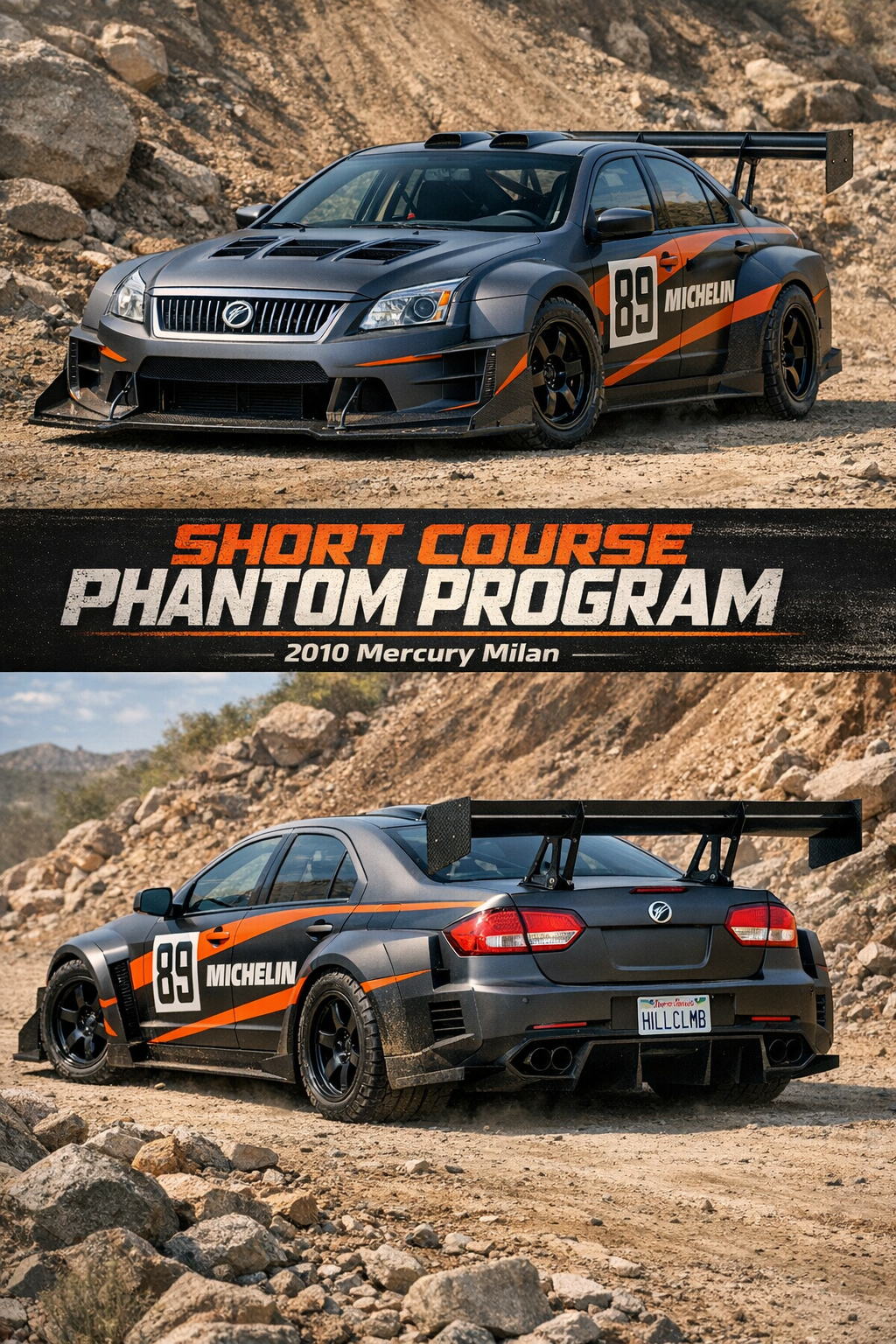
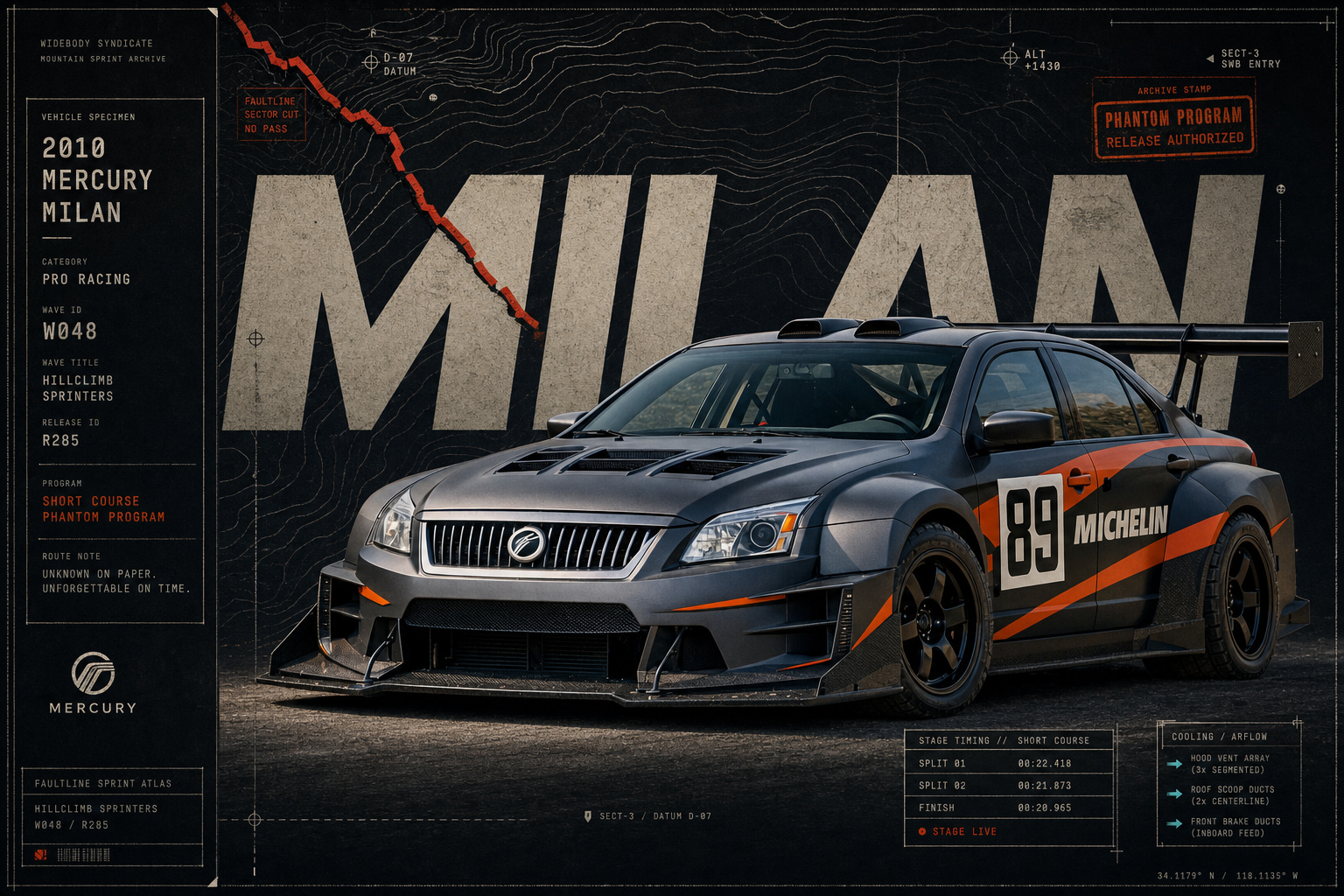
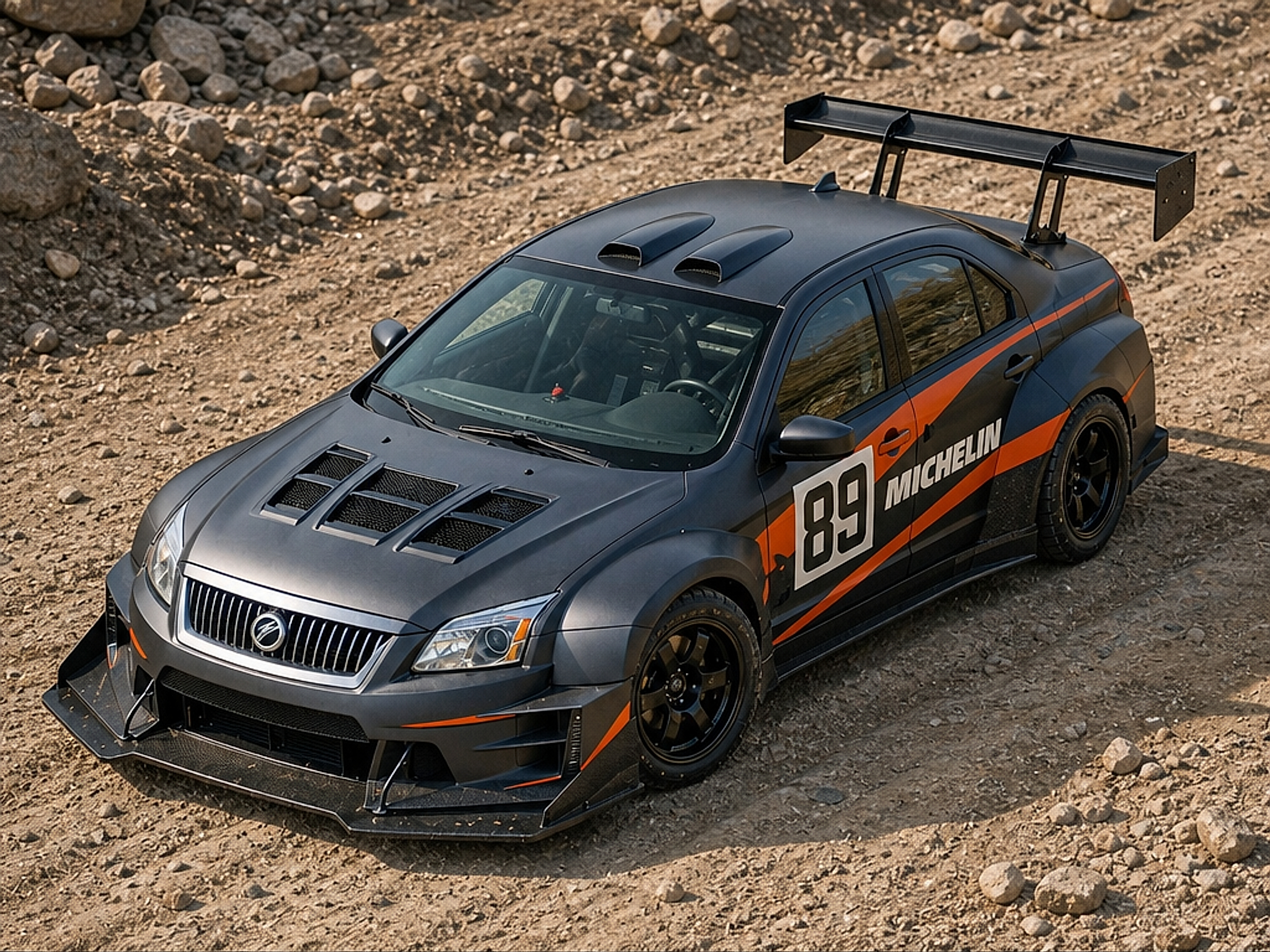
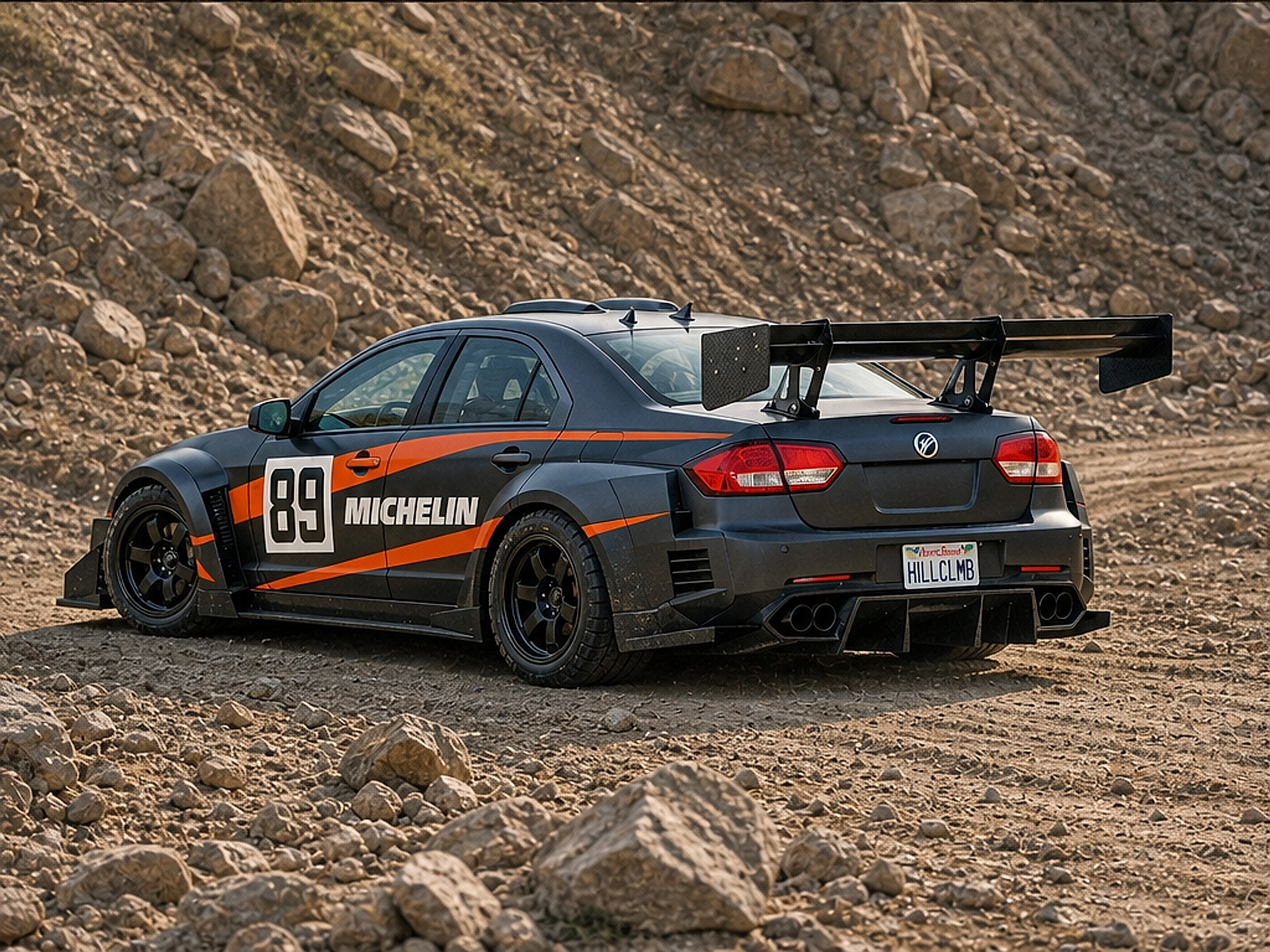
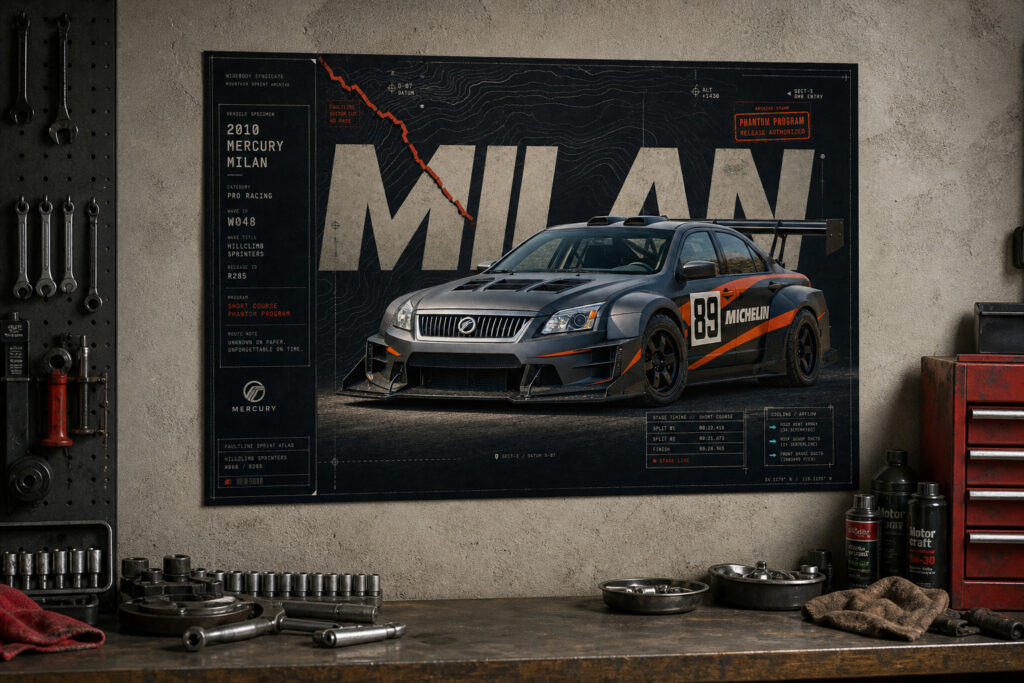
The 2010 Mercury Milan was never supposed to be anybody’s hero car, which is exactly why the Short Course Phantom Program works. It keeps the sedan silhouette but turns everything underneath into short-run violence: widened track, stubby overhang aero, and cooling that treats a 60–90 second hillclimb like a qualifying lap. The squared, layered arches aren’t styling exercises—they’re wheelhouse pressure relief and debris management, with inner ducting that feeds brakes and side-mounted heat exchangers.
This is a low-speed downforce build for loose surfaces, not a highway wing flex. A deep splitter with real inlet area, a roof-exit heat strategy, and a tall twin-element wing give the Milan the kind of pitch control you normally expect from purpose-built sprint platforms. It reads like an archive oddity until you notice the details: vent geometry, serviceable aero, and a stance set for compression travel instead of parking-lot drama.
Release Image Studies
Image studies from every angle.
Comparison Shots
Blueprint / Collector Archive
Engineering Artifacts
The technical study and collectible interpretation of one build, preserved together.
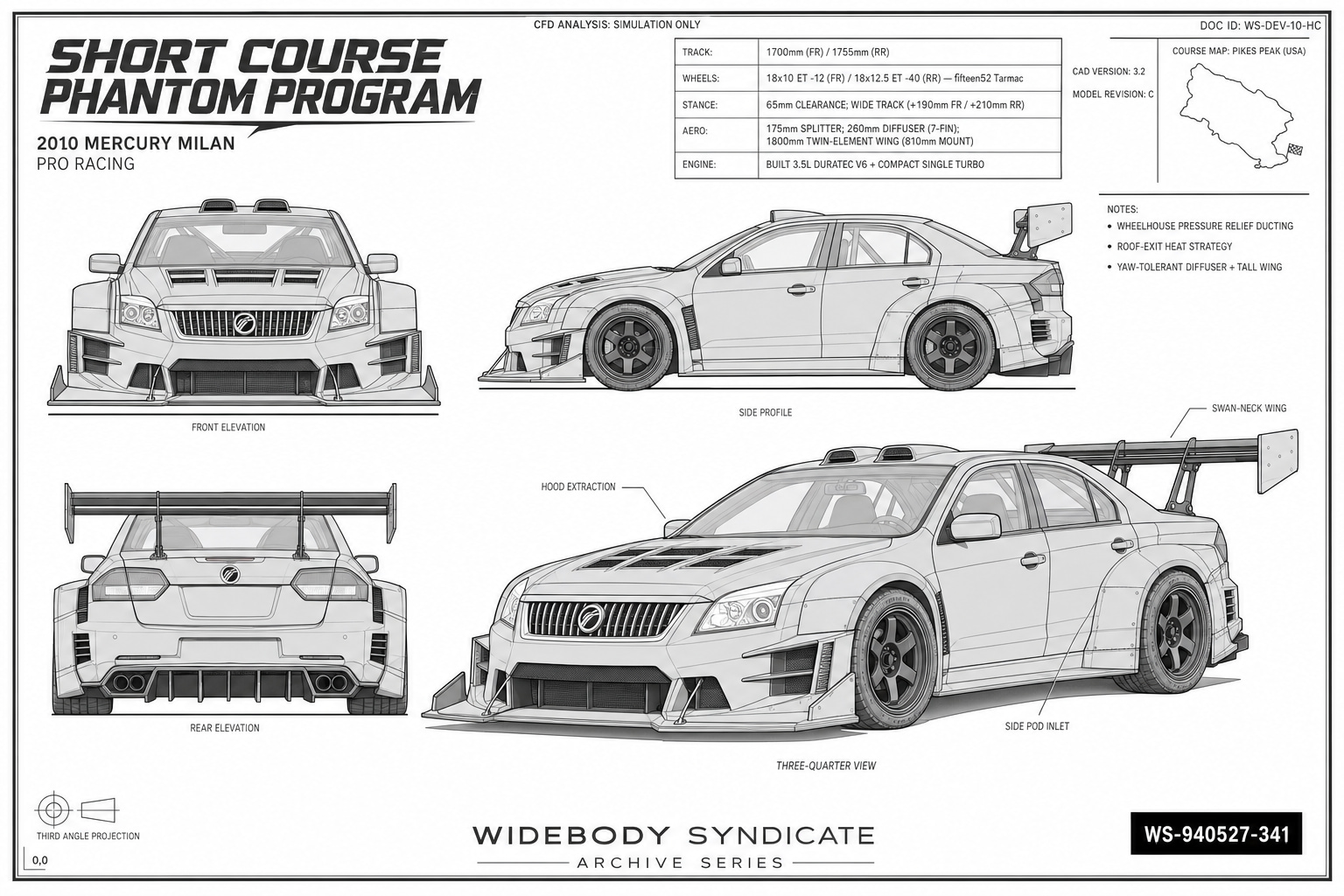
A presentation-grade collector artifact created for this release and preserved as part of the Widebody Syndicate archive.
Selected archive goods are available for collectors.
Technical Dossier
Platform
2010 Mercury Milan
Mercury’s Milan is one of those quietly important early-2010s midsize sedans that lived in the space between fleet anonymity and grown-up daily-driver confidence. Under the skin it shares Ford’s CD3 bones with the Fusion, which means a long, low four-door profile, sensible proportions, and a chassis engineered for real-world roads rather than spec-sheet theatrics.
In 2010 form, the Milan represents the end of Mercury’s era: clean surfacing, restrained brightwork, and a deliberately upscale take on a mainstream platform. It’s the kind of base car that does its job without begging for attention—exactly why it works as a cultural time capsule of American commuter design right before everything became an “activity vehicle.”
Aero Package
175 mm forward splitter with internal ribbing and large up-swept winglets/dive planes per side
Dual NACA ducts feeding brake/oil cooling channels integrated into the front aero structure
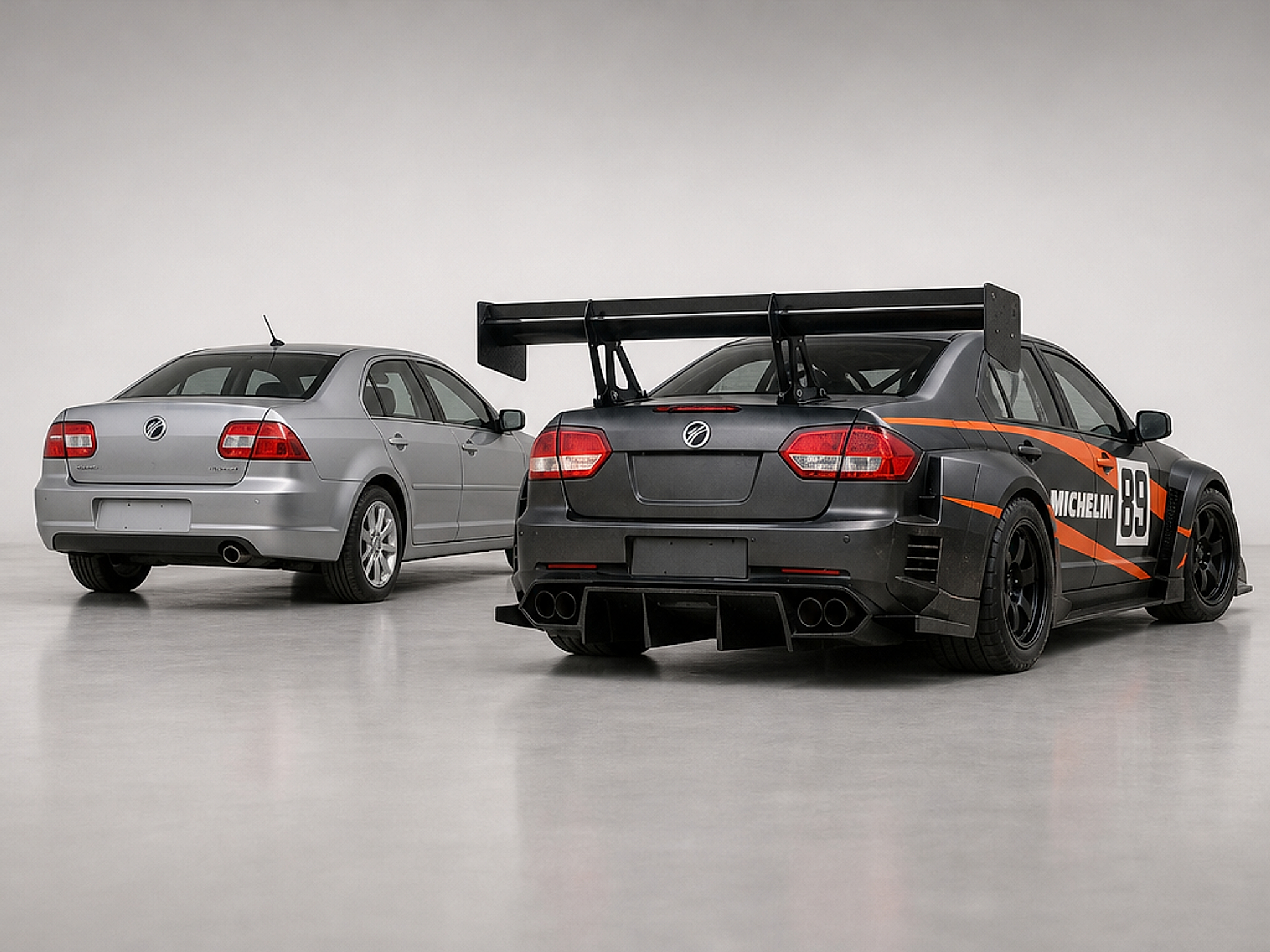
260 mm deep rear diffuser with seven vertical fins for yaw-tolerant ground effect
1800 mm twin-element rear wing on swan-neck pylons with manual flap adjustment and tall endplates
Chassis
Built for tight, rugged uphill dirt circuits where the car is constantly transitioning—brake, rotate, catch, and fire. The aero is tuned for low-speed authority and stability in yaw, while the cooling strategy assumes repeated short runs with minimal recovery time.
Wheels & Tires
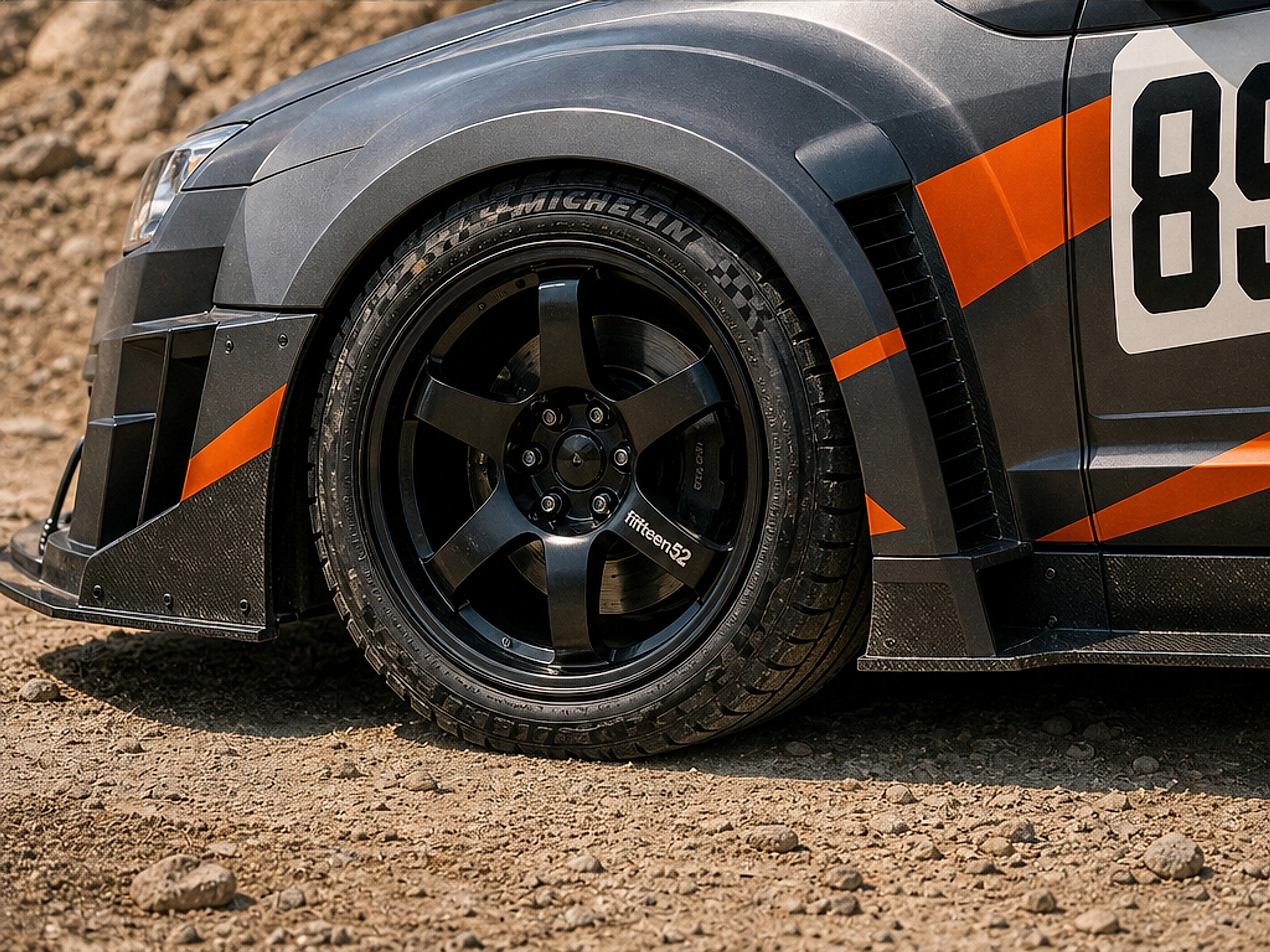
Front: 18x10.0 ET-12 on 295/40R18 Michelin Pilot Sport Off-Road
Rear: 18x12.5 ET-40 on 335/40R18 Michelin Pilot Sport Off-Road
Matte black fifteen52 Tarmac forged wheels sized for brake clearance and sidewall support
Powertrain
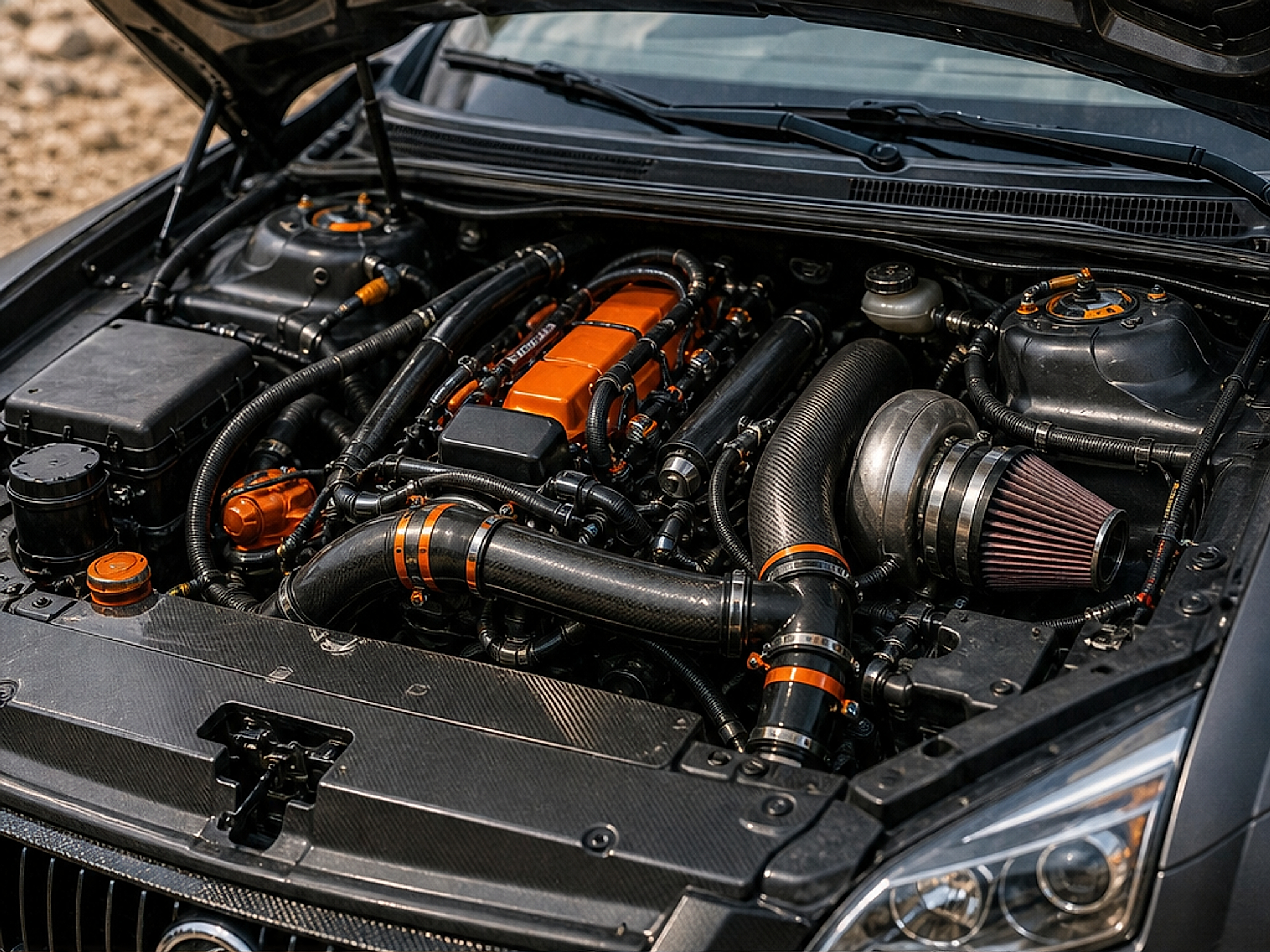
3.5L Duratec V6 base with forged bottom end and a compact single-turbo setup for fast transient response
Air-to-water intercooling with sidepod heat exchangers to reduce heat soak between short runs
Dry-sump oiling and baffled fuel system to survive sustained pitch/yaw on uphill dirt
ECU calibration focused on torque shaping
anti-lag strategy
and repeatable IAT control
Fabrication Notes
Front subframe and control arm package revised to achieve widened track with corrected scrub radius and bump steer
Splitter and wing mounts tied into chassis pickup points with serviceable crush structures for off-course impacts
Wheelhouse liners built as functional ducts with removable panels for cleaning and cooler access
Underbody sealed forward with reinforced skid sections to protect aero surfaces on rutted starts
Design Philosophy
The 2010 Mercury Milan was never supposed to be anybody’s hero car, which is exactly why the Short Course Phantom Program works. It keeps the sedan silhouette but turns everything underneath into short-run violence: widened track, stubby overhang aero, and cooling that treats a 60–90 second hillclimb like a qualifying lap. The squared, layered arches aren’t styling exercises—they’re wheelhouse pressure relief and debris management, with inner ducting that feeds brakes and side-mounted heat exchangers.
This is a low-speed downforce build for loose surfaces, not a highway wing flex. A deep splitter with real inlet area, a roof-exit heat strategy, and a tall twin-element wing give the Milan the kind of pitch control you normally expect from purpose-built sprint platforms. It reads like an archive oddity until you notice the details: vent geometry, serviceable aero, and a stance set for compression travel instead of parking-lot drama.
▧Platform+
2010 Mercury Milan
Mercury’s Milan is one of those quietly important early-2010s midsize sedans that lived in the space between fleet anonymity and grown-up daily-driver confidence. Under the skin it shares Ford’s CD3 bones with the Fusion, which means a long, low four-door profile, sensible proportions, and a chassis engineered for real-world roads rather than spec-sheet theatrics.
In 2010 form, the Milan represents the end of Mercury’s era: clean surfacing, restrained brightwork, and a deliberately upscale take on a mainstream platform. It’s the kind of base car that does its job without begging for attention—exactly why it works as a cultural time capsule of American commuter design right before everything became an “activity vehicle.”
⌘Aero Package+
175 mm forward splitter with internal ribbing and large up-swept winglets/dive planes per side
Dual NACA ducts feeding brake/oil cooling channels integrated into the front aero structure
260 mm deep rear diffuser with seven vertical fins for yaw-tolerant ground effect
1800 mm twin-element rear wing on swan-neck pylons with manual flap adjustment and tall endplates
⟡Chassis+
Built for tight, rugged uphill dirt circuits where the car is constantly transitioning—brake, rotate, catch, and fire. The aero is tuned for low-speed authority and stability in yaw, while the cooling strategy assumes repeated short runs with minimal recovery time.
◎Wheels & Tires+
Front: 18x10.0 ET-12 on 295/40R18 Michelin Pilot Sport Off-Road
Rear: 18x12.5 ET-40 on 335/40R18 Michelin Pilot Sport Off-Road
Matte black fifteen52 Tarmac forged wheels sized for brake clearance and sidewall support
▤Powertrain+
3.5L Duratec V6 base with forged bottom end and a compact single-turbo setup for fast transient response
Air-to-water intercooling with sidepod heat exchangers to reduce heat soak between short runs
Dry-sump oiling and baffled fuel system to survive sustained pitch/yaw on uphill dirt
ECU calibration focused on torque shaping
anti-lag strategy
and repeatable IAT control
△Fabrication Notes+
Front subframe and control arm package revised to achieve widened track with corrected scrub radius and bump steer
Splitter and wing mounts tied into chassis pickup points with serviceable crush structures for off-course impacts
Wheelhouse liners built as functional ducts with removable panels for cleaning and cooler access
Underbody sealed forward with reinforced skid sections to protect aero surfaces on rutted starts
×Design Philosophy+
The 2010 Mercury Milan was never supposed to be anybody’s hero car, which is exactly why the Short Course Phantom Program works. It keeps the sedan silhouette but turns everything underneath into short-run violence: widened track, stubby overhang aero, and cooling that treats a 60–90 second hillclimb like a qualifying lap. The squared, layered arches aren’t styling exercises—they’re wheelhouse pressure relief and debris management, with inner ducting that feeds brakes and side-mounted heat exchangers.
This is a low-speed downforce build for loose surfaces, not a highway wing flex. A deep splitter with real inlet area, a roof-exit heat strategy, and a tall twin-element wing give the Milan the kind of pitch control you normally expect from purpose-built sprint platforms. It reads like an archive oddity until you notice the details: vent geometry, serviceable aero, and a stance set for compression travel instead of parking-lot drama.
Part of
Wave 48
Hillclimb Sprinters
This release is our answer to the hillclimb question nobody asked politely: what happens when you build for 60 to 90 seconds of terror instead of 20 minutes of elegance? Across coupes, a sedan, a pickup, and an SUV, the logic is the same: short-course sprint engineering where rotation matters more than top speed, and cooling is treated like ammunition.
Explore Wave 48 → 6 BuildsKeep Exploring
The archive is always growing. New releases, waves, and blueprints added regularly.