R287
Summit Strike Protocol
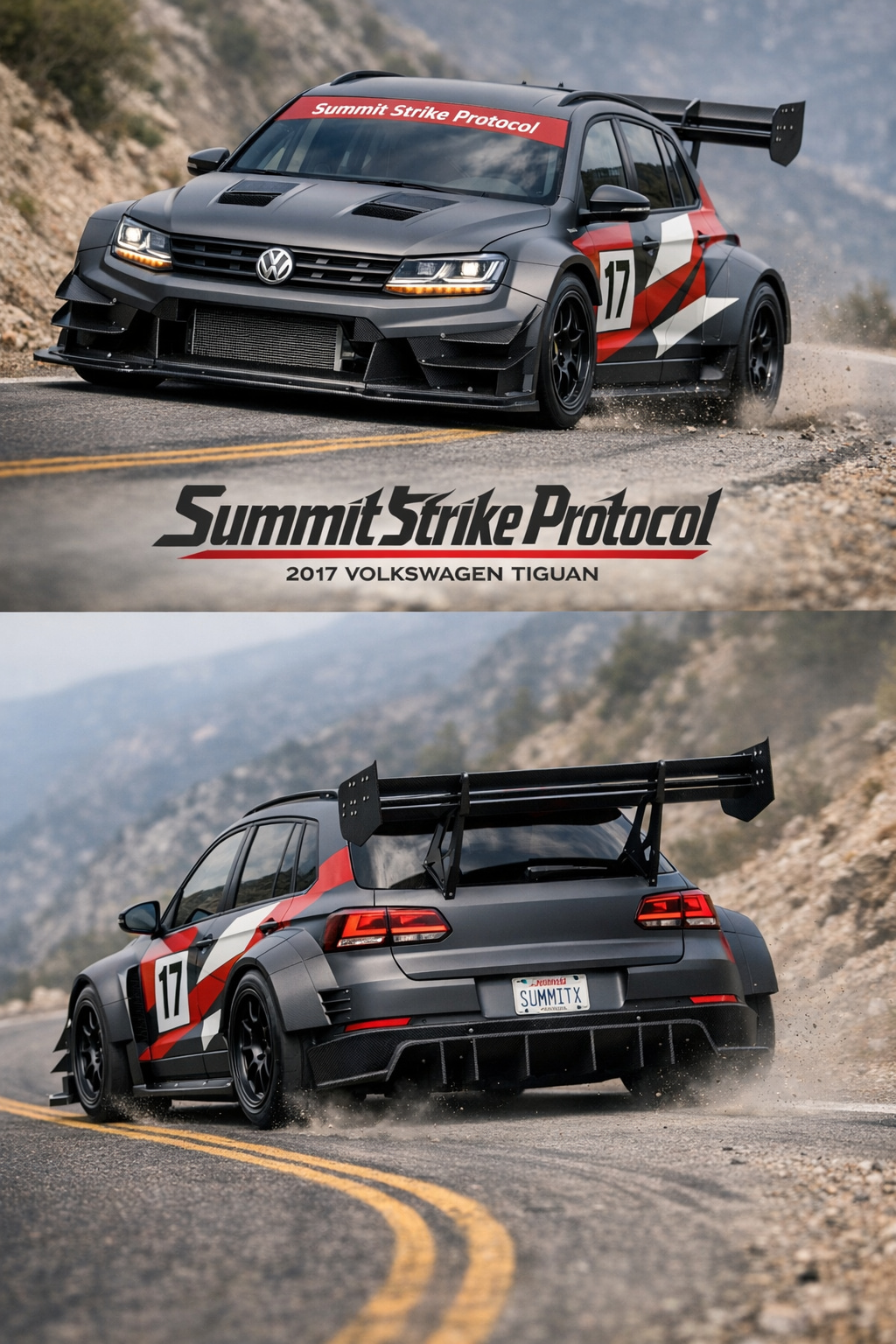
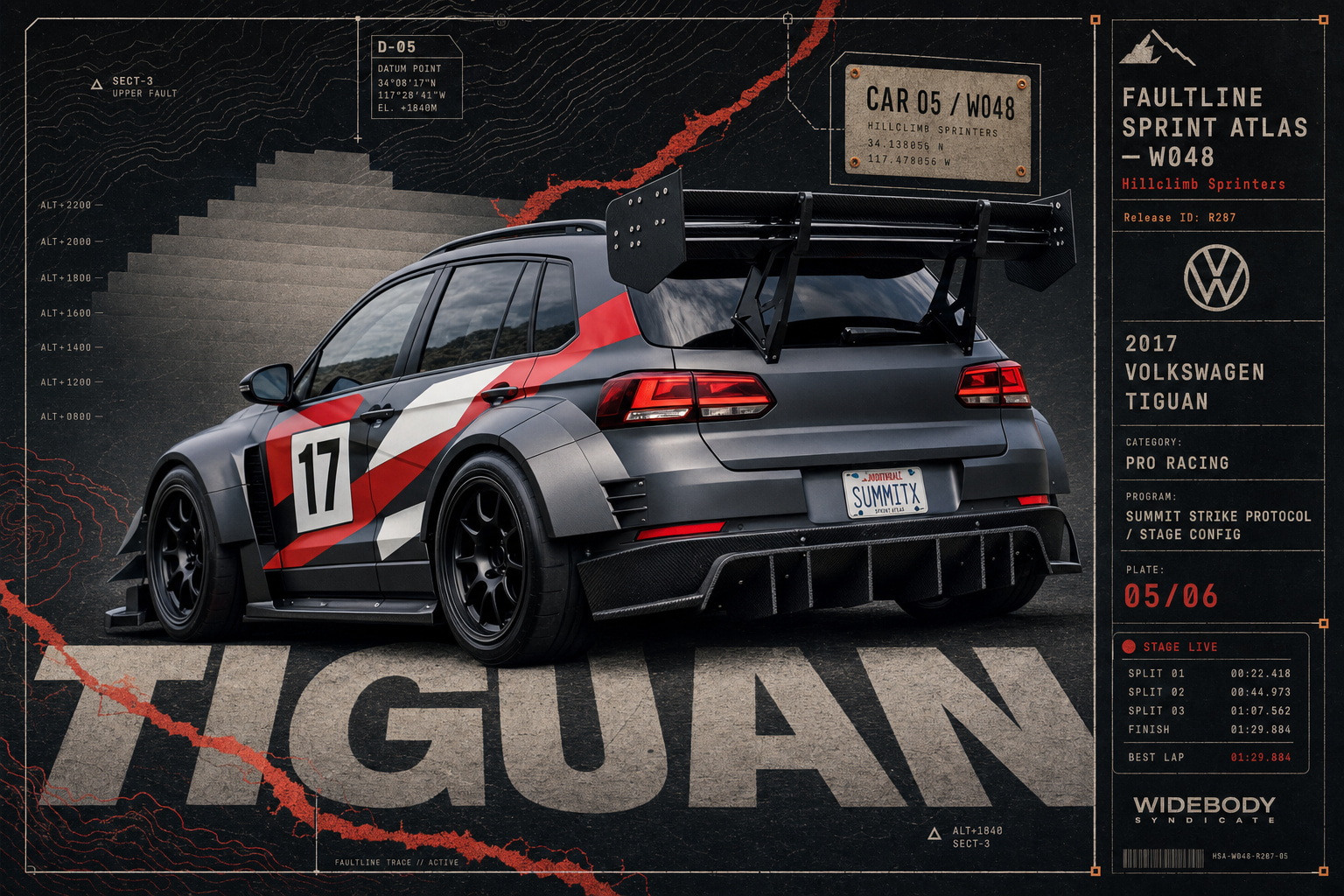
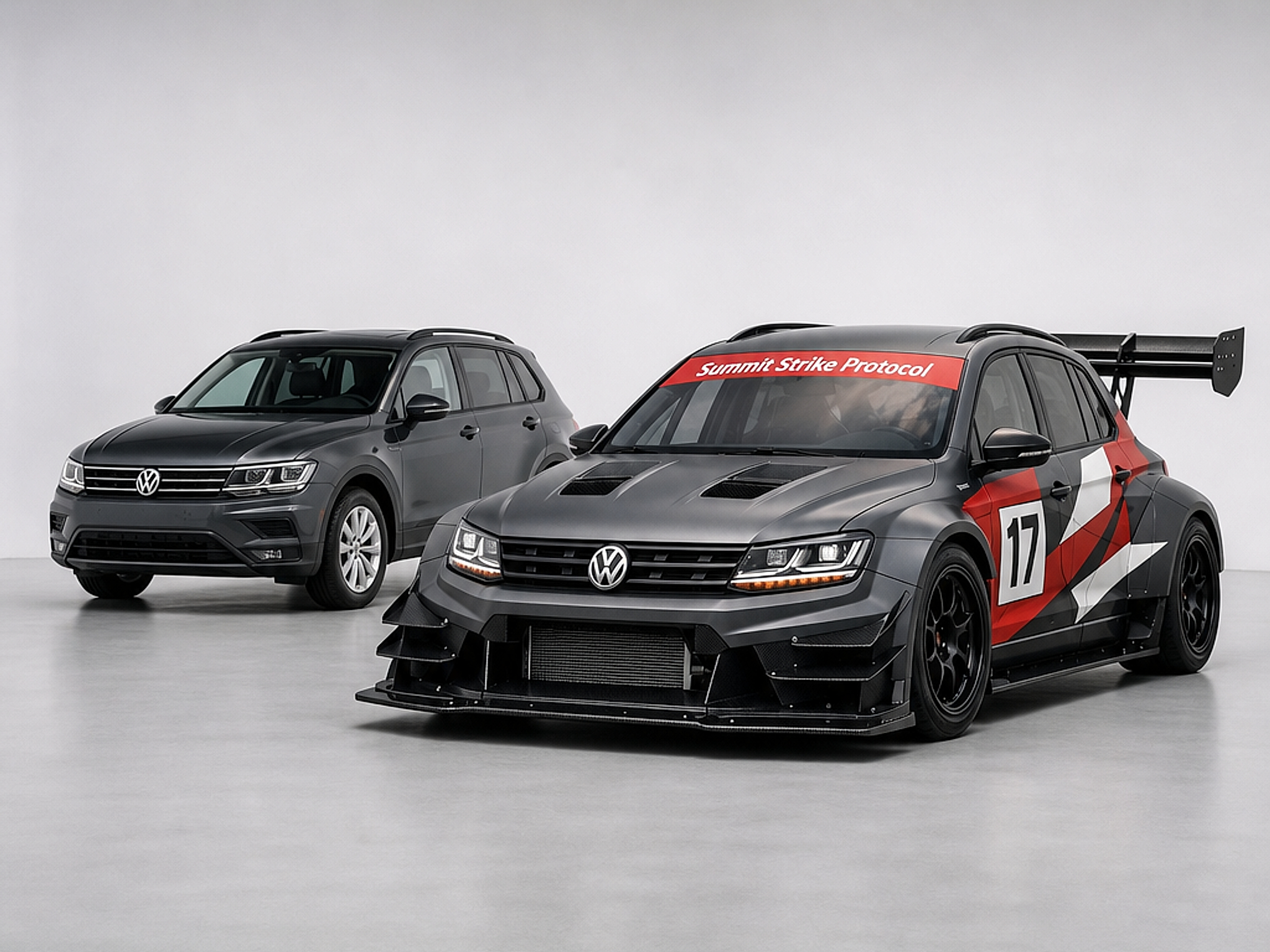
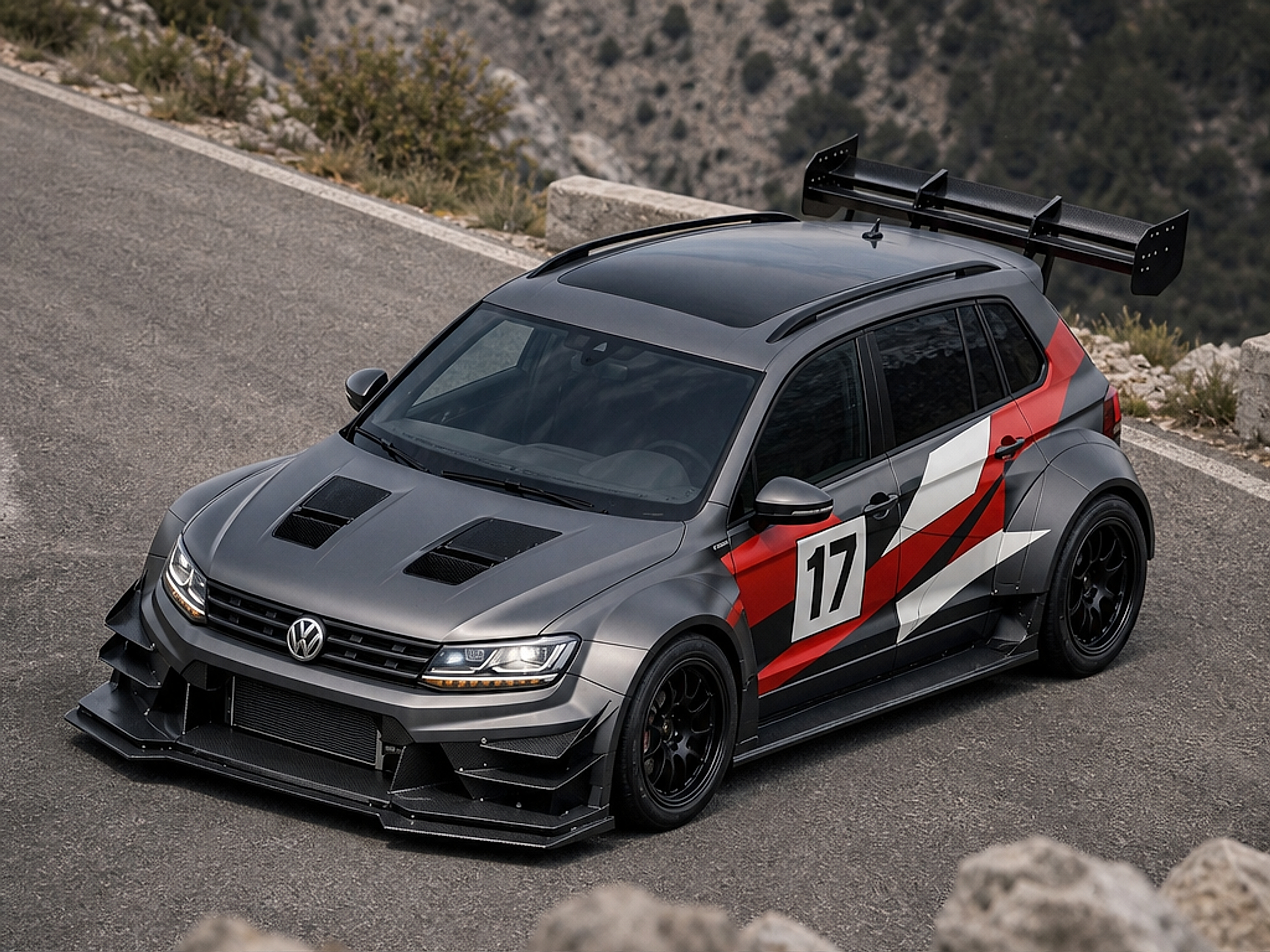
Summit Strike Protocol takes a 2017 Tiguan and deletes the “daily” from its vocabulary. The proportions get pulled inward and outward at the same time: stubby, wide, and planted, with squared-off 110mm front and 130mm rear flares built around real tire. It’s the kind of silhouette that makes sense only when you’ve watched a short hillclimb sprint—hard braking, instant rotation, and full throttle again before the turbo even has time to cool its thoughts.
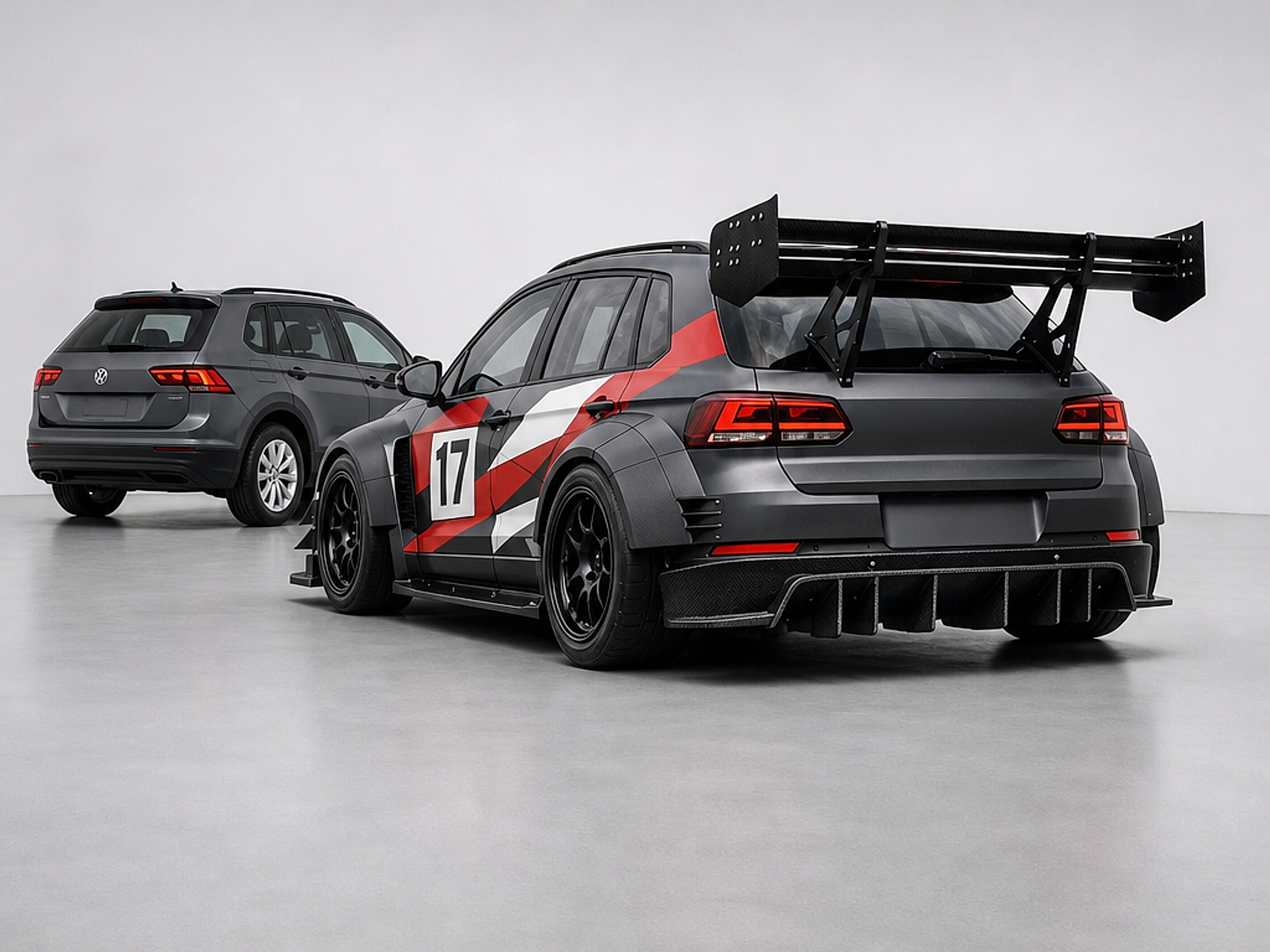
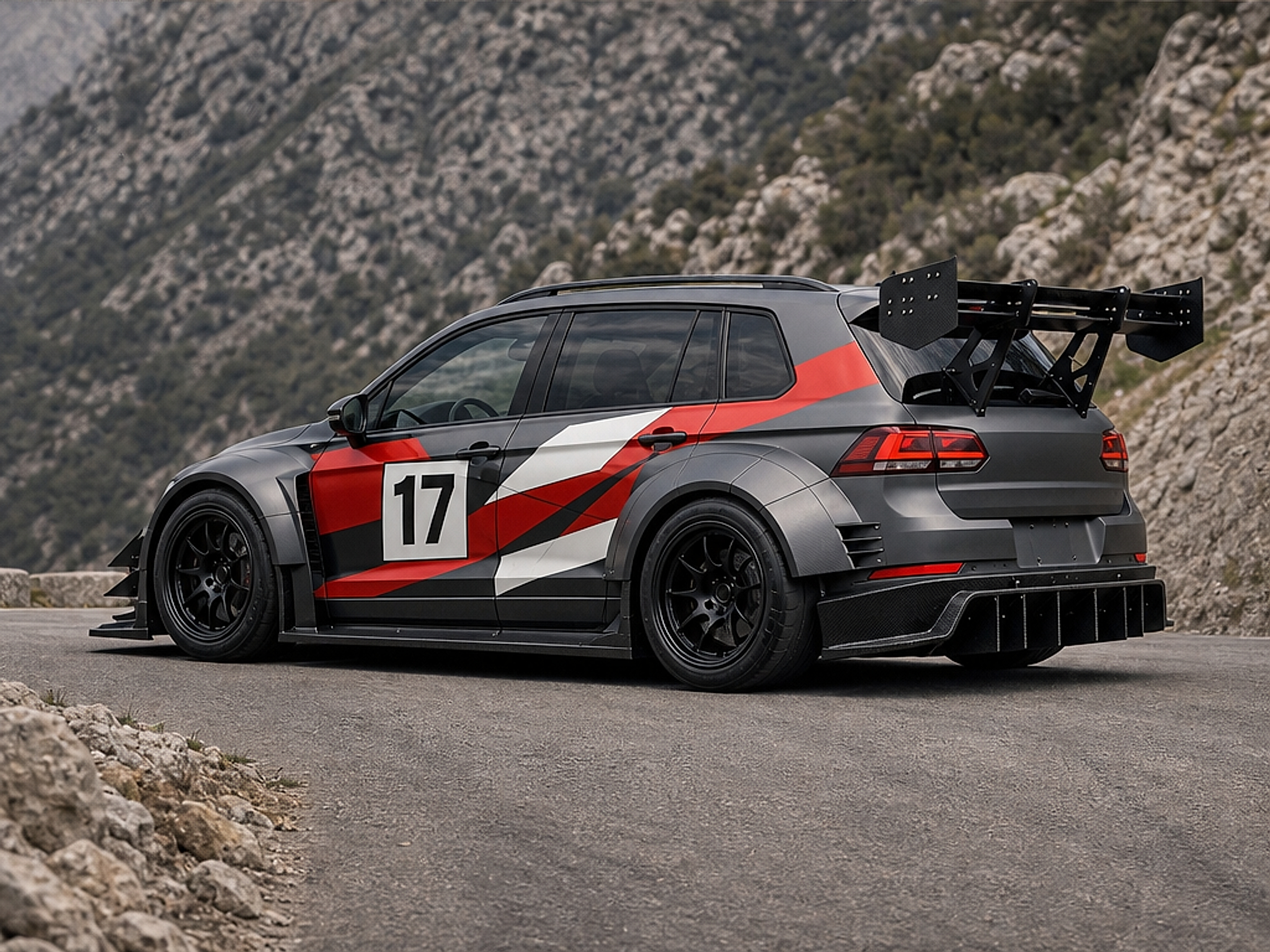
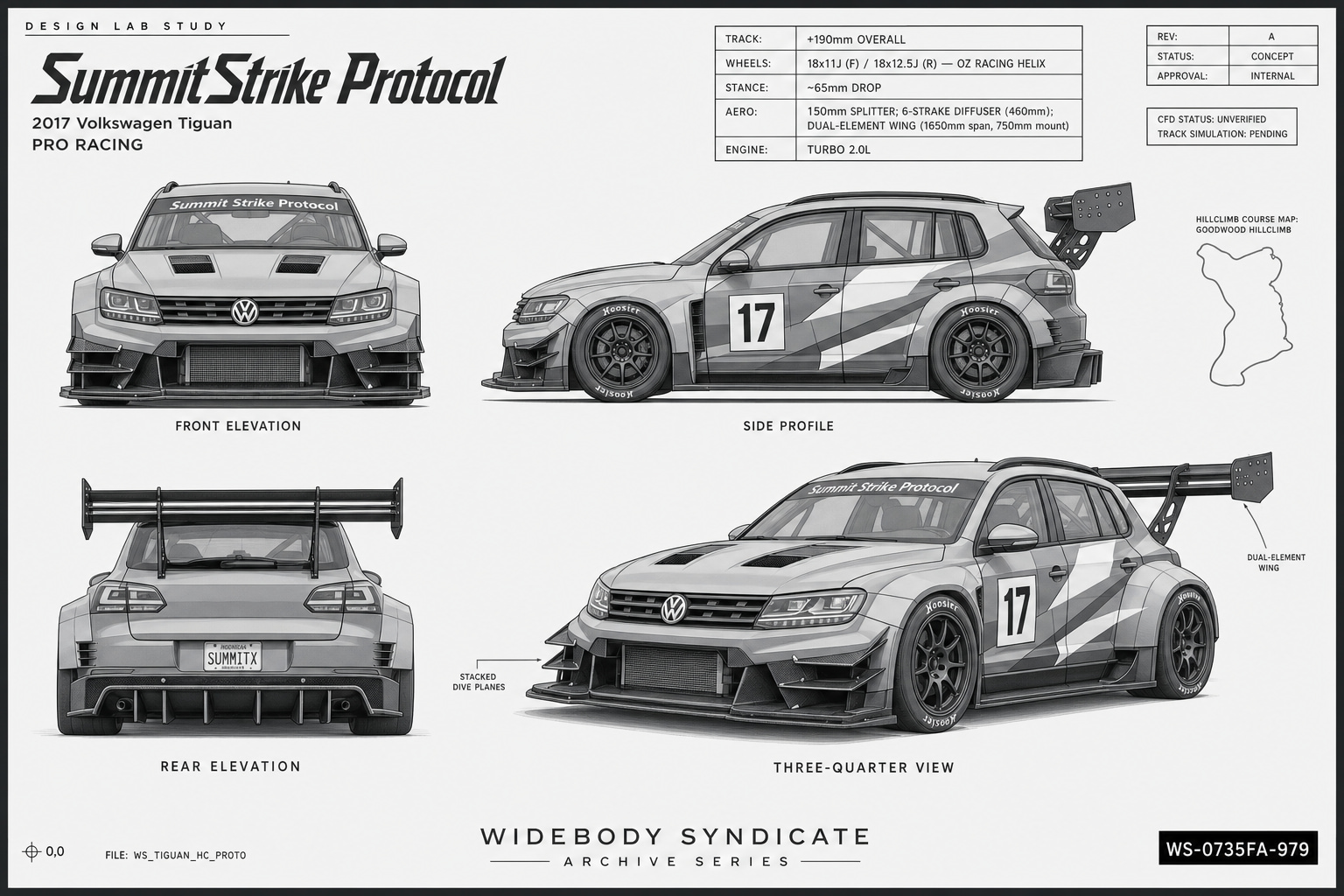
The aero isn’t cosplay. A 150mm splitter with stacked dive planes, a deep six-strake diffuser, and a tall dual-element wing are sized for low-speed load and stability through elevation changes where the chassis goes light. Satin graphite keeps it stealth, while the red/ivory geometry reads like a timing beacon against rock and guardrail—an OEM-era compact SUV turned into a purpose-built, numbers-on-the-doors problem.
Release Image Studies
Image studies from every angle.
Comparison Shots
Blueprint / Collector Archive
Engineering Artifacts
The technical study and collectible interpretation of one build, preserved together.
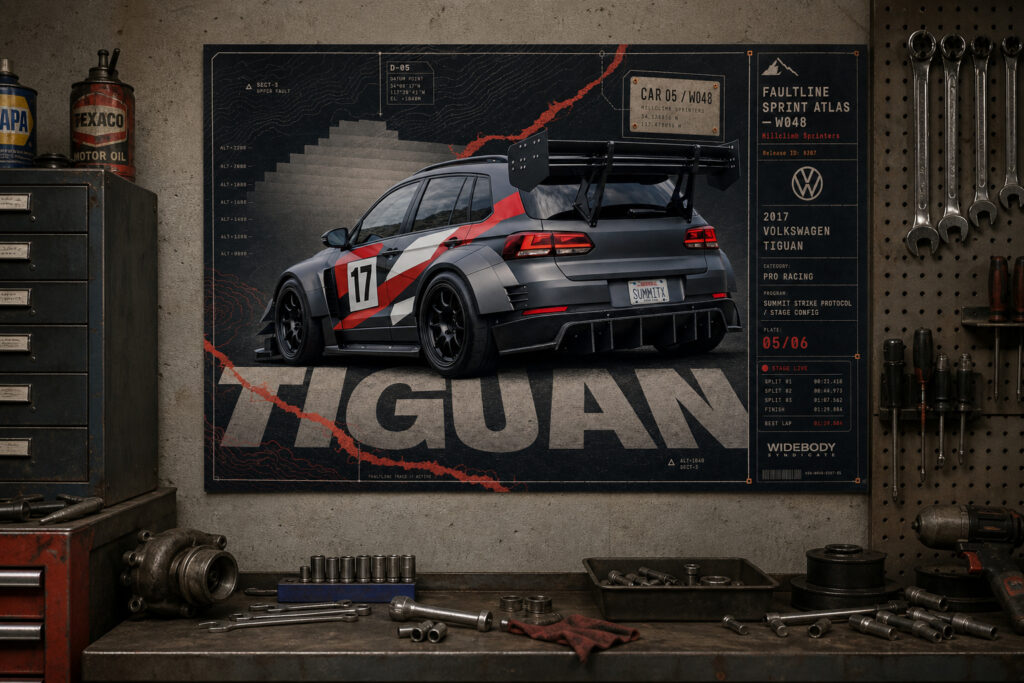
A presentation-grade collector artifact created for this release and preserved as part of the Widebody Syndicate archive.
Selected archive goods are available for collectors.
Technical Dossier
Platform
2017 Volkswagen Tiguan
Volkswagen’s first-gen Tiguan hits that sweet spot of peak 2010s OEM design: compact, upright, and quietly confident. In 2017 form it’s a familiar sight for good reason—tidy proportions, short overhangs, and a cabin-forward stance that reads more “European daily” than oversized crossover. It’s a platform built for real-world pace, with a solid road feel and the kind of packaging that made it a go-to for commuters, young families, and anyone needing one vehicle to do everything.
Under the clean, sensible skin is VW’s MQB-era thinking before everything got bigger and softer—practical, modular, and engineered to live a long life in traffic, weather, and road-trip miles. As a base vehicle, the 2017 Tiguan is honest and versatile: enough character to be interesting, enough restraint to disappear into the background when it needs to, and a shape that’s instantly readable in any setting.
Aero Package
150mm-projection carbon splitter with three 65mm dive planes for front load and yaw stability
Oversized central radiator inlet with ducting to FMIC and dedicated brake cooling inlets
Deep rear diffuser extending rearward with six vertical strakes at 90mm spacing
Dual-element rear wing on swan-neck pylons
1650mm span with tall slotted endplates and vortex generators
Chassis
Envisioned on a narrow mountain short course: steep grades, quick crests, and corners that arrive before the car settles. Loose gravel at the edges punishes sloppy placement, so the build leans on mechanical grip and aero stability to stay calm when the surface gets light and the elevation changes mid-corner.
Wheels & Tires
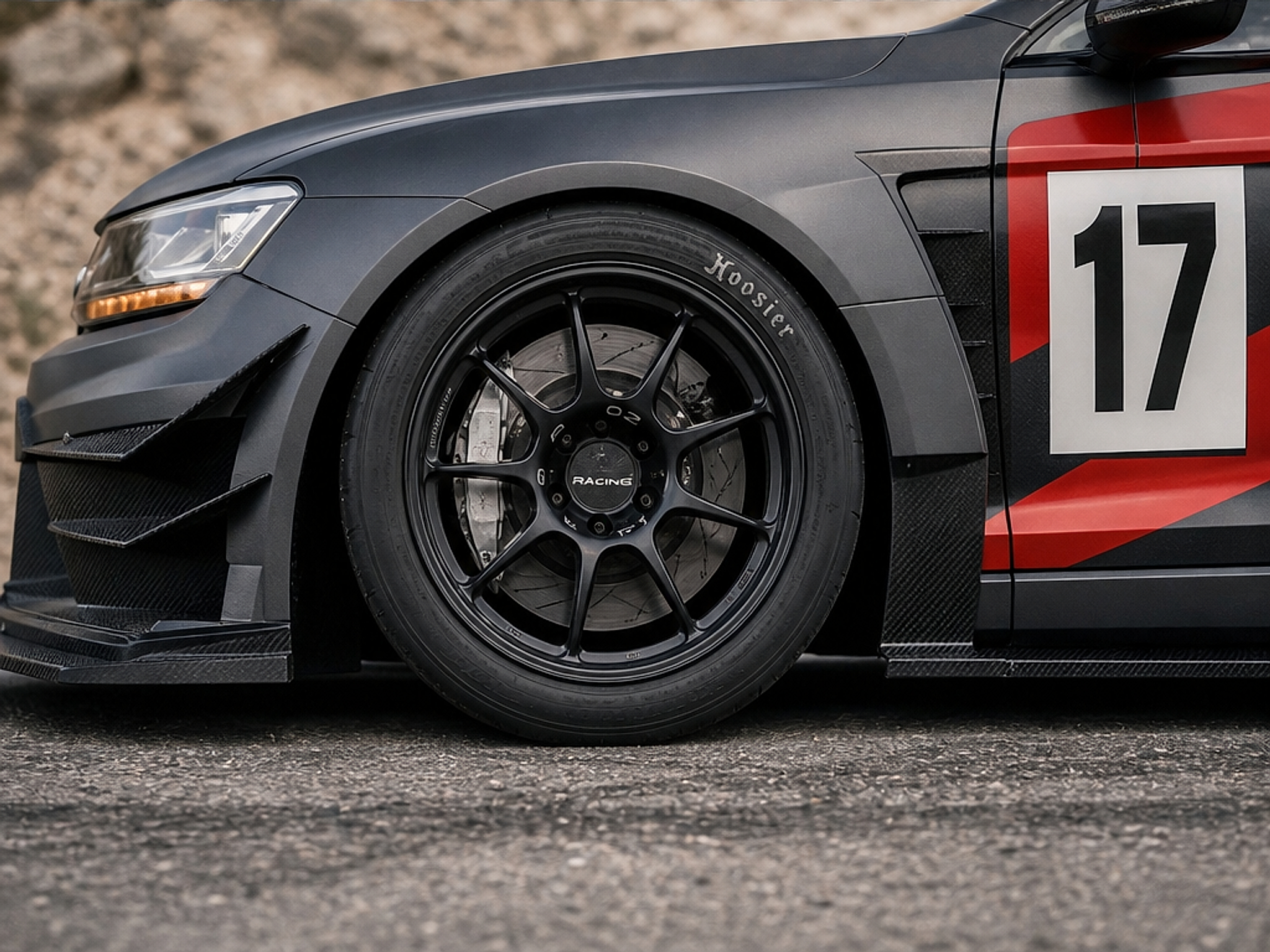
OZ Racing Helix forged wheels: 18x11J front
18x12.5J rear
matte black
Hoosier sprint compound: 315/40-18 front
335/40-18 rear for fast heat and bite
Track width increased +190mm overall to stabilize contact patch under load
Ride height lowered ~65mm with coilovers and reinforced control arms for geometry control
Powertrain
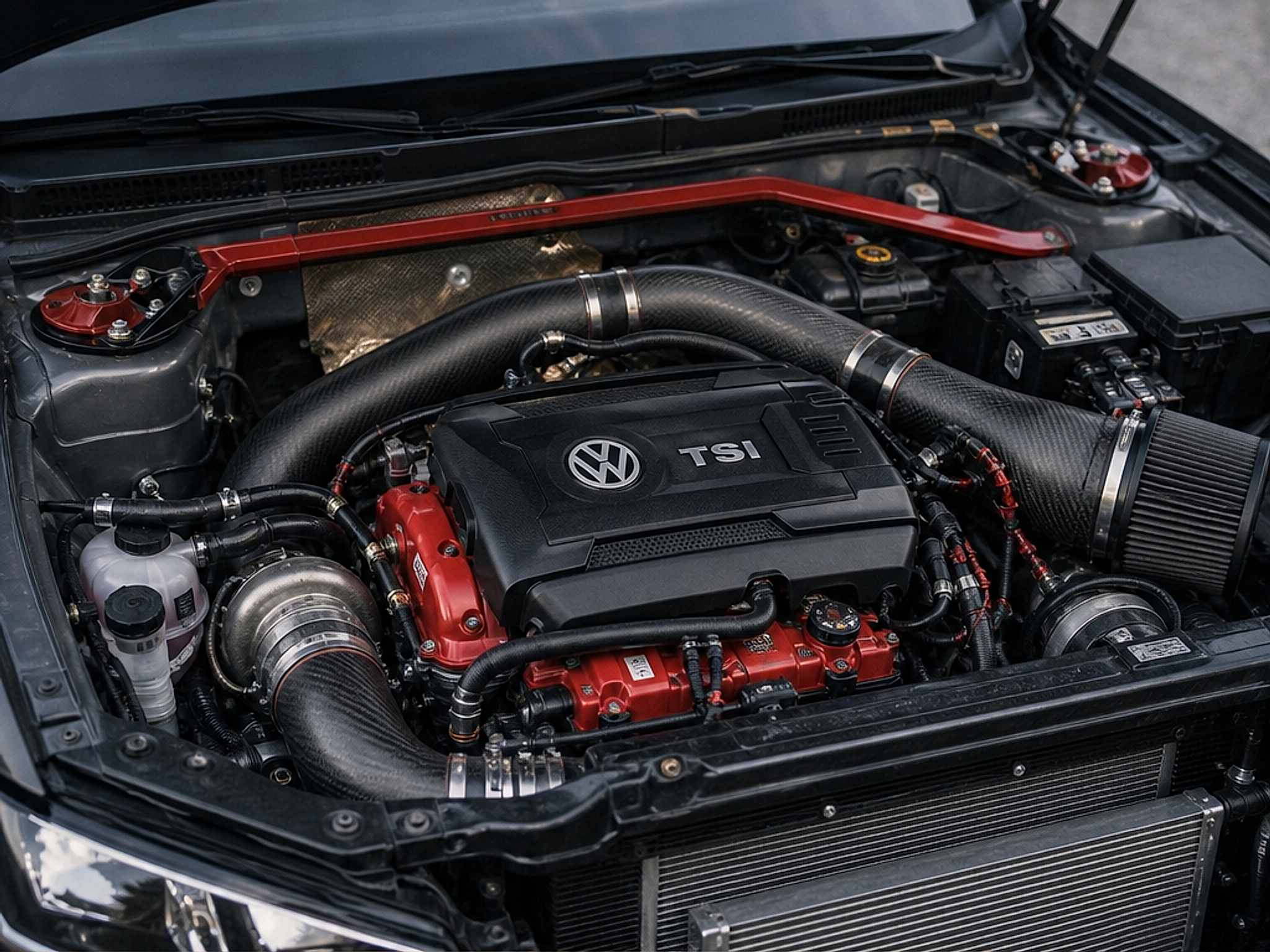
EA888 2.0T retained with sprint-focused boost and thermal strategy (intercooler efficiency over peak headline power)
Front-mid packaging concept to pull mass rearward and improve turn-in under braking
High-capacity charge-air and coolant system with direct ram-air feeds via hood NACA ducts
Sidepod-style intake and heat extraction behind the front wheels to manage underhood pressure
Fabrication Notes
Widebody built with squared arch templates for repeatable tire clearance at full lock/compression
Sealed ducting from bumper and hood to heat exchangers to prevent pressure leakage at speed
Reinforced skirt/shelf structure to survive curb strikes and gravel-edge abuse
Wing and diffuser mounts tied into chassis hard points to keep aero load from flexing bodywork
Design Philosophy
Summit Strike Protocol takes a 2017 Tiguan and deletes the “daily” from its vocabulary. The proportions get pulled inward and outward at the same time: stubby, wide, and planted, with squared-off 110mm front and 130mm rear flares built around real tire. It’s the kind of silhouette that makes sense only when you’ve watched a short hillclimb sprint—hard braking, instant rotation, and full throttle again before the turbo even has time to cool its thoughts.
The aero isn’t cosplay. A 150mm splitter with stacked dive planes, a deep six-strake diffuser, and a tall dual-element wing are sized for low-speed load and stability through elevation changes where the chassis goes light. Satin graphite keeps it stealth, while the red/ivory geometry reads like a timing beacon against rock and guardrail—an OEM-era compact SUV turned into a purpose-built, numbers-on-the-doors problem.
▧Platform+
2017 Volkswagen Tiguan
Volkswagen’s first-gen Tiguan hits that sweet spot of peak 2010s OEM design: compact, upright, and quietly confident. In 2017 form it’s a familiar sight for good reason—tidy proportions, short overhangs, and a cabin-forward stance that reads more “European daily” than oversized crossover. It’s a platform built for real-world pace, with a solid road feel and the kind of packaging that made it a go-to for commuters, young families, and anyone needing one vehicle to do everything.
Under the clean, sensible skin is VW’s MQB-era thinking before everything got bigger and softer—practical, modular, and engineered to live a long life in traffic, weather, and road-trip miles. As a base vehicle, the 2017 Tiguan is honest and versatile: enough character to be interesting, enough restraint to disappear into the background when it needs to, and a shape that’s instantly readable in any setting.
⌘Aero Package+
150mm-projection carbon splitter with three 65mm dive planes for front load and yaw stability
Oversized central radiator inlet with ducting to FMIC and dedicated brake cooling inlets
Deep rear diffuser extending rearward with six vertical strakes at 90mm spacing
Dual-element rear wing on swan-neck pylons
1650mm span with tall slotted endplates and vortex generators
⟡Chassis+
Envisioned on a narrow mountain short course: steep grades, quick crests, and corners that arrive before the car settles. Loose gravel at the edges punishes sloppy placement, so the build leans on mechanical grip and aero stability to stay calm when the surface gets light and the elevation changes mid-corner.
◎Wheels & Tires+
OZ Racing Helix forged wheels: 18x11J front
18x12.5J rear
matte black
Hoosier sprint compound: 315/40-18 front
335/40-18 rear for fast heat and bite
Track width increased +190mm overall to stabilize contact patch under load
Ride height lowered ~65mm with coilovers and reinforced control arms for geometry control
▤Powertrain+
EA888 2.0T retained with sprint-focused boost and thermal strategy (intercooler efficiency over peak headline power)
Front-mid packaging concept to pull mass rearward and improve turn-in under braking
High-capacity charge-air and coolant system with direct ram-air feeds via hood NACA ducts
Sidepod-style intake and heat extraction behind the front wheels to manage underhood pressure
△Fabrication Notes+
Widebody built with squared arch templates for repeatable tire clearance at full lock/compression
Sealed ducting from bumper and hood to heat exchangers to prevent pressure leakage at speed
Reinforced skirt/shelf structure to survive curb strikes and gravel-edge abuse
Wing and diffuser mounts tied into chassis hard points to keep aero load from flexing bodywork
×Design Philosophy+
Summit Strike Protocol takes a 2017 Tiguan and deletes the “daily” from its vocabulary. The proportions get pulled inward and outward at the same time: stubby, wide, and planted, with squared-off 110mm front and 130mm rear flares built around real tire. It’s the kind of silhouette that makes sense only when you’ve watched a short hillclimb sprint—hard braking, instant rotation, and full throttle again before the turbo even has time to cool its thoughts.
The aero isn’t cosplay. A 150mm splitter with stacked dive planes, a deep six-strake diffuser, and a tall dual-element wing are sized for low-speed load and stability through elevation changes where the chassis goes light. Satin graphite keeps it stealth, while the red/ivory geometry reads like a timing beacon against rock and guardrail—an OEM-era compact SUV turned into a purpose-built, numbers-on-the-doors problem.
Part of
Wave 48
Hillclimb Sprinters
This release is our answer to the hillclimb question nobody asked politely: what happens when you build for 60 to 90 seconds of terror instead of 20 minutes of elegance? Across coupes, a sedan, a pickup, and an SUV, the logic is the same: short-course sprint engineering where rotation matters more than top speed, and cooling is treated like ammunition.
Explore Wave 48 → 6 BuildsKeep Exploring
The archive is always growing. New releases, waves, and blueprints added regularly.