








WS Widebody Syndicate
Neon Halo Initiative

R245

Neon Halo Initiative

2011 Toyota Prius

Series NPC Cars
Category Concept
Wave Wave 41

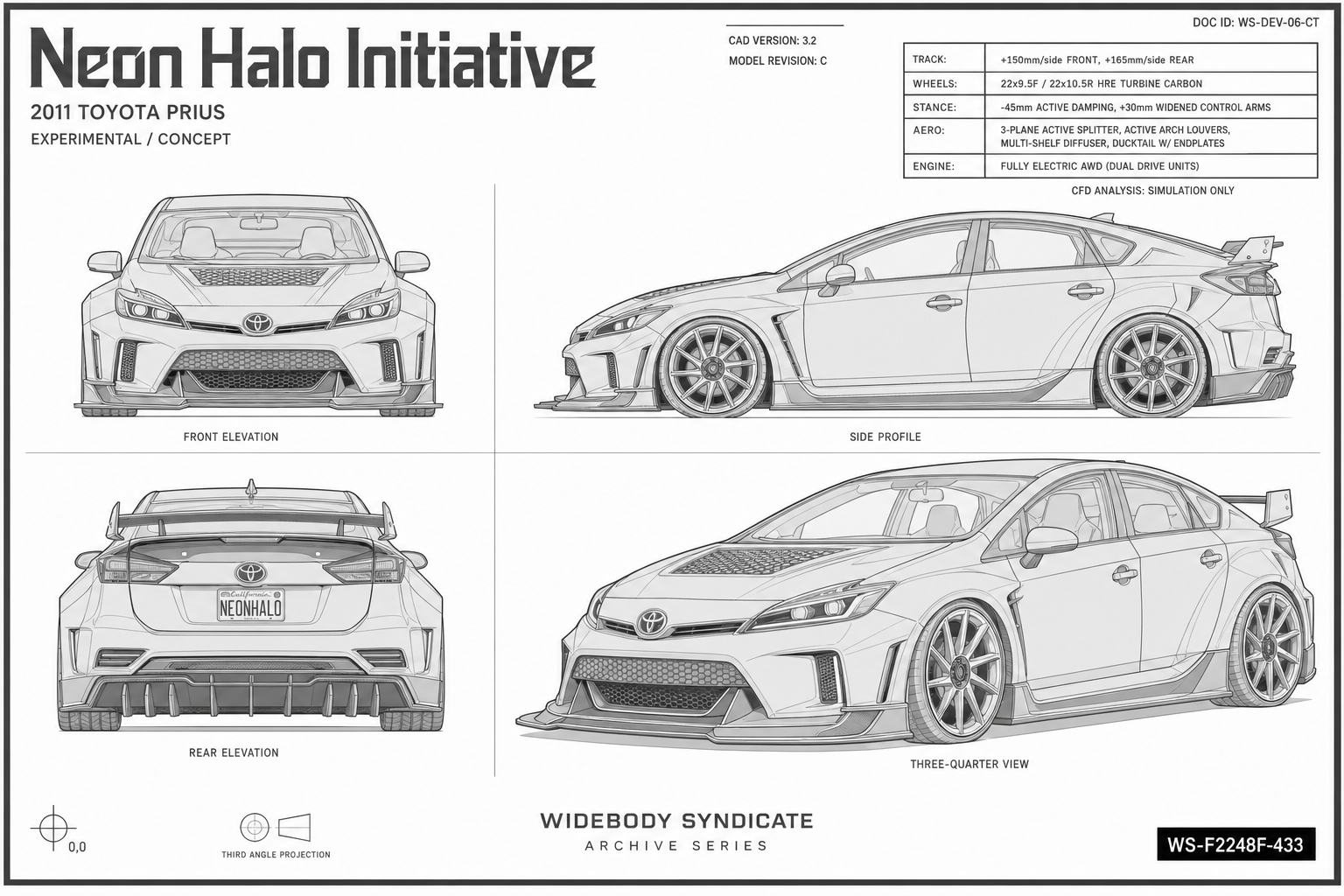
Neon Halo Initiative treats the 2011 Prius like the silhouette Toyota never stopped refining: keep the roofline, doors, and greenhouse, then redraw every panel as a single continuous aero surface. The result is a 2045-style halo hatch with a 300mm wider front track and 330mm wider rear, where the arches aren’t “add-ons” so much as pressure-managed bodywork—thickened lips, clean detach points, and active louvers placed where the wake actually forms.

Up front, the extended nose and three-plane active splitter read like wind-tunnel homework, not cosplay. The illuminated tessellated hood vent and the hatch-mounted heat extractor aren’t just visuals—they’re the plumbing for a high-output EV thermal system, using adaptive shutters to trade cooling for range. It’s still instantly Prius in profile, but now it looks like the flagship that taught the rest of the lineup how to cheat the air.
Share Release X FB

Image studies from every angle.

6 curated frames · swipe / tap to inspect

Comparison Shots

Engineering Artifacts

The technical study and collectible interpretation of one build, preserved together.

01
Technical DrawingBlueprint archive
Neon Halo Initiative blueprint

Platform

2011 Toyota Prius

2011 Toyota Prius

The 2011 Toyota Prius platform revolutionized hybrid technology with its innovative synergy drive system and aerodynamic design, setting new standards for efficiency without sacrificing practicality. With a compact hatchback silhouette and a meticulously engineered chassis, this model balances lightweight construction and rigid body structure, offering a refined yet unpretentious foundation that has influenced eco-conscious mobility worldwide.

ToyotaPrius2011
View Platform

Aero Package

165mm-forward front fascia with three-plane active splitter and adjustable outer dive planes
Active front-arch louvers (150x50mm) positioned behind the wheel centerline for demand-based extraction
Recessed vertical NACA corner ducts feeding composite brake duct plenums
Multi-level rear diffuser (three shelves) with tall strakes for stable underbody extraction
Integrated ducktail spoiler with endplates and vortex generators to reduce tip vortices

Chassis

The stance comes from real geometry: +300mm total up front and +330mm total in the rear, paired with a 45mm drop that still leaves room for underbody airflow management. The rear flare’s concave channel intentionally feeds the diffuser zone, and the tall strakes keep extraction stable at speed. It’s designed to look planted in a showroom photo and behave planted on a fast road.

Wheels & Tires

HRE turbine-style carbon wheels: 22x9.5 front
22x10.5 rear in satin liquid titanium
Michelin Pilot Sport EVZ: 275/30ZR22 front
295/30ZR22 rear
Active wheel-center cooling vents indexed to brake airflow paths
Track-width matched offsets to sit flush with the widened arches without excessive spacer reliance

Powertrain

Dual-motor AWD layout with front-mid and rear-mid drive units targeting 50/50 mass distribution
Floor-mounted battery pack with dedicated sidepod cooling channels integrated into the widened sills
Centralized power electronics with direct extraction through the hood vent cluster
Rear heat rejection through hatch venting to reduce underbody thermal soak near the diffuser

Fabrication Notes

Widebody executed as full panel replacements with continuous radii—no bolt-on flare breaks at the door cuts
Active louver modules packaged into thickened arch lips with service access from the inner liners
Splitter and diffuser built as modular carbon assemblies with hard mounting points tied into crash structure
Thermal ducting designed as sealed plenums (not open “styling holes”) to maintain pressure and reduce drag
×

Design Philosophy

Neon Halo Initiative treats the 2011 Prius like the silhouette Toyota never stopped refining: keep the roofline, doors, and greenhouse, then redraw every panel as a single continuous aero surface. The result is a 2045-style halo hatch with a 300mm wider front track and 330mm wider rear, where the arches aren’t “add-ons” so much as pressure-managed bodywork—thickened lips, clean detach points, and active louvers placed where the wake actually forms.

Up front, the extended nose and three-plane active splitter read like wind-tunnel homework, not cosplay. The illuminated tessellated hood vent and the hatch-mounted heat extractor aren’t just visuals—they’re the plumbing for a high-output EV thermal system, using adaptive shutters to trade cooling for range. It’s still instantly Prius in profile, but now it looks like the flagship that taught the rest of the lineup how to cheat the air.

Platform+
2011 Toyota Prius

2011 Toyota Prius

The 2011 Toyota Prius platform revolutionized hybrid technology with its innovative synergy drive system and aerodynamic design, setting new standards for efficiency without sacrificing practicality. With a compact hatchback silhouette and a meticulously engineered chassis, this model balances lightweight construction and rigid body structure, offering a refined yet unpretentious foundation that has influenced eco-conscious mobility worldwide.

ToyotaPrius2011
View Platform
Aero Package+

165mm-forward front fascia with three-plane active splitter and adjustable outer dive planes
Active front-arch louvers (150x50mm) positioned behind the wheel centerline for demand-based extraction
Recessed vertical NACA corner ducts feeding composite brake duct plenums
Multi-level rear diffuser (three shelves) with tall strakes for stable underbody extraction
Integrated ducktail spoiler with endplates and vortex generators to reduce tip vortices

Chassis+

The stance comes from real geometry: +300mm total up front and +330mm total in the rear, paired with a 45mm drop that still leaves room for underbody airflow management. The rear flare’s concave channel intentionally feeds the diffuser zone, and the tall strakes keep extraction stable at speed. It’s designed to look planted in a showroom photo and behave planted on a fast road.

Wheels & Tires+

HRE turbine-style carbon wheels: 22x9.5 front
22x10.5 rear in satin liquid titanium
Michelin Pilot Sport EVZ: 275/30ZR22 front
295/30ZR22 rear
Active wheel-center cooling vents indexed to brake airflow paths
Track-width matched offsets to sit flush with the widened arches without excessive spacer reliance

Powertrain+

Dual-motor AWD layout with front-mid and rear-mid drive units targeting 50/50 mass distribution
Floor-mounted battery pack with dedicated sidepod cooling channels integrated into the widened sills
Centralized power electronics with direct extraction through the hood vent cluster
Rear heat rejection through hatch venting to reduce underbody thermal soak near the diffuser

Fabrication Notes+

Widebody executed as full panel replacements with continuous radii—no bolt-on flare breaks at the door cuts
Active louver modules packaged into thickened arch lips with service access from the inner liners
Splitter and diffuser built as modular carbon assemblies with hard mounting points tied into crash structure
Thermal ducting designed as sealed plenums (not open “styling holes”) to maintain pressure and reduce drag

×Design Philosophy+

Neon Halo Initiative treats the 2011 Prius like the silhouette Toyota never stopped refining: keep the roofline, doors, and greenhouse, then redraw every panel as a single continuous aero surface. The result is a 2045-style halo hatch with a 300mm wider front track and 330mm wider rear, where the arches aren’t “add-ons” so much as pressure-managed bodywork—thickened lips, clean detach points, and active louvers placed where the wake actually forms.

Up front, the extended nose and three-plane active splitter read like wind-tunnel homework, not cosplay. The illuminated tessellated hood vent and the hatch-mounted heat extractor aren’t just visuals—they’re the plumbing for a high-output EV thermal system, using adaptive shutters to trade cooling for range. It’s still instantly Prius in profile, but now it looks like the flagship that taught the rest of the lineup how to cheat the air.

Part of
Wave 41

2045 Redevelopment Platforms

We just finished bolting tomorrow onto yesterday, and yeah, it’s as ridiculous as it sounds. This drop is our 2045 halo-car fever dream where the usual heroes get company from the vehicles everyone ignores in the parking lot.

Explore Wave 41 → 6 Builds

Keep Exploring

The archive is always growing. New releases, waves, and blueprints added regularly.