R254
Iron Vanguard Mk1
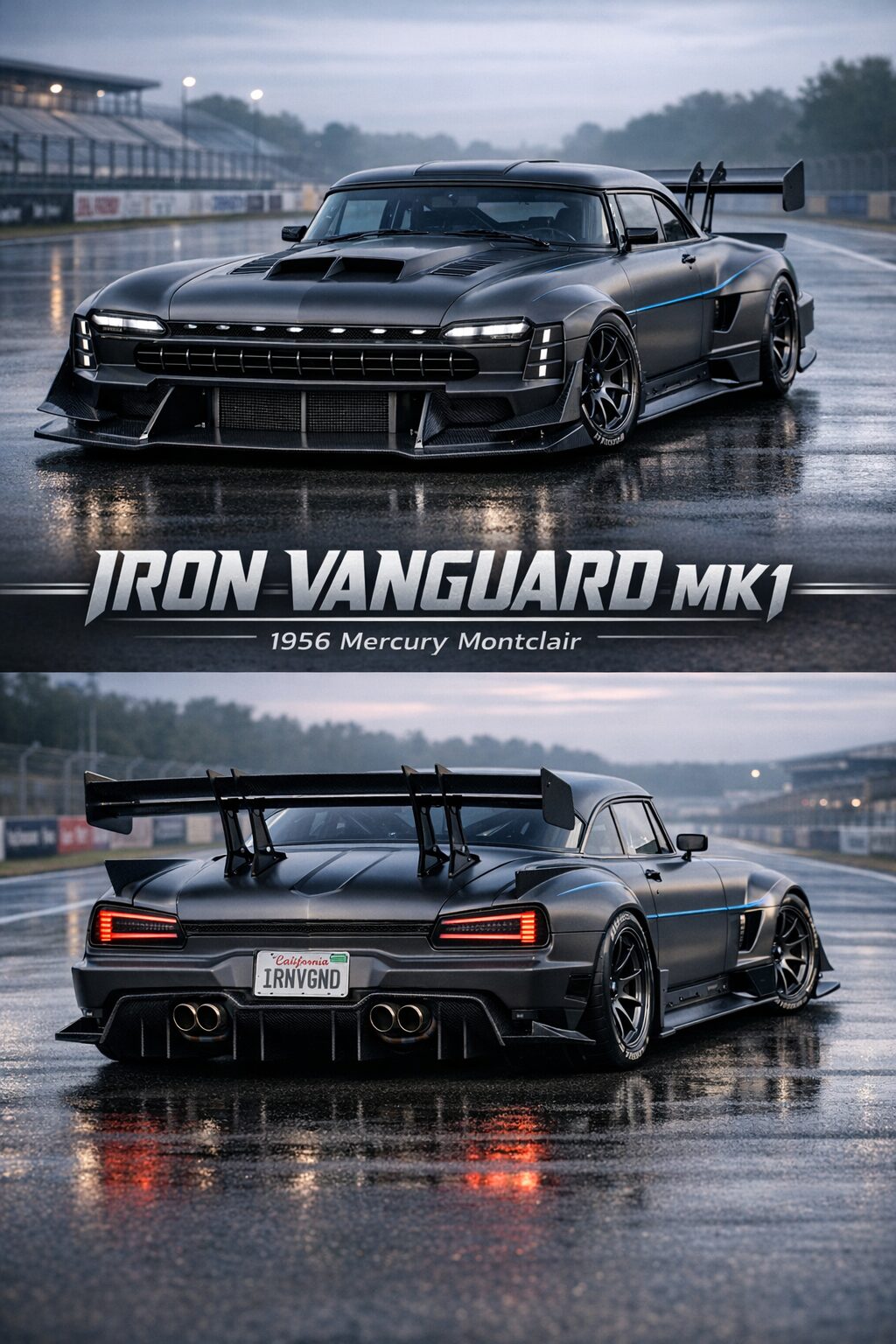
Iron Vanguard Mk1 treats the ’56 Montclair like a silhouette car that escaped the wind tunnel and went straight to scrutineering. The roofline and tailfins still read Mercury from 50 meters, but everything below the beltline is re-authored for lap time: a 210mm wider front track, 230mm wider rear, layered trapezoidal flares, and a splitter/dive-plane package that looks brutal because it has a job.
This is a 2045 GT5 works-style prototype built around thermal control and aero balance, not nostalgia. The hood’s recessed intake and louvered heat exits keep under-hood pressure honest, the side shelves seal the floor, and the extended deck feeds a tall swan-neck wing and a nine-strake diffuser—classic American grand coupe proportions, now speaking fluent endurance racing.
Release Image Studies
Image studies from every angle.
Comparison Shots
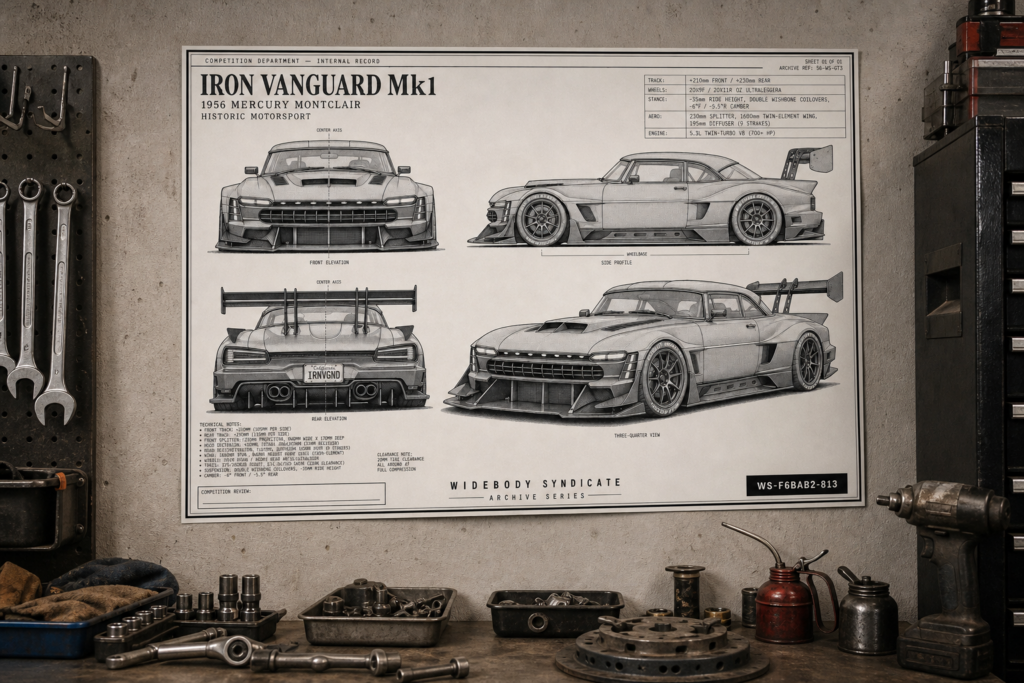
Blueprint / Collector Archive
Engineering Artifacts
The technical study and collectible interpretation of one build, preserved together.
Selected archive goods are available for collectors.
Technical Dossier
Platform
1956 Mercury Montclair
The 1956 Mercury Montclair stands as an iconic symbol of mid-50s American automotive design, embodying the era’s bold blend of style and innovation. With its broad, expressive grille, sweeping roofline, and roomy proportions, the Montclair delivers a commanding presence that balances classic luxury with approachable performance. Its sturdy ladder frame chassis and smooth V8 powertrain underline a platform built for confident cruising, making it a perfect canvas for enthusiasts who appreciate authentic vintage muscle paired with timeless design.
Aero Package
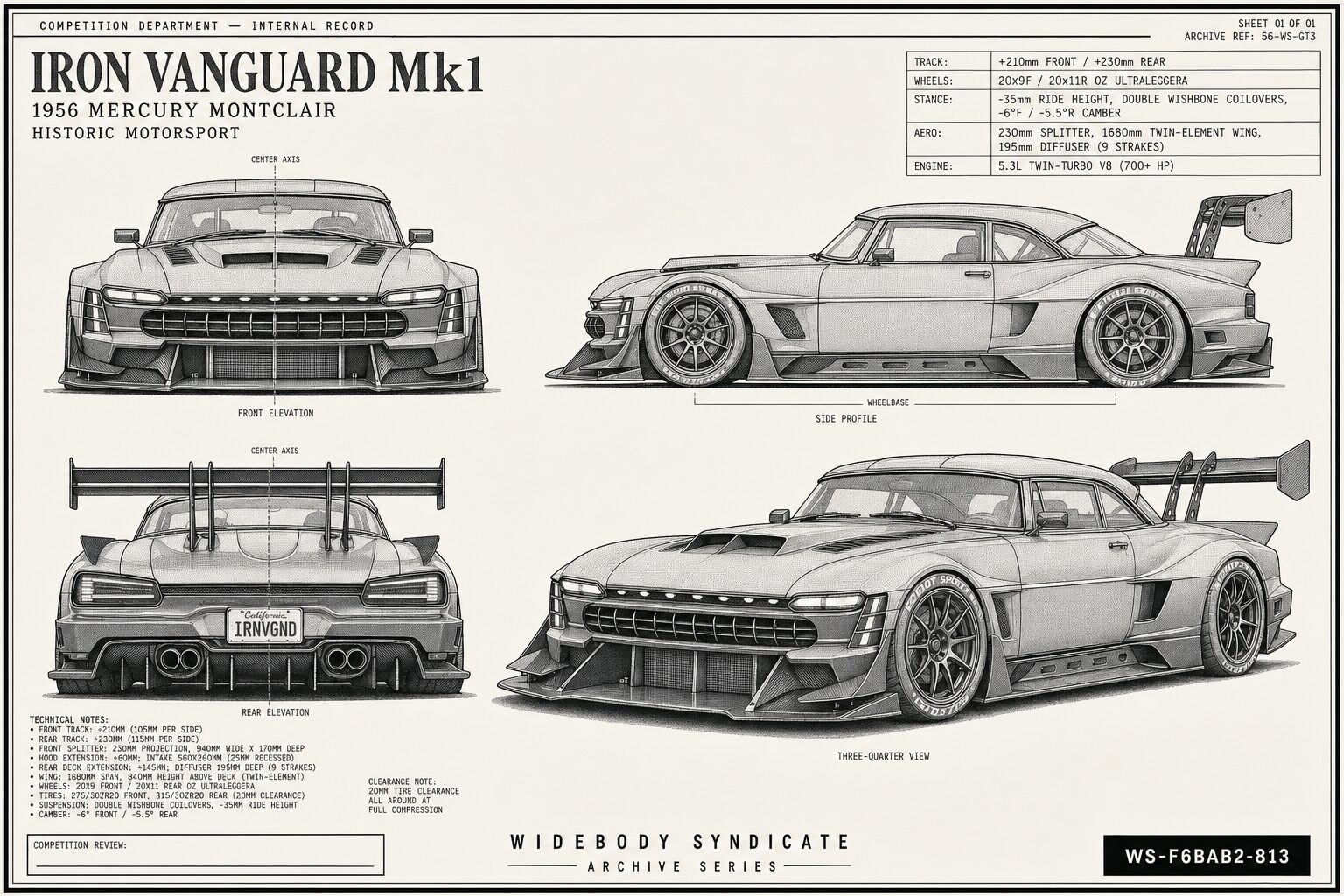
230mm forward multi-element splitter (940mm wide / 170mm deep) with adjustable edge dive planes
75mm deep continuous side skirts with convex under-bulge and recessed teardrop reliefs for flow conditioning
195mm deep rear diffuser with nine strakes and mild inward camber for wake control
1680mm two-element wing on swan-neck pylons with adjustable AoA and tall endplates with vortex steps
Chassis
Shown at dawn on Circuit de la Sarthe’s test surface, the Iron Vanguard reads like a works car between validation runs—soft light catching the layered splitter planes, the fender extraction, and the tall wing structure. It’s the kind of setting where cooling margins, brake temps, and aero balance matter more than headlines.
Wheels & Tires
OZ Racing Ultraleggera forged 20x9 in Satin Gunmetal with machined faces and anodized black lips
Michelin Pilot Sport Cup 2: 275/30ZR20 front, 315/30ZR20 rear
Track-focused alignment: ~-6.0° front camber, ~-5.5° rear camber
Ride height lowered ~35mm with double-wishbone coilovers and adjustable anti-roll bars
Powertrain
Bespoke 5.3L twin-turbo V8 with direct injection targeting 700+ hp and endurance-safe torque delivery
Dual vertical front radiator inlets feeding high-capacity crossflow radiators with controlled extraction
Dedicated brake cooling paths via fender/NACA duct strategy and managed exit slots
Motorsport-grade engine management calibrated for repeatable heat cycles and long-stint consistency
Fabrication Notes
Widebody executed as layered composite over widened track—flares shaped to create a functional aero shelf rather than cosmetic overhang
Splitter, skirts, diffuser, and wing built as modular carbon assemblies for quick service and angle/ride-height iteration
Hood intake and venting designed as a pressure-management system: feed heat exchangers, then extract to low-pressure zones
Rear deck extension and diffuser mounting reinforced to handle wing load paths and diffuser sealing without panel flex
Design Philosophy
Iron Vanguard Mk1 treats the ’56 Montclair like a silhouette car that escaped the wind tunnel and went straight to scrutineering. The roofline and tailfins still read Mercury from 50 meters, but everything below the beltline is re-authored for lap time: a 210mm wider front track, 230mm wider rear, layered trapezoidal flares, and a splitter/dive-plane package that looks brutal because it has a job.
This is a 2045 GT5 works-style prototype built around thermal control and aero balance, not nostalgia. The hood’s recessed intake and louvered heat exits keep under-hood pressure honest, the side shelves seal the floor, and the extended deck feeds a tall swan-neck wing and a nine-strake diffuser—classic American grand coupe proportions, now speaking fluent endurance racing.
▧Platform+
1956 Mercury Montclair
The 1956 Mercury Montclair stands as an iconic symbol of mid-50s American automotive design, embodying the era’s bold blend of style and innovation. With its broad, expressive grille, sweeping roofline, and roomy proportions, the Montclair delivers a commanding presence that balances classic luxury with approachable performance. Its sturdy ladder frame chassis and smooth V8 powertrain underline a platform built for confident cruising, making it a perfect canvas for enthusiasts who appreciate authentic vintage muscle paired with timeless design.
⌘Aero Package+
230mm forward multi-element splitter (940mm wide / 170mm deep) with adjustable edge dive planes
75mm deep continuous side skirts with convex under-bulge and recessed teardrop reliefs for flow conditioning
195mm deep rear diffuser with nine strakes and mild inward camber for wake control
1680mm two-element wing on swan-neck pylons with adjustable AoA and tall endplates with vortex steps
⟡Chassis+
Shown at dawn on Circuit de la Sarthe’s test surface, the Iron Vanguard reads like a works car between validation runs—soft light catching the layered splitter planes, the fender extraction, and the tall wing structure. It’s the kind of setting where cooling margins, brake temps, and aero balance matter more than headlines.
◎Wheels & Tires+
OZ Racing Ultraleggera forged 20x9 in Satin Gunmetal with machined faces and anodized black lips
Michelin Pilot Sport Cup 2: 275/30ZR20 front, 315/30ZR20 rear
Track-focused alignment: ~-6.0° front camber, ~-5.5° rear camber
Ride height lowered ~35mm with double-wishbone coilovers and adjustable anti-roll bars
▤Powertrain+
Bespoke 5.3L twin-turbo V8 with direct injection targeting 700+ hp and endurance-safe torque delivery
Dual vertical front radiator inlets feeding high-capacity crossflow radiators with controlled extraction
Dedicated brake cooling paths via fender/NACA duct strategy and managed exit slots
Motorsport-grade engine management calibrated for repeatable heat cycles and long-stint consistency
△Fabrication Notes+
Widebody executed as layered composite over widened track—flares shaped to create a functional aero shelf rather than cosmetic overhang
Splitter, skirts, diffuser, and wing built as modular carbon assemblies for quick service and angle/ride-height iteration
Hood intake and venting designed as a pressure-management system: feed heat exchangers, then extract to low-pressure zones
Rear deck extension and diffuser mounting reinforced to handle wing load paths and diffuser sealing without panel flex
×Design Philosophy+
Iron Vanguard Mk1 treats the ’56 Montclair like a silhouette car that escaped the wind tunnel and went straight to scrutineering. The roofline and tailfins still read Mercury from 50 meters, but everything below the beltline is re-authored for lap time: a 210mm wider front track, 230mm wider rear, layered trapezoidal flares, and a splitter/dive-plane package that looks brutal because it has a job.
This is a 2045 GT5 works-style prototype built around thermal control and aero balance, not nostalgia. The hood’s recessed intake and louvered heat exits keep under-hood pressure honest, the side shelves seal the floor, and the extended deck feeds a tall swan-neck wing and a nine-strake diffuser—classic American grand coupe proportions, now speaking fluent endurance racing.
Part of
Wave 43
GT5 2045: Vol. 1
In 2045, GT5 is what happens when the world’s biggest racing league stops caring about pedigree and starts caring about lap time. This volume is our opening grid: sacred icons, oddball commuters, and an American land-yacht all dragged through the same rulebook and the same wind tunnel.
Explore Wave 43 → 6 BuildsKeep Exploring
The archive is always growing. New releases, waves, and blueprints added regularly.