R262
Longtail Element C-Study
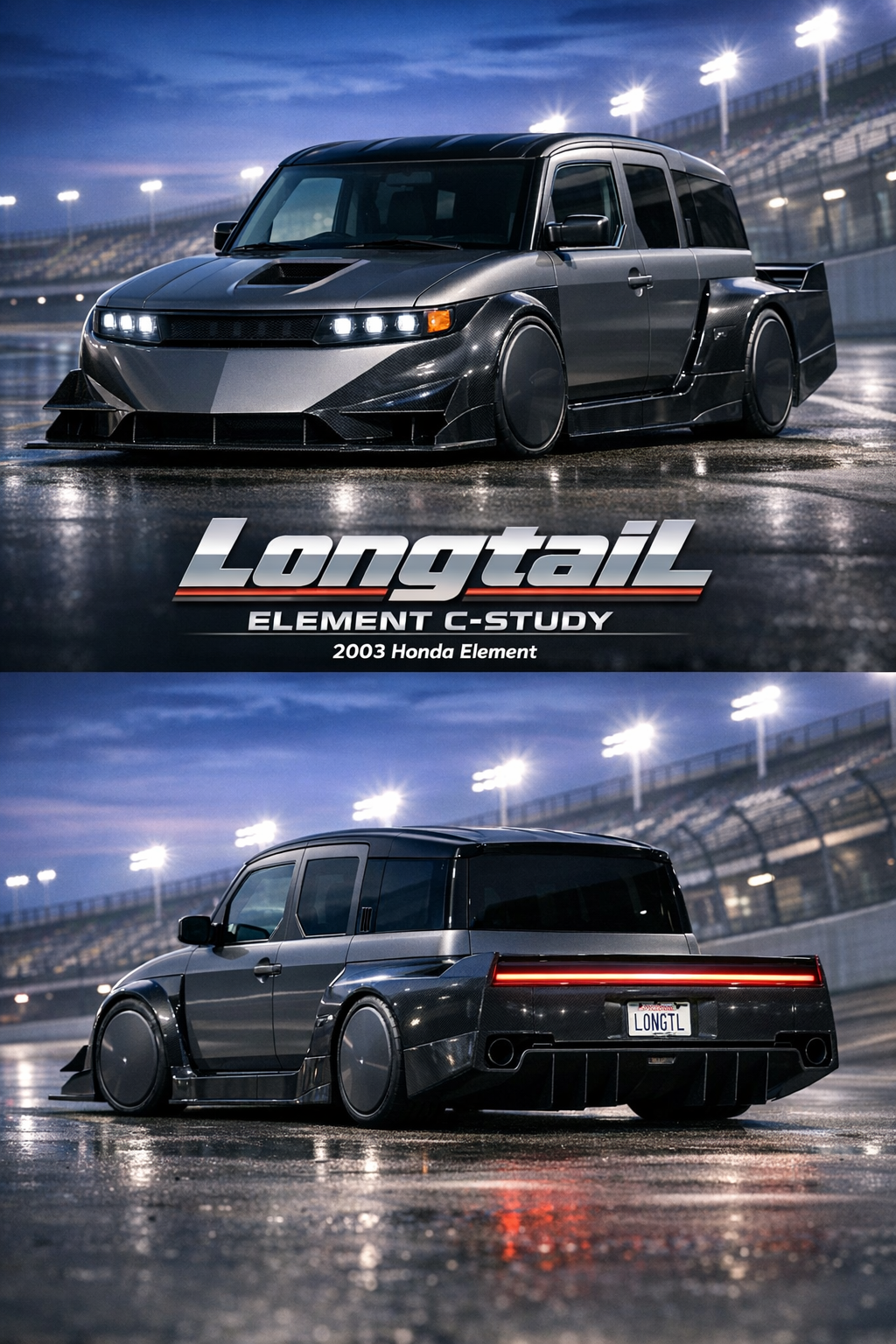
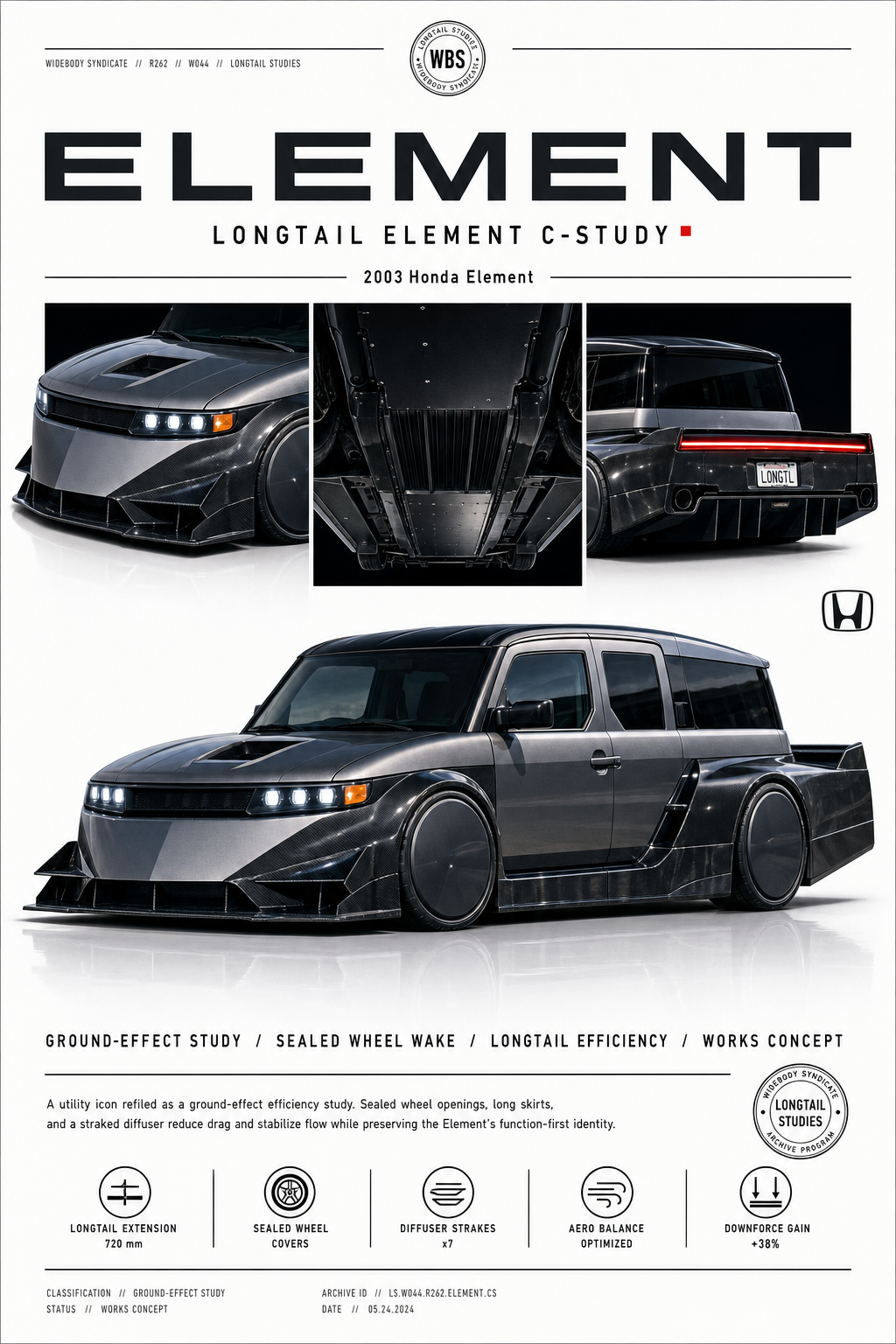
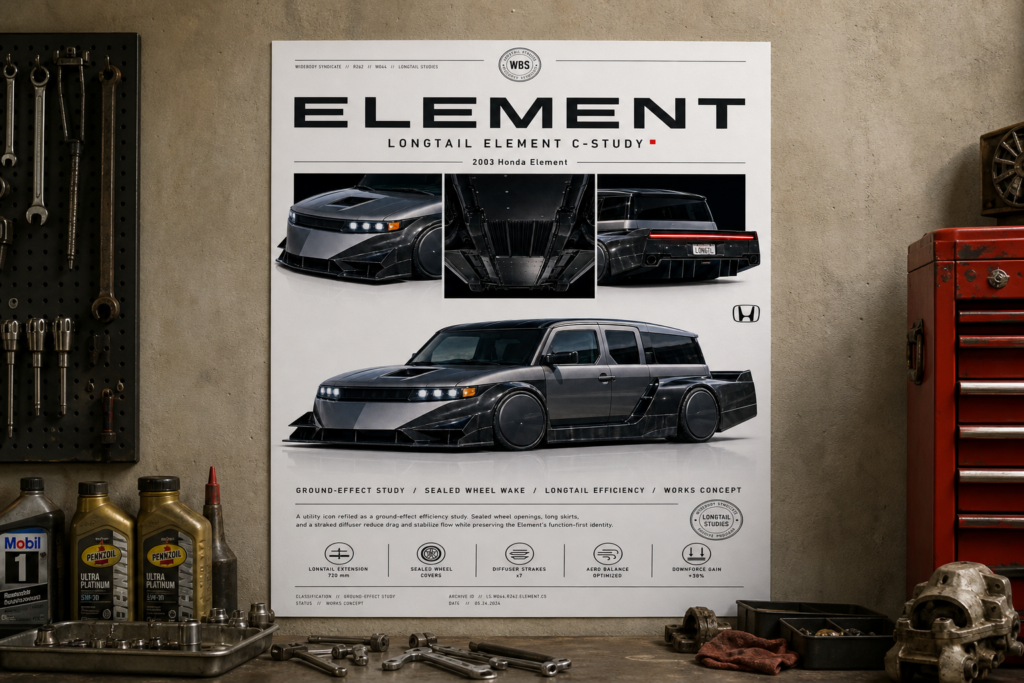
The 2003 Honda Element was never meant to care about drag coefficient or yaw stability, which is exactly why this C-Study works. The Longtail Element takes the upright, slab-sided Honda silhouette and stretches it into a Group C reading: a pointed wedge nose, faired wheels, and a rear deck that keeps the airflow attached long after the stock hatch would have dumped it into turbulence. It still reads “Element” in the greenhouse and proportions—just rewritten with endurance-racer priorities.
Under the skin, the concept leans on believable aero fundamentals: sealed wheel openings to calm the wake, a flat splitter to set the front pressure field, long skirts to protect the underbody, and a deep, straked diffuser to do the real work. No hero wing, no gimmicks—just longtail efficiency and ground-effect discipline, packaged like a factory works sketch that somehow escaped into the pit lane.
Release Image Studies
Image studies from every angle.
Comparison Shots
Blueprint / Collector Archive
Engineering Artifacts
The technical study and collectible interpretation of one build, preserved together.
A presentation-grade collector artifact created for this release and preserved as part of the Widebody Syndicate archive.
Selected archive goods are available for collectors.
Technical Dossier
Platform
2003 Honda Element
Honda’s 2003 Element is the kind of early-2000s experiment that aged into a cult classic. Built on CR‑V roots and tuned for real-world utility, it mixes a tall, upright greenhouse with a short, functional nose and a near-vertical tail—more urban tool than traditional SUV. The clamshell side access, rubberized flooring, and stadium-like seating height weren’t gimmicks so much as Honda applying product-design logic to a car people actually live out of.
From a chassis standpoint it’s honest and straightforward: a compact footprint with a long roofline, MacPherson strut front and multi-link rear, and a drivetrain lineup centered around the K-series four-cylinder. It’s not precious, and that’s the point—the Element is a platform that takes miles, gear, and daily abuse without drama, which is exactly why it keeps showing up in enthusiast hands years later.
Aero Package
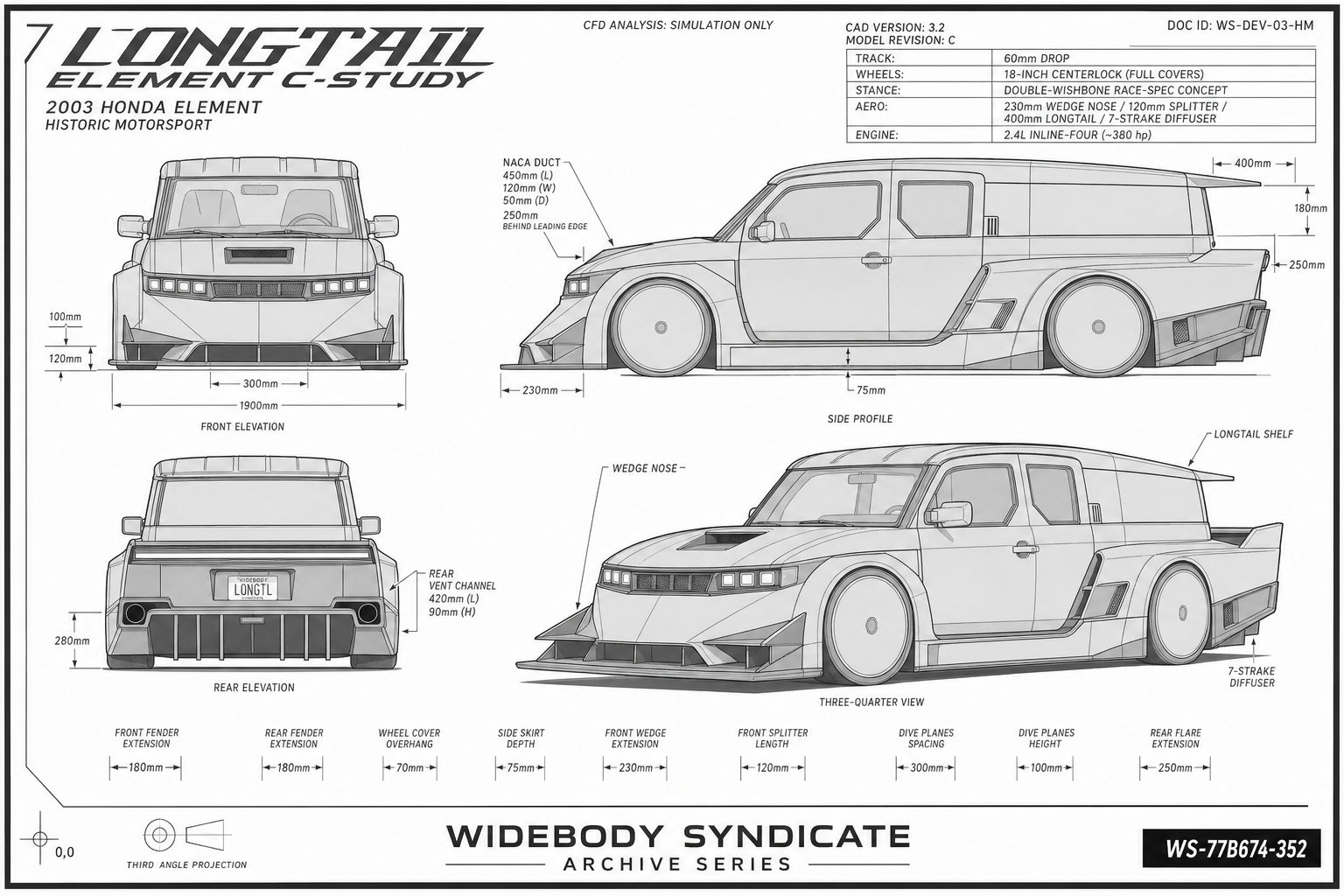
230mm extended wedge nose with 120mm forward splitter spanning ~1900mm
Twin vertical dive planes to manage front corner separation and feed brake ducts
75mm deep side skirts acting as underbody fences for venturi consistency
Full-width rear aero shelf (180mm) with subtle vortex generators to control downwash
Deep rear diffuser extending ~280mm with seven vertical strakes for expansion control
Chassis
Set in a twilight endurance pit lane, the Longtail Element reads like a private test mule that accidentally looks too finished. Banked-circuit stability is the target: longtail attachment, skirt-protected underfloor, and diffuser expansion tuned for high-speed confidence rather than short-run spectacle.
Wheels & Tires
18-inch OZ Racing-style magnesium centerlock wheels with full aero covers
275/30R18 slicks for a square
endurance-oriented footprint
Track widened ~180mm per side front and rear to support the bodywork and reduce load transfer
Low ride height target (~60mm drop) with bump control to protect the underfloor
Powertrain
Front-engine 2.4L Honda inline-four build targeting ~380 hp with motorsport ECU strategy
High-efficiency charge and coolant packaging fed by the hood NACA duct
Paddle-shifted 6-speed sequential concept with endurance-friendly ratios
Brake and rear-zone cooling routed through body vents and ducting rather than open wheel wells
Fabrication Notes
Composite outer skin over a reinforced inner structure to support longtail loads and diffuser mounting
Wheel fairings designed with service access for tire changes and brake inspection
Underbody sealing and skirt alignment treated as a tolerance-critical aero surface
Rear diffuser strakes tied into hard points to prevent flex at speed
Heat management around rear arch exhaust outlets with shielding and airflow extraction
Design Philosophy
The 2003 Honda Element was never meant to care about drag coefficient or yaw stability, which is exactly why this C-Study works. The Longtail Element takes the upright, slab-sided Honda silhouette and stretches it into a Group C reading: a pointed wedge nose, faired wheels, and a rear deck that keeps the airflow attached long after the stock hatch would have dumped it into turbulence. It still reads “Element” in the greenhouse and proportions—just rewritten with endurance-racer priorities.
Under the skin, the concept leans on believable aero fundamentals: sealed wheel openings to calm the wake, a flat splitter to set the front pressure field, long skirts to protect the underbody, and a deep, straked diffuser to do the real work. No hero wing, no gimmicks—just longtail efficiency and ground-effect discipline, packaged like a factory works sketch that somehow escaped into the pit lane.
▧Platform+
2003 Honda Element
Honda’s 2003 Element is the kind of early-2000s experiment that aged into a cult classic. Built on CR‑V roots and tuned for real-world utility, it mixes a tall, upright greenhouse with a short, functional nose and a near-vertical tail—more urban tool than traditional SUV. The clamshell side access, rubberized flooring, and stadium-like seating height weren’t gimmicks so much as Honda applying product-design logic to a car people actually live out of.
From a chassis standpoint it’s honest and straightforward: a compact footprint with a long roofline, MacPherson strut front and multi-link rear, and a drivetrain lineup centered around the K-series four-cylinder. It’s not precious, and that’s the point—the Element is a platform that takes miles, gear, and daily abuse without drama, which is exactly why it keeps showing up in enthusiast hands years later.
⌘Aero Package+
230mm extended wedge nose with 120mm forward splitter spanning ~1900mm
Twin vertical dive planes to manage front corner separation and feed brake ducts
75mm deep side skirts acting as underbody fences for venturi consistency
Full-width rear aero shelf (180mm) with subtle vortex generators to control downwash
Deep rear diffuser extending ~280mm with seven vertical strakes for expansion control
⟡Chassis+
Set in a twilight endurance pit lane, the Longtail Element reads like a private test mule that accidentally looks too finished. Banked-circuit stability is the target: longtail attachment, skirt-protected underfloor, and diffuser expansion tuned for high-speed confidence rather than short-run spectacle.
◎Wheels & Tires+
18-inch OZ Racing-style magnesium centerlock wheels with full aero covers
275/30R18 slicks for a square
endurance-oriented footprint
Track widened ~180mm per side front and rear to support the bodywork and reduce load transfer
Low ride height target (~60mm drop) with bump control to protect the underfloor
▤Powertrain+
Front-engine 2.4L Honda inline-four build targeting ~380 hp with motorsport ECU strategy
High-efficiency charge and coolant packaging fed by the hood NACA duct
Paddle-shifted 6-speed sequential concept with endurance-friendly ratios
Brake and rear-zone cooling routed through body vents and ducting rather than open wheel wells
△Fabrication Notes+
Composite outer skin over a reinforced inner structure to support longtail loads and diffuser mounting
Wheel fairings designed with service access for tire changes and brake inspection
Underbody sealing and skirt alignment treated as a tolerance-critical aero surface
Rear diffuser strakes tied into hard points to prevent flex at speed
Heat management around rear arch exhaust outlets with shielding and airflow extraction
×Design Philosophy+
The 2003 Honda Element was never meant to care about drag coefficient or yaw stability, which is exactly why this C-Study works. The Longtail Element takes the upright, slab-sided Honda silhouette and stretches it into a Group C reading: a pointed wedge nose, faired wheels, and a rear deck that keeps the airflow attached long after the stock hatch would have dumped it into turbulence. It still reads “Element” in the greenhouse and proportions—just rewritten with endurance-racer priorities.
Under the skin, the concept leans on believable aero fundamentals: sealed wheel openings to calm the wake, a flat splitter to set the front pressure field, long skirts to protect the underbody, and a deep, straked diffuser to do the real work. No hero wing, no gimmicks—just longtail efficiency and ground-effect discipline, packaged like a factory works sketch that somehow escaped into the pit lane.
Part of
Wave 44
Longtail Studies
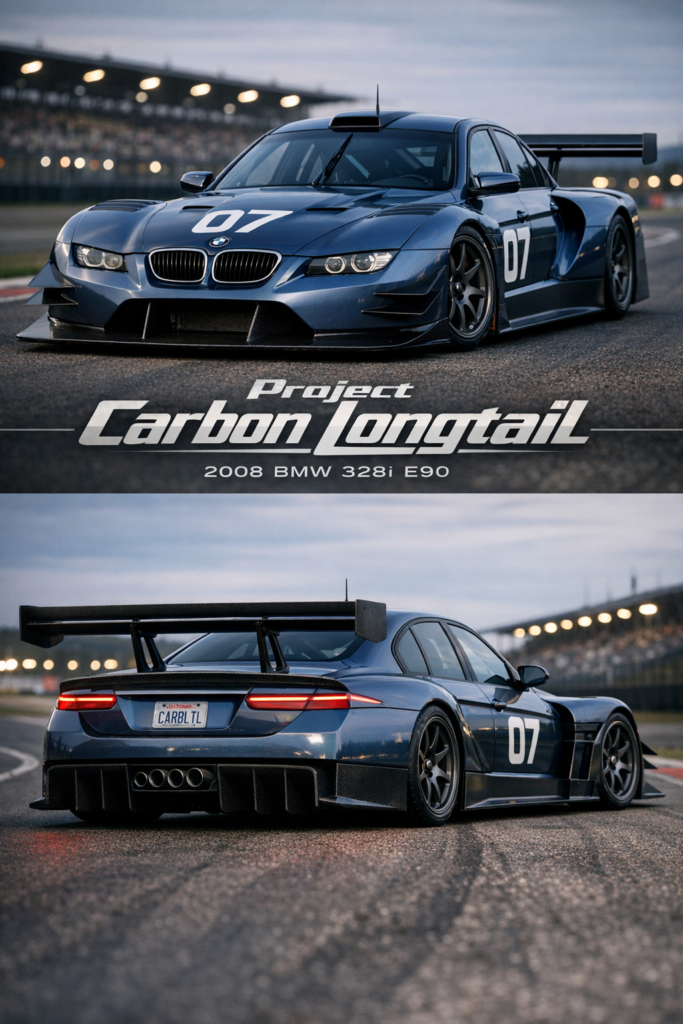
I got bored of normal proportions, so we went full Group C on the stuff nobody asked for. Microcar cabrios, rally legends, a sensible BMW sedan, an actual Honda Element, a compact pickup, and a mid-engine MR2 all lined up in the shop with the same disease: wedge noses, covered wheels, and rear decks stretched like we’re trying to outrun the calendar.
Explore Wave 44 → 6 BuildsKeep Exploring
The archive is always growing. New releases, waves, and blueprints added regularly.