



R228
Project Wind Kami Initiative
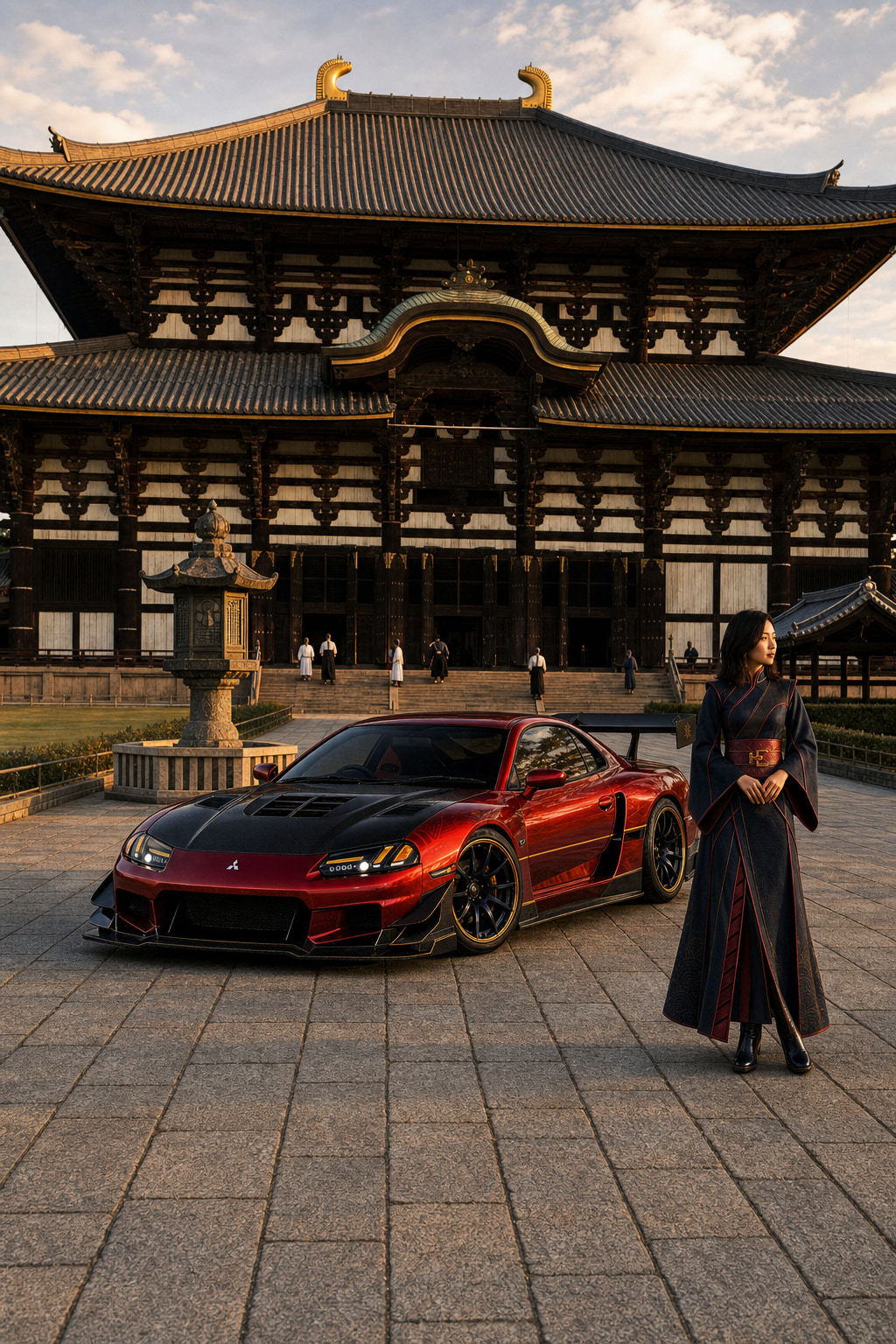
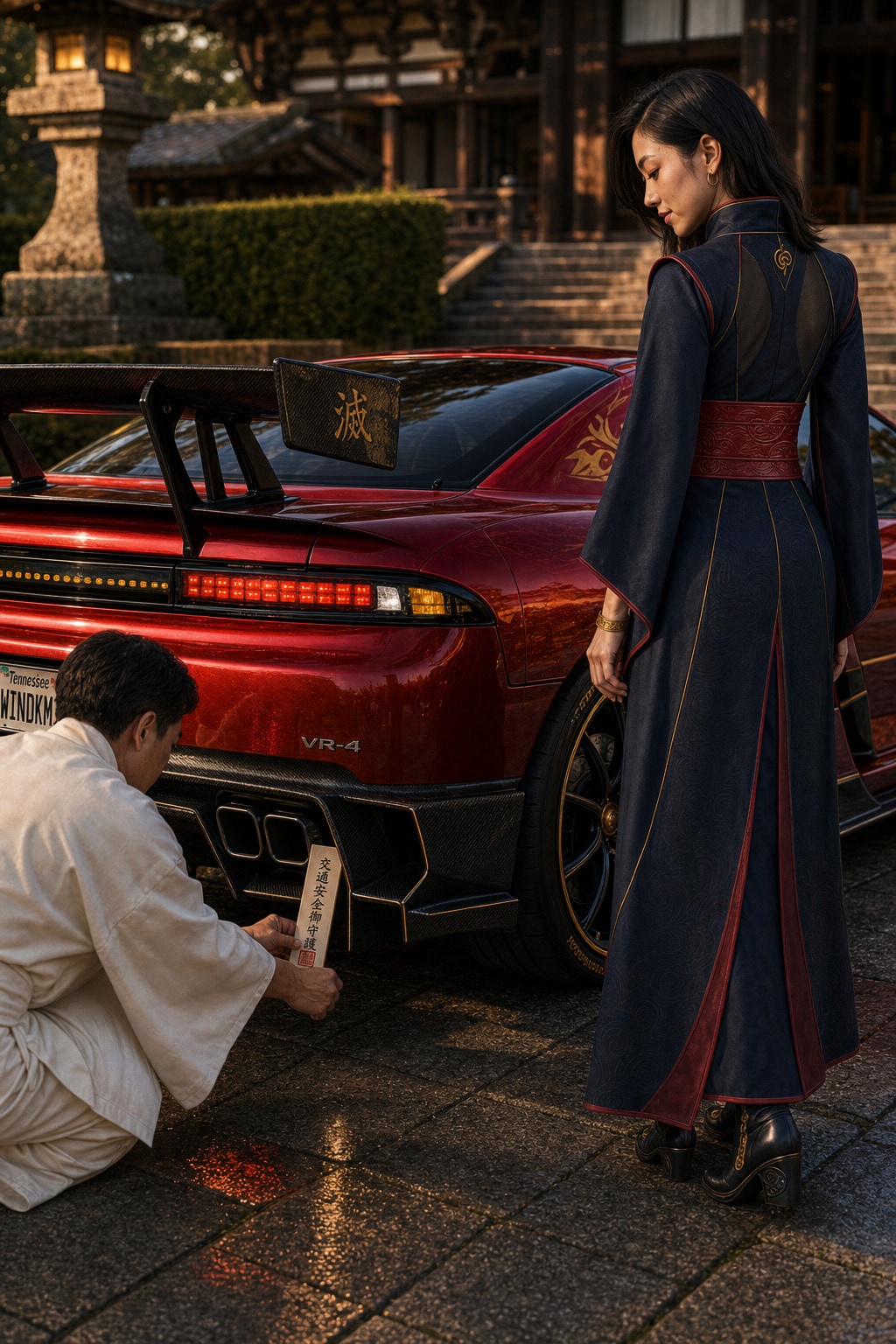
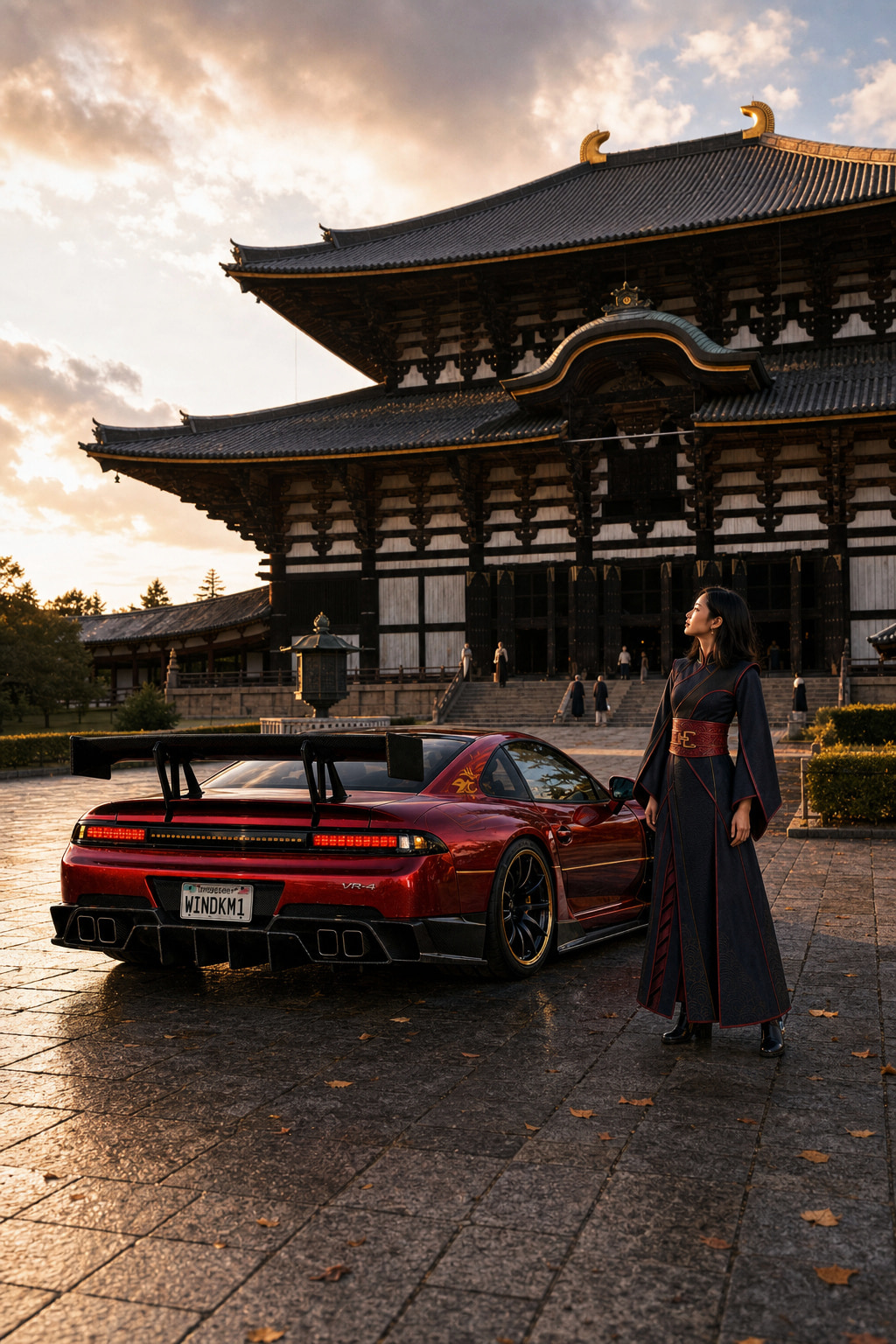
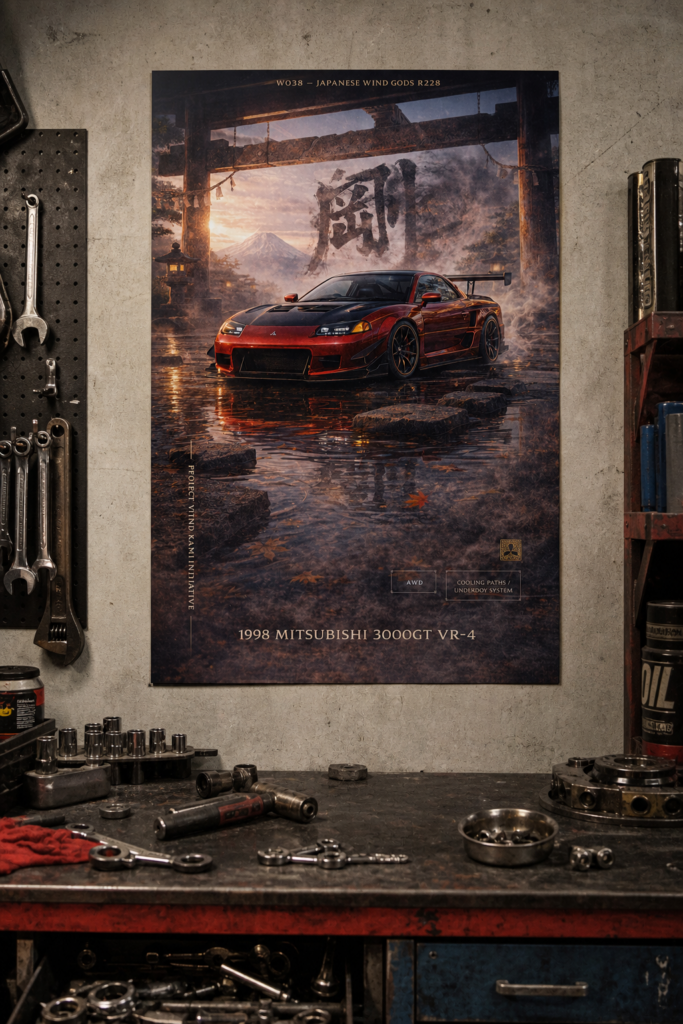
Project Wind Kami Initiative takes the late-run 3000GT VR-4—already a high-speed, high-mass AWD GT—and forces it through a GT500 silhouette filter without losing the roofline, glass, or door geometry that makes the Z16 instantly recognizable. The body is re-authored around airflow: 110mm front and 130mm rear per-side width, tri-layer arches that read like moving pressure lines, and extraction where the factory car always needed it—wheel wells, engine bay, and rear bumper wake.
It’s not “wide for wide.” The splitter, flat side shelf, and long diffuser are treated as one underbody system, with ducting that actually has somewhere to go. The surfaces carry the cultural cues—crest ridges, mask-like lamp pockets, lacquer-edge contrast—while the engineering stays honest: cooling paths are sized, vents are placed where pressure is high, and the wing sits in clean air on swan-necks like a proper time-attack car that grew up around endurance racing.
Release Image Studies
Image studies from every angle.
Comparison Shots
Blueprint / Collector Archive
Engineering Artifacts
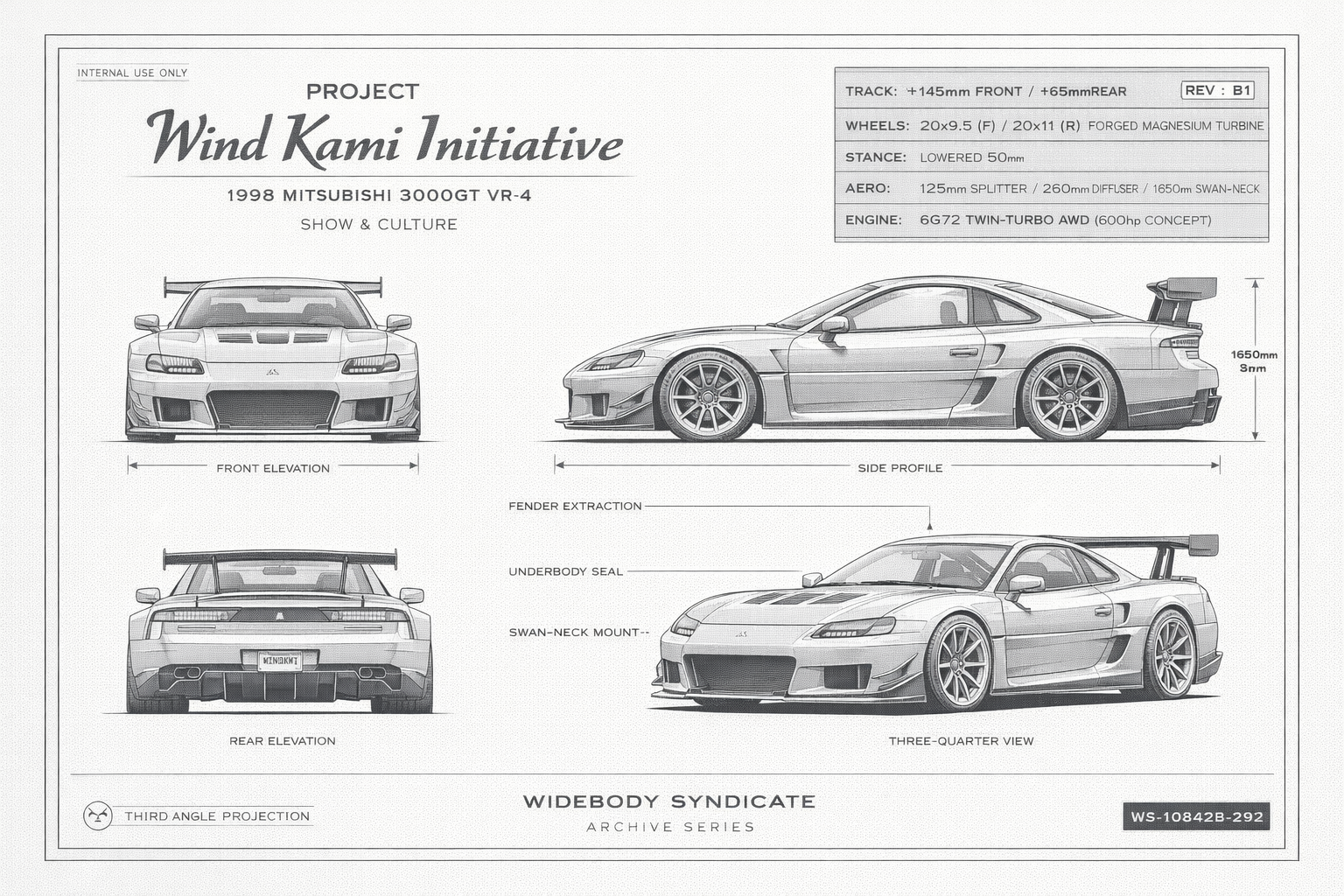
The technical study and collectible interpretation of one build, preserved together.
A presentation-grade collector artifact created for this release and preserved as part of the Widebody Syndicate archive.
Selected archive goods are available for collectors.
Technical Dossier
Platform
1998 Mitsubishi 3000GT VR-4
Mitsubishi’s 3000GT VR-4 was peak ‘90s Japan: a flagship GT built to devour highway miles at illegal speeds while flexing a spec sheet that read like a tech manifesto. In 1998 form it’s a wide-shouldered, low-slung 2+2 with a twin-turbo 6G72 V6 driving all four wheels—more autobahn bruiser than lightweight hero, and proud of it.
What makes the VR-4 culturally sticky is how unapologetically advanced it was for the era: a big-coupe alternative to the usual sports car diet, engineered with the confidence of a manufacturer chasing the world stage. Today it carries that same presence—complex, substantial, and charismatic—an icon from the moment Japan’s performance cars started feeling like rolling electronics as much as engines and steel.
Aero Package
125mm forward splitter plane with paired outer dive planes
Carbon hood with central trapezoidal heat-extraction vent and pressure ridges
260mm-long rear diffuser with five strakes and a deep central tunnel
High-mount 1650mm dual-element swan-neck GT wing with adjustable flap
Chassis
Set up like a demo car that still has to earn its presence on a fast circuit: big braking demand, long high-speed sections, and enough technical corners to expose aero balance. The aero map is built to be tunable—rake, wing angle, and diffuser performance all respond to sensible setup changes rather than one fixed “show stance.”
Wheels & Tires
20x9.5J front forged magnesium turbine-spoke wheels
20x11J rear forged magnesium turbine-spoke wheels
Yokohama ADVAN A048 265/30ZR20 front
Yokohama ADVAN A048 305/30ZR20 rear
Powertrain
6G72 3.0L twin-turbo retained
tuned to ~600hp with modern boost control and intercooler efficiency focus
Sequential 6-speed racing gearbox concept with motorsport clutch and driveline serviceability
AWD retained with strengthened transfer case strategy and heat management for sustained load
Split cooling architecture: under-splitter radiator support plus side-fed ducting to charge-air and brake systems
Fabrication Notes
Tri-layer arch surfacing requires multi-piece molds and bonded inner tubs for tire clearance and vent routing
Fender and skirt intakes are hard-ducted to brakes/intercoolers to avoid dead-end “style vents”
Swan-neck wing mounts tie into rear structure with load-spreading plates
not just hatch skin
Diffuser and side shelf are indexed to chassis points to maintain rake sensitivity and repeatable ride-height tuning
Design Philosophy
Project Wind Kami Initiative takes the late-run 3000GT VR-4—already a high-speed, high-mass AWD GT—and forces it through a GT500 silhouette filter without losing the roofline, glass, or door geometry that makes the Z16 instantly recognizable. The body is re-authored around airflow: 110mm front and 130mm rear per-side width, tri-layer arches that read like moving pressure lines, and extraction where the factory car always needed it—wheel wells, engine bay, and rear bumper wake.
It’s not “wide for wide.” The splitter, flat side shelf, and long diffuser are treated as one underbody system, with ducting that actually has somewhere to go. The surfaces carry the cultural cues—crest ridges, mask-like lamp pockets, lacquer-edge contrast—while the engineering stays honest: cooling paths are sized, vents are placed where pressure is high, and the wing sits in clean air on swan-necks like a proper time-attack car that grew up around endurance racing.
▧Platform+
1998 Mitsubishi 3000GT VR-4
Mitsubishi’s 3000GT VR-4 was peak ‘90s Japan: a flagship GT built to devour highway miles at illegal speeds while flexing a spec sheet that read like a tech manifesto. In 1998 form it’s a wide-shouldered, low-slung 2+2 with a twin-turbo 6G72 V6 driving all four wheels—more autobahn bruiser than lightweight hero, and proud of it.
What makes the VR-4 culturally sticky is how unapologetically advanced it was for the era: a big-coupe alternative to the usual sports car diet, engineered with the confidence of a manufacturer chasing the world stage. Today it carries that same presence—complex, substantial, and charismatic—an icon from the moment Japan’s performance cars started feeling like rolling electronics as much as engines and steel.
⌘Aero Package+
125mm forward splitter plane with paired outer dive planes
Carbon hood with central trapezoidal heat-extraction vent and pressure ridges
260mm-long rear diffuser with five strakes and a deep central tunnel
High-mount 1650mm dual-element swan-neck GT wing with adjustable flap
⟡Chassis+
Set up like a demo car that still has to earn its presence on a fast circuit: big braking demand, long high-speed sections, and enough technical corners to expose aero balance. The aero map is built to be tunable—rake, wing angle, and diffuser performance all respond to sensible setup changes rather than one fixed “show stance.”
◎Wheels & Tires+
20x9.5J front forged magnesium turbine-spoke wheels
20x11J rear forged magnesium turbine-spoke wheels
Yokohama ADVAN A048 265/30ZR20 front
Yokohama ADVAN A048 305/30ZR20 rear
▤Powertrain+
6G72 3.0L twin-turbo retained
tuned to ~600hp with modern boost control and intercooler efficiency focus
Sequential 6-speed racing gearbox concept with motorsport clutch and driveline serviceability
AWD retained with strengthened transfer case strategy and heat management for sustained load
Split cooling architecture: under-splitter radiator support plus side-fed ducting to charge-air and brake systems
△Fabrication Notes+
Tri-layer arch surfacing requires multi-piece molds and bonded inner tubs for tire clearance and vent routing
Fender and skirt intakes are hard-ducted to brakes/intercoolers to avoid dead-end “style vents”
Swan-neck wing mounts tie into rear structure with load-spreading plates
not just hatch skin
Diffuser and side shelf are indexed to chassis points to maintain rake sensitivity and repeatable ride-height tuning
×Design Philosophy+
Project Wind Kami Initiative takes the late-run 3000GT VR-4—already a high-speed, high-mass AWD GT—and forces it through a GT500 silhouette filter without losing the roofline, glass, or door geometry that makes the Z16 instantly recognizable. The body is re-authored around airflow: 110mm front and 130mm rear per-side width, tri-layer arches that read like moving pressure lines, and extraction where the factory car always needed it—wheel wells, engine bay, and rear bumper wake.
It’s not “wide for wide.” The splitter, flat side shelf, and long diffuser are treated as one underbody system, with ducting that actually has somewhere to go. The surfaces carry the cultural cues—crest ridges, mask-like lamp pockets, lacquer-edge contrast—while the engineering stays honest: cooling paths are sized, vents are placed where pressure is high, and the wing sits in clean air on swan-necks like a proper time-attack car that grew up around endurance racing.
Part of
Wave 38
Japanese Wind Gods
We just finished a little temple-courtyard science experiment: take the legends, the heroes, and the weirdos of JDM history and run them through a Wind God filter until the bodywork starts speaking in vortices. Same silhouette rules, same recognizable faces, but now every fender is a blade, every vent is a confession, and every swan-neck wing is basically a shrine that also happens to make downforce.
Explore Wave 38 → 6 BuildsKeep Exploring
The archive is always growing. New releases, waves, and blueprints added regularly.