







WS Widebody Syndicate
Kazekami Ascendancy Program

R225

Kazekami Ascendancy Program

2000 Toyota Supra Mk4

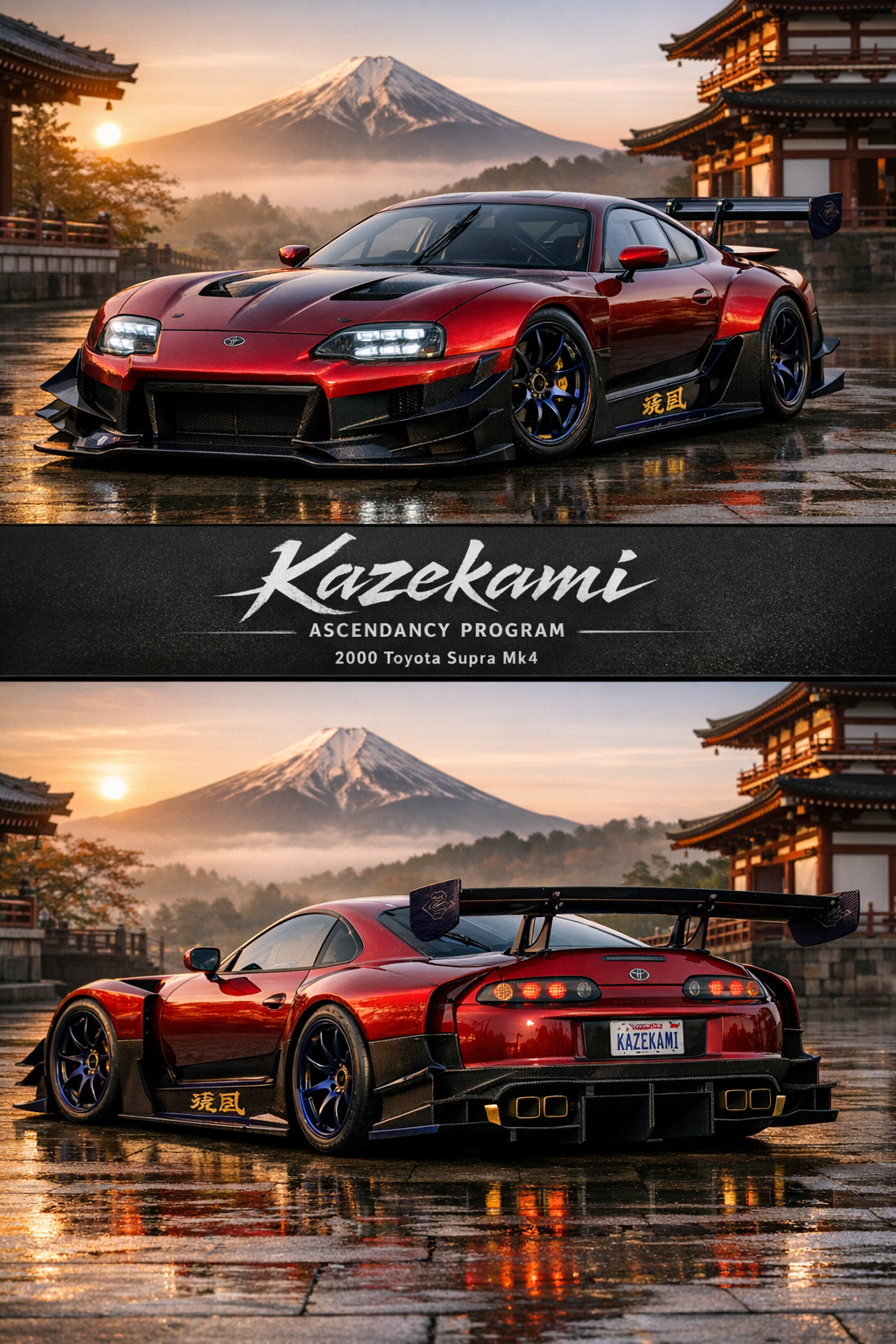
Kazekami Ascendancy Program treats the Mk4 Supra like a homologation problem, not a nostalgia piece—an extreme GT500-style silhouette where every surface is there to manage pressure, heat, and yaw stability. The iconic roofline and hatch arc stay readable, but everything around them is re-architected in carbon: trapezoidal front arches with real extraction, a deep side shelf to seal the floor, and a rear quarter that feeds a diffuser inlet like it’s the car’s main engine.

The cultural cues are restrained and purposeful—mask-like surfacing, torii geometry in the diffuser and exhaust, indigo lacquer accents—because the car’s story is told at speed. Wide track, low ride height, and a tall swan-neck wing build the kind of high-speed confidence you’d expect on Fuji’s long straight, with the 2JZ-GTE reworked around endurance priorities: dry sump, serious charge cooling, and packaging that assumes hours, not pulls.
Share Release X FB

Image studies from every angle.

6 curated frames · swipe / tap to inspect

Comparison Shots

Engineering Artifacts

The technical study and collectible interpretation of one build, preserved together.

01
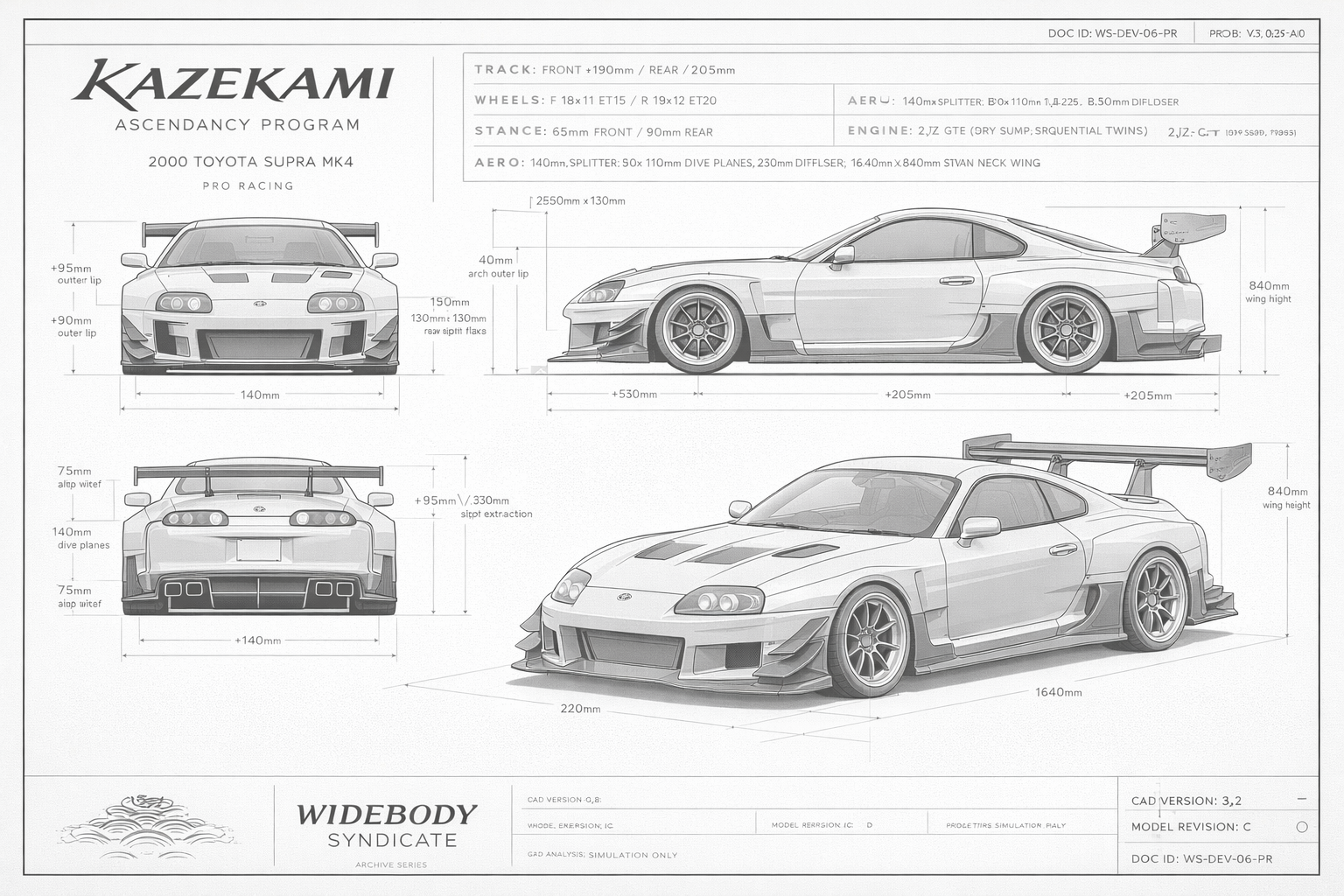
Technical DrawingBlueprint archive
Kazekami Ascendancy Program blueprint
02
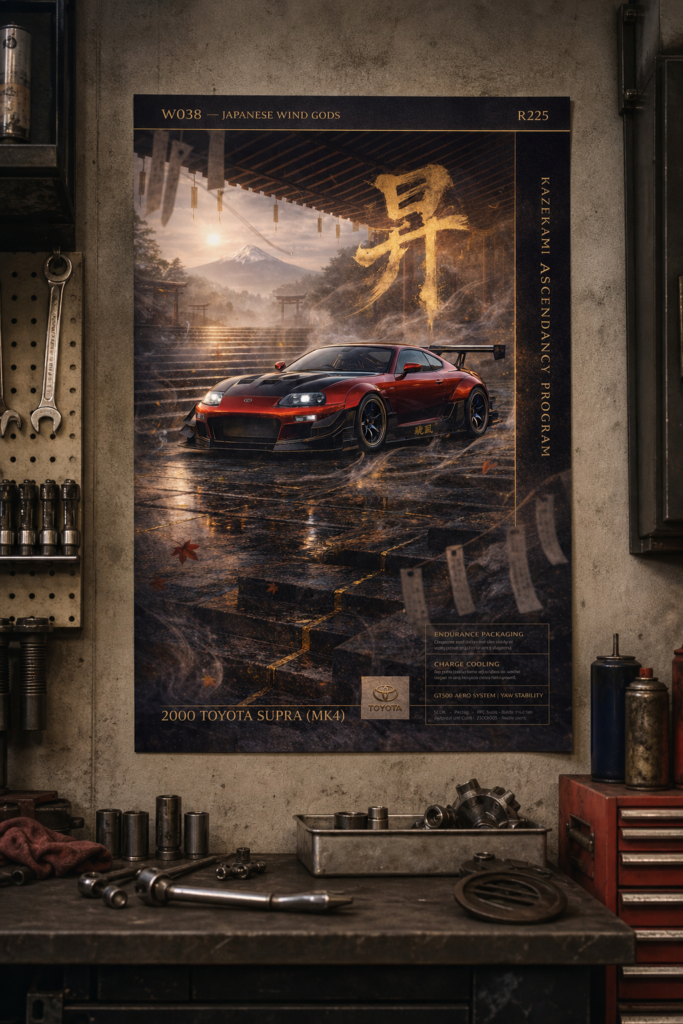
Kazekami Ascendancy Program Collector EditionCollector artifact
Kazekami Ascendancy Program Collector Edition

A presentation-grade collector artifact created for this release and preserved as part of the Widebody Syndicate archive.

Platform

2000 Toyota Supra Mk4

2000 Toyota Supra Mk4

The 2000 Toyota Supra Mk4 stands as a legendary platform in the world of performance cars, revered for its robust 2JZ-GTE inline-six engine and finely tuned chassis dynamics. This rear-wheel-drive coupe blends Japanese engineering precision with raw motorsport potential, making it a foundational piece for tuners and builders chasing that perfect balance of power and handling. Its timeless silhouette and mechanical simplicity offer an endlessly adaptable canvas for both street and track-focused builds, firmly cementing its place in automotive culture.

ToyotaSupra Mk42000
View Platform

Aero Package

140mm front splitter with dual 90mm vertical dive planes for yaw stability and front axle load
390mm x 130mm front fender extraction vents to evacuate wheel-well pressure and improve brake cooling
220mm-deep rear diffuser exit with tri-plane ‘torii’ geometry to balance wing load and underfloor expansion
Dual-element swan-neck rear wing (1640mm span
840mm deck height) with endplate detailing and micro-VGs for wake control

Chassis

This Supra is drawn for Japanese Super GT-style circuits where straight-line speed meets high-commitment aero corners—Fuji’s main straight and 100R are the mental reference points. The package leans on wheel-well extraction, a sealed floor, and a tall wing to stay stable when the car is loaded and slightly crossed up at speed.

Wheels & Tires

18x11 ET15 forged magnesium front wheels with deep concavity and turbine-inspired spoke layout
18x12 ET20 forged magnesium rear wheels to match expanded rear track and diffuser-fed stability
310/30-18 front and 330/30-18 rear semi-slick fitment for GT-style footprint and sidewall control
Ride height target: 65mm front / 80mm rear to maintain rake and diffuser efficiency

Powertrain

2JZ-GTE retained with endurance-focused rebuild: forged rotating assembly
head sealing
and sustained EGT management
Sequential twin-turbo strategy prioritized for corner-exit response and midrange rather than peak dyno numbers
Dry-sump lubrication to survive sustained lateral load and high-speed braking zones
Top-mount intercooler ducting integrated with hood vent shelves for pressure-driven heat extraction

Fabrication Notes

Widebody surfaces built as multi-piece carbon assemblies for serviceability (fender/arch sections
vent frames
skirt shelves)
Wheel-well venting tied to inner-liner ducting to prevent turbulent re-ingestion and keep extraction effective
Splitter and undertray mounted with reinforced hardpoints to handle aero load without flex-induced ride-height change
Rear diffuser and exhaust surround heat-shielded with titanium and composite isolation to protect resin systems
×

Design Philosophy

Kazekami Ascendancy Program treats the Mk4 Supra like a homologation problem, not a nostalgia piece—an extreme GT500-style silhouette where every surface is there to manage pressure, heat, and yaw stability. The iconic roofline and hatch arc stay readable, but everything around them is re-architected in carbon: trapezoidal front arches with real extraction, a deep side shelf to seal the floor, and a rear quarter that feeds a diffuser inlet like it’s the car’s main engine.

The cultural cues are restrained and purposeful—mask-like surfacing, torii geometry in the diffuser and exhaust, indigo lacquer accents—because the car’s story is told at speed. Wide track, low ride height, and a tall swan-neck wing build the kind of high-speed confidence you’d expect on Fuji’s long straight, with the 2JZ-GTE reworked around endurance priorities: dry sump, serious charge cooling, and packaging that assumes hours, not pulls.

Platform+
2000 Toyota Supra Mk4

2000 Toyota Supra Mk4

The 2000 Toyota Supra Mk4 stands as a legendary platform in the world of performance cars, revered for its robust 2JZ-GTE inline-six engine and finely tuned chassis dynamics. This rear-wheel-drive coupe blends Japanese engineering precision with raw motorsport potential, making it a foundational piece for tuners and builders chasing that perfect balance of power and handling. Its timeless silhouette and mechanical simplicity offer an endlessly adaptable canvas for both street and track-focused builds, firmly cementing its place in automotive culture.

ToyotaSupra Mk42000
View Platform
Aero Package+

140mm front splitter with dual 90mm vertical dive planes for yaw stability and front axle load
390mm x 130mm front fender extraction vents to evacuate wheel-well pressure and improve brake cooling
220mm-deep rear diffuser exit with tri-plane ‘torii’ geometry to balance wing load and underfloor expansion
Dual-element swan-neck rear wing (1640mm span
840mm deck height) with endplate detailing and micro-VGs for wake control

Chassis+

This Supra is drawn for Japanese Super GT-style circuits where straight-line speed meets high-commitment aero corners—Fuji’s main straight and 100R are the mental reference points. The package leans on wheel-well extraction, a sealed floor, and a tall wing to stay stable when the car is loaded and slightly crossed up at speed.

Wheels & Tires+

18x11 ET15 forged magnesium front wheels with deep concavity and turbine-inspired spoke layout
18x12 ET20 forged magnesium rear wheels to match expanded rear track and diffuser-fed stability
310/30-18 front and 330/30-18 rear semi-slick fitment for GT-style footprint and sidewall control
Ride height target: 65mm front / 80mm rear to maintain rake and diffuser efficiency

Powertrain+

2JZ-GTE retained with endurance-focused rebuild: forged rotating assembly
head sealing
and sustained EGT management
Sequential twin-turbo strategy prioritized for corner-exit response and midrange rather than peak dyno numbers
Dry-sump lubrication to survive sustained lateral load and high-speed braking zones
Top-mount intercooler ducting integrated with hood vent shelves for pressure-driven heat extraction

Fabrication Notes+

Widebody surfaces built as multi-piece carbon assemblies for serviceability (fender/arch sections
vent frames
skirt shelves)
Wheel-well venting tied to inner-liner ducting to prevent turbulent re-ingestion and keep extraction effective
Splitter and undertray mounted with reinforced hardpoints to handle aero load without flex-induced ride-height change
Rear diffuser and exhaust surround heat-shielded with titanium and composite isolation to protect resin systems

×Design Philosophy+

Kazekami Ascendancy Program treats the Mk4 Supra like a homologation problem, not a nostalgia piece—an extreme GT500-style silhouette where every surface is there to manage pressure, heat, and yaw stability. The iconic roofline and hatch arc stay readable, but everything around them is re-architected in carbon: trapezoidal front arches with real extraction, a deep side shelf to seal the floor, and a rear quarter that feeds a diffuser inlet like it’s the car’s main engine.

The cultural cues are restrained and purposeful—mask-like surfacing, torii geometry in the diffuser and exhaust, indigo lacquer accents—because the car’s story is told at speed. Wide track, low ride height, and a tall swan-neck wing build the kind of high-speed confidence you’d expect on Fuji’s long straight, with the 2JZ-GTE reworked around endurance priorities: dry sump, serious charge cooling, and packaging that assumes hours, not pulls.

Part of
Wave 38

Japanese Wind Gods

We just finished a little temple-courtyard science experiment: take the legends, the heroes, and the weirdos of JDM history and run them through a Wind God filter until the bodywork starts speaking in vortices. Same silhouette rules, same recognizable faces, but now every fender is a blade, every vent is a confession, and every swan-neck wing is basically a shrine that also happens to make downforce.

Explore Wave 38 → 6 Builds

Keep Exploring

The archive is always growing. New releases, waves, and blueprints added regularly.