
WS Widebody Syndicate
Speedy Conejo Program

R170

Speedy Conejo Program

1969 Pontiac GTO Judge

Series Sacred Cars
Category Circuit
Wave Wave 29

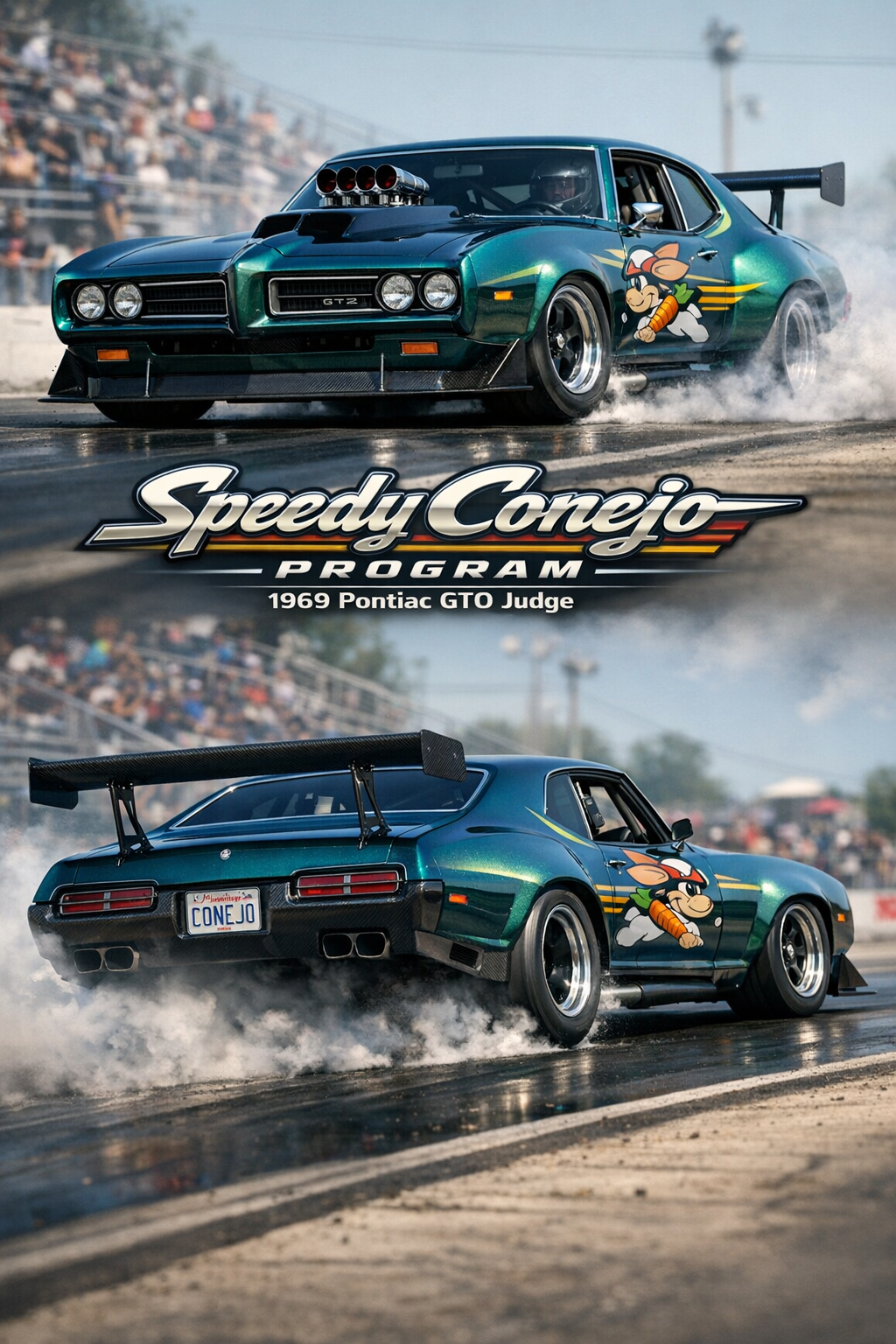
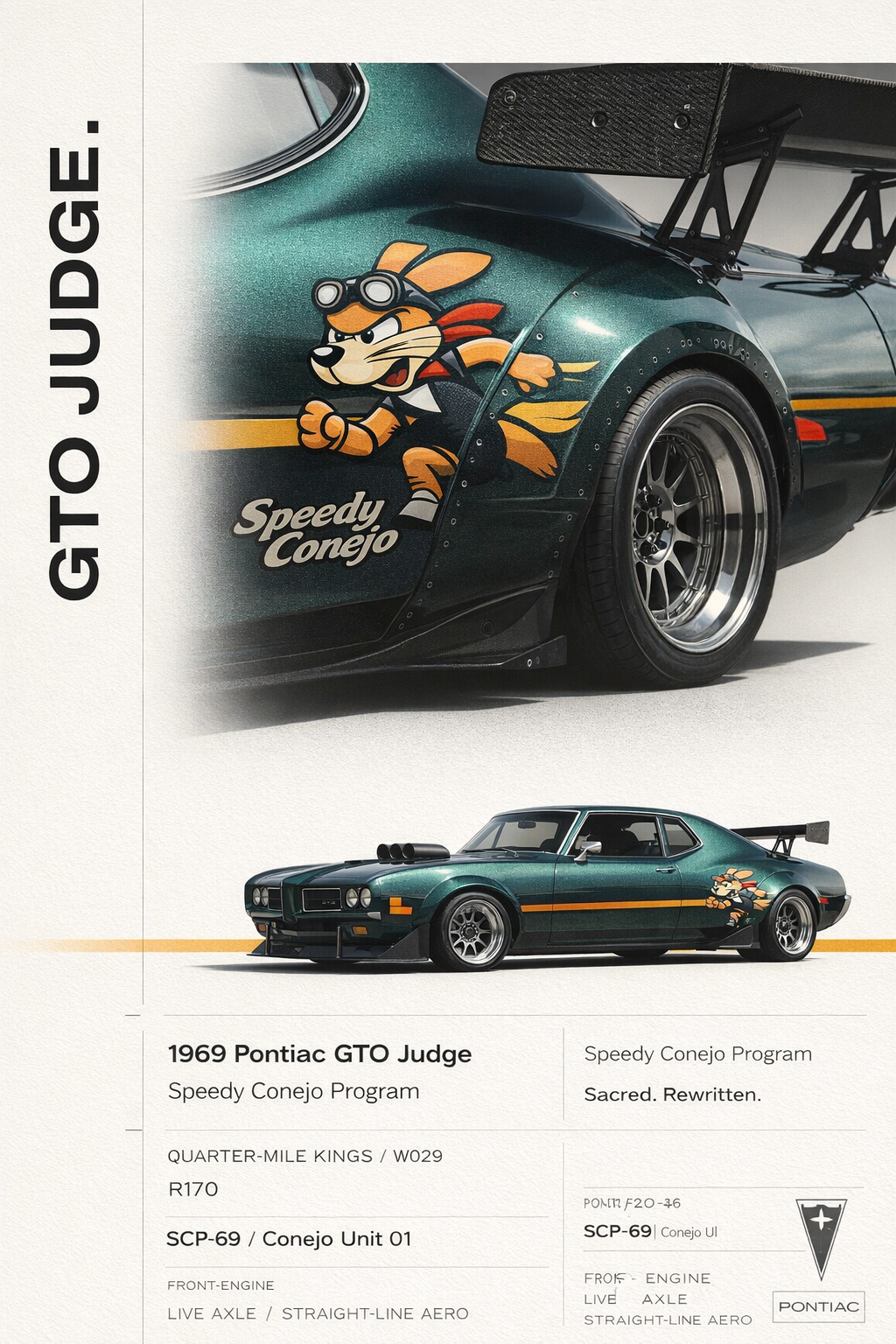
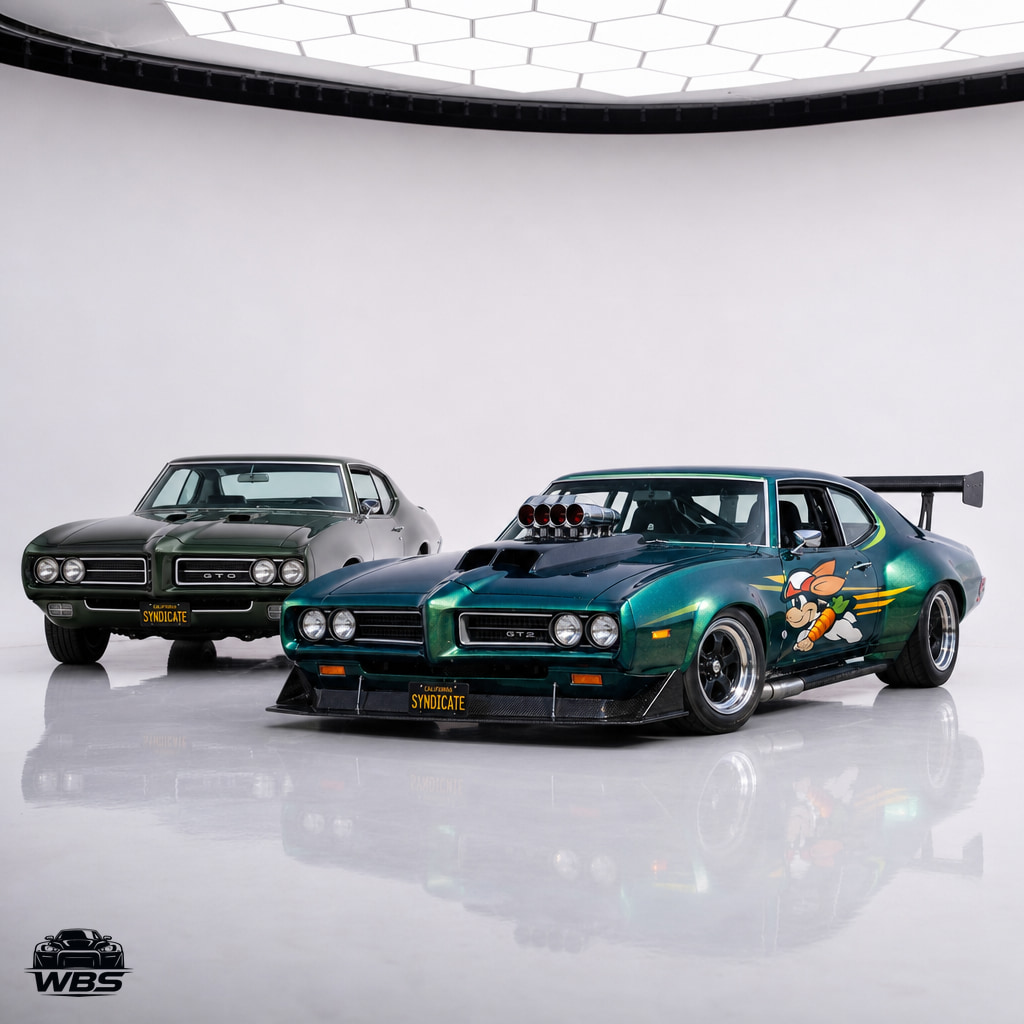
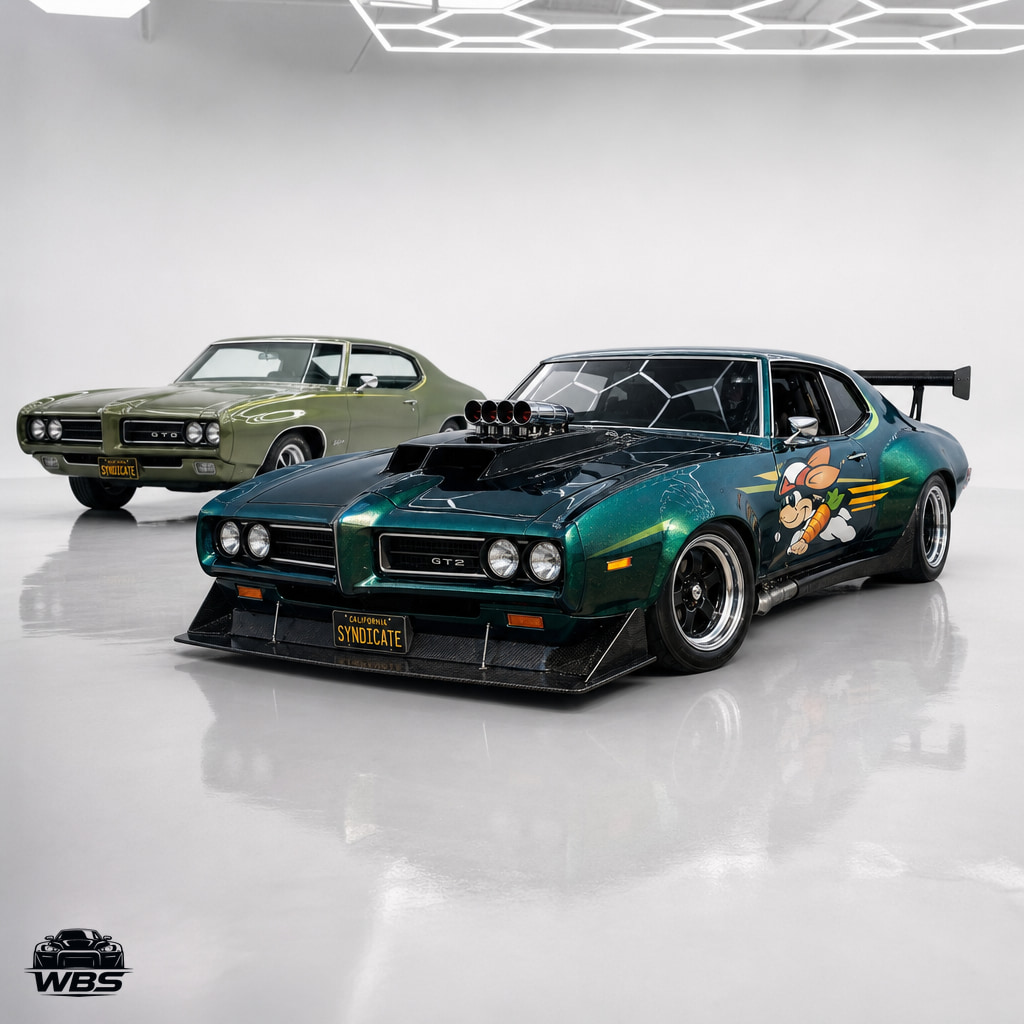
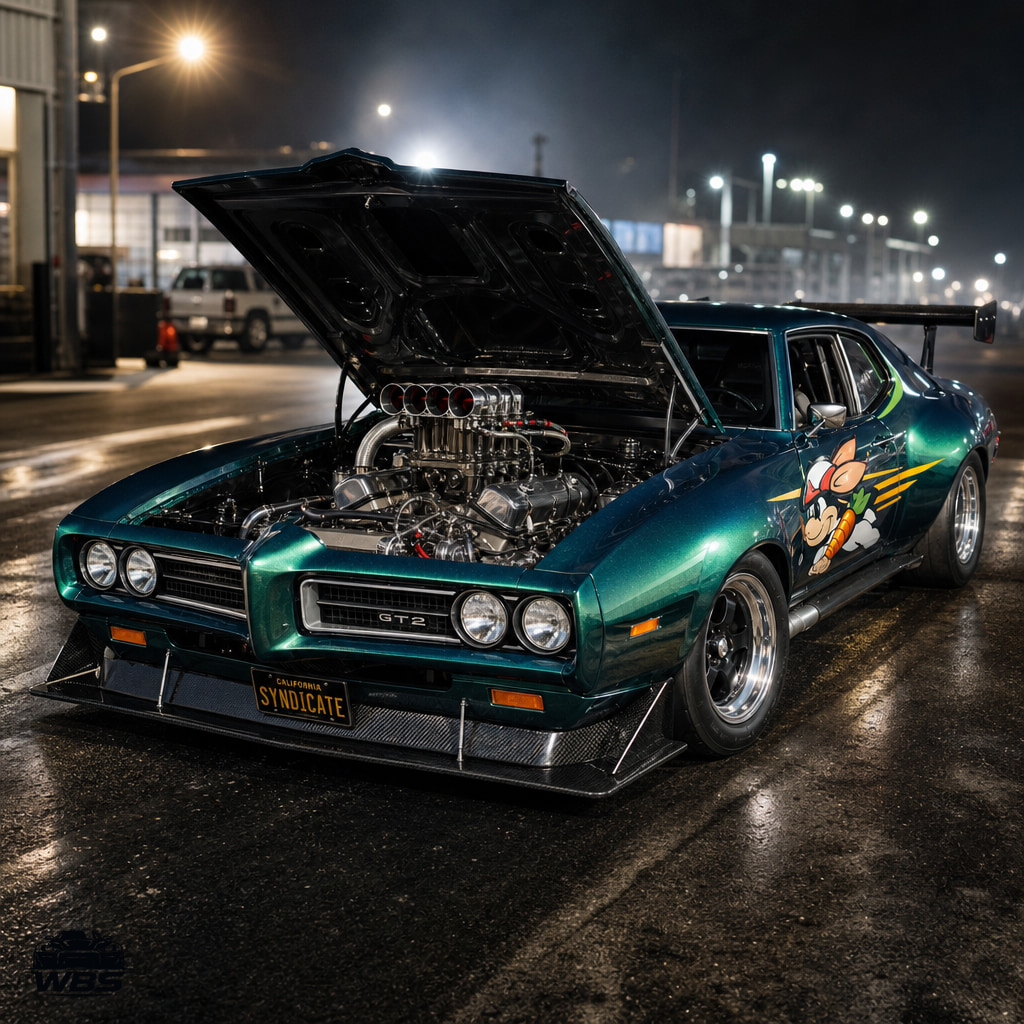
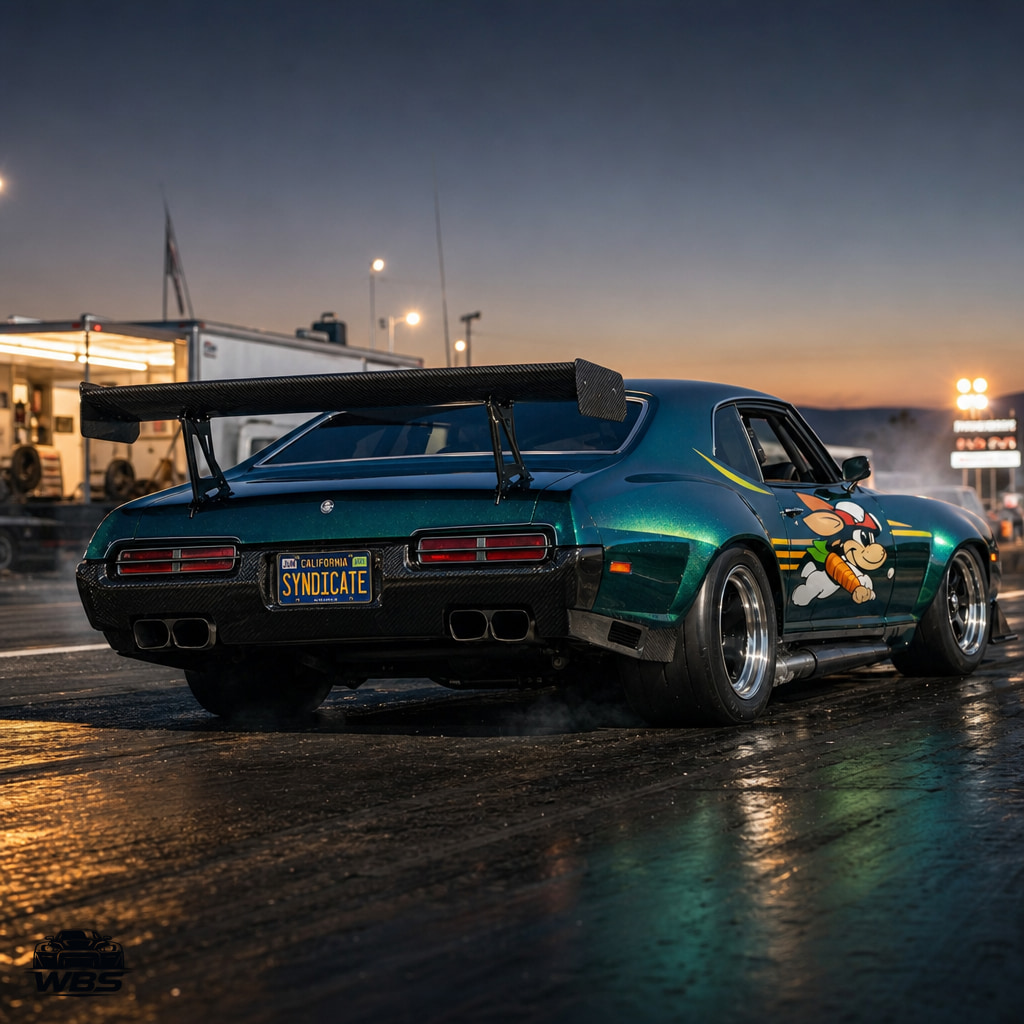
The Speedy Conejo Program takes a sacred ’69 GTO Judge and commits the kind of heresy that only makes sense at the tree: a front-engine, wide-track pro drag coupe built to leave hard, stay straight, and pull clean through the lights. The cartoon rabbit on the quarter isn’t an apology—it’s a warning that this Judge lives for the first 330 feet and the last 200 mph.

Under the bright wrap and exaggerated arches is a believable drag recipe: simplified front end, a properly located live axle, and aero that’s there to keep the nose down and the car calm when the slicks finally hook. It’s muscle-car silhouette meets modern strip discipline—built to be staged, heated, and sent.
Share Release X FB

Image studies from every angle.

6 curated frames · swipe / tap to inspect

Comparison Shots

Engineering Artifacts

The technical study and collectible interpretation of one build, preserved together.

01
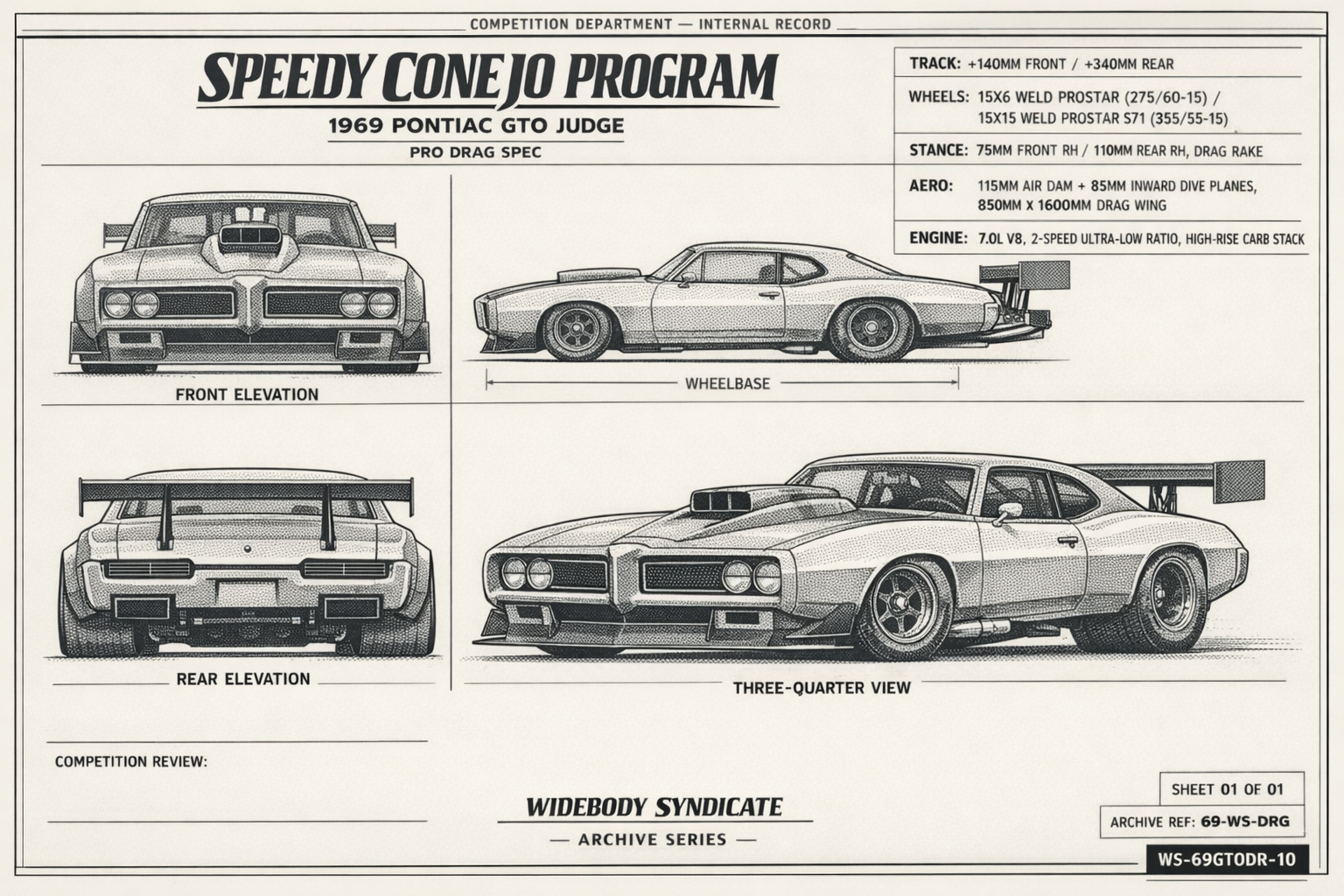
Technical DrawingBlueprint archive
Speedy Conejo Program blueprint
02
Speedy Conejo Program Collector EditionCollector artifact
Speedy Conejo Program Collector Edition

A presentation-grade collector artifact created for this release and preserved as part of the Widebody Syndicate archive.

Platform

1969 Pontiac GTO Judge

1969 Pontiac GTO Judge

The 1969 Pontiac GTO Judge stands as an iconic muscle car platform, embodying the raw power and bold styling of the late '60s American performance era. Built on a robust A-body chassis, the Judge features aggressive proportions with a long hood, short deck, and a wide stance that hints at its potent V8 capabilities. Its clean, muscular lines and signature Judge graphics capture the spirit of street dominance and drag strip heritage, making it a timeless foundation for enthusiasts and builders alike.

PontiacGTO Judge1969
View Platform

Aero Package

Ultra-low flat-plane front air dam with corner dive planes/fences to control front lift on launch
Cowl-induction hood with tall central scoop to feed a high-rise intake/carb stack
Single-element carbon drag wing on reinforced decklid structure for top-end stability
60mm shelf-style side skirts to reduce underbody airflow and stabilize rake
Front fender side ducts feeding radiator/oil cooler airflow management

Chassis

Set up for the strip: stable on the launch, calm through the traps, and engineered to repeat instead of surviving one heroic pass. The widened rear track and aero balance are aimed at keeping the GTO composed when speed climbs and the surface gets real.

Wheels & Tires

Front: 15x6 Weld ProStar forged with 275/60-15 DOT drag radials
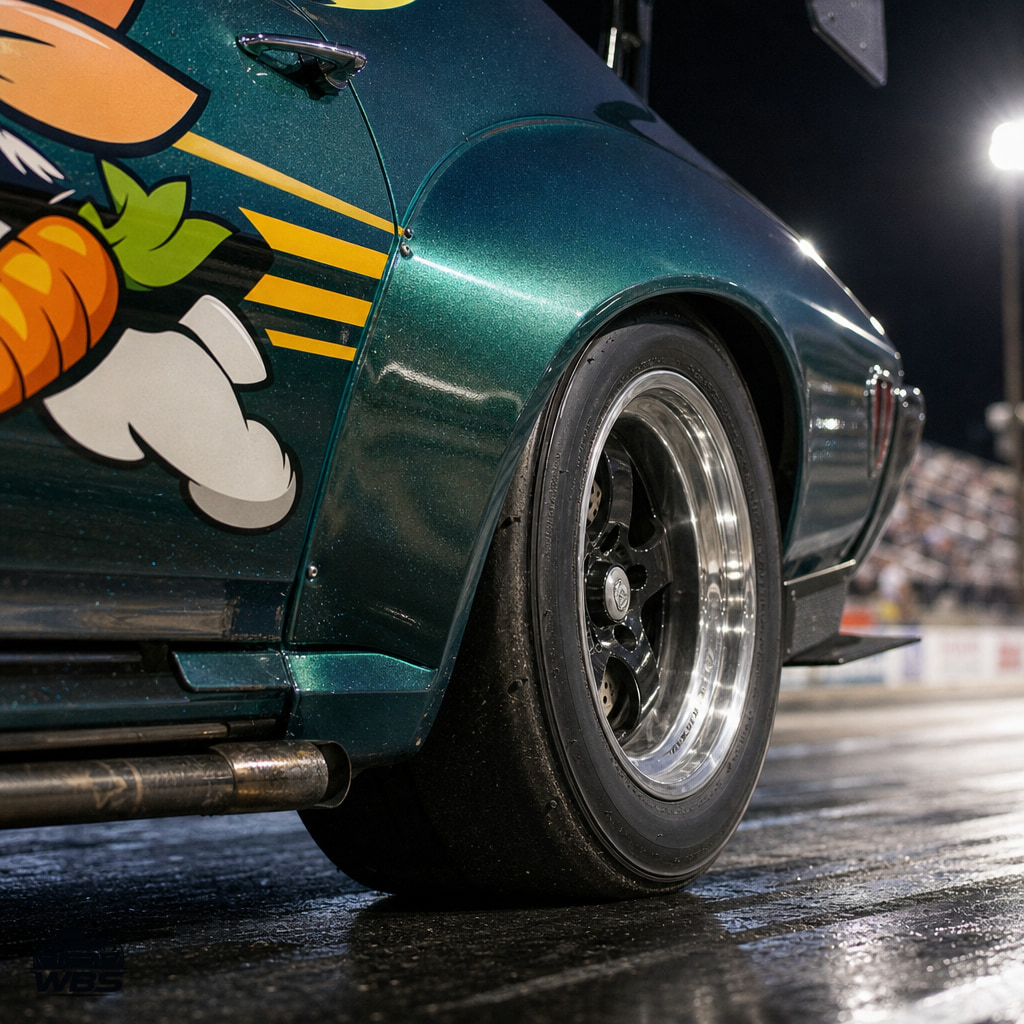
Rear: 15x15 Weld ProStar S71 forged (center-lock) with 355/55-15 Goodyear Eagle drag slicks
Staggered track increase: +140mm overall front, +340mm overall rear for footprint and stability
Drag-oriented ride heights: ~75mm front, ~110mm rear for controlled rake and weight transfer

Powertrain

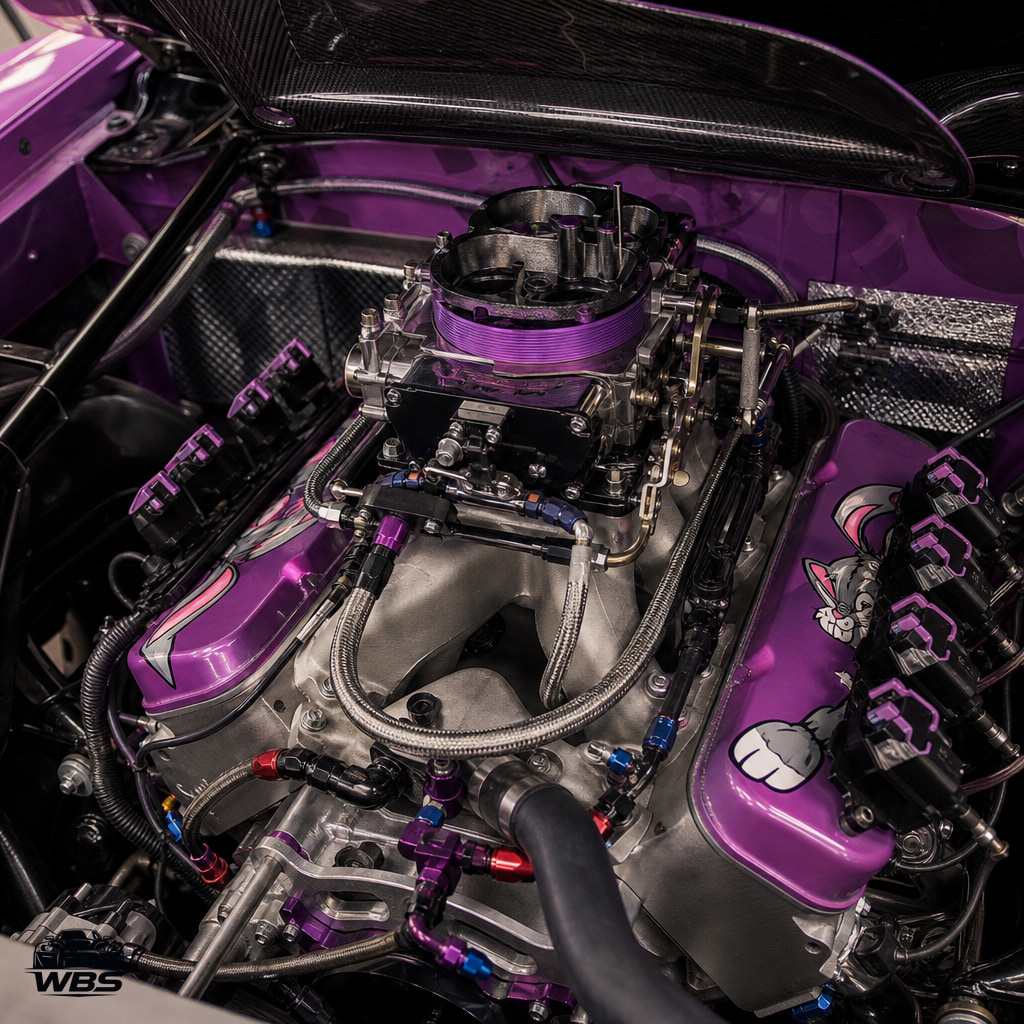
7.0L Pontiac-based V8 built for boost-free, big-torque drag duty with a high-rise intake and carb
High-stall, drag-spec torque converter tuned for a hard leave without killing consistency
2-speed drag automatic with ultra-low overall gearing for quick shift recovery and top-end pull
Reinforced live axle with 4-link, anti-roll bar, and drag valving to keep it square under load

Fabrication Notes

Quarter-panel widening begins forward of wheel center to keep the flare transition load-bearing and paint-wrap friendly
Decklid and rear structure plated and triangulated to carry wing load without oil-canning at speed
Front air dam mounted to reinforced points with quick-remove hardware for service and transport
Four-link brackets and axle tubes gusseted; anti-roll bar mounts tied into the rear structure
Heat management: side-exit exhaust shielding and ducting designed around cooler/radiator pressure zones

×

Design Philosophy

The Speedy Conejo Program takes a sacred ’69 GTO Judge and commits the kind of heresy that only makes sense at the tree: a front-engine, wide-track pro drag coupe built to leave hard, stay straight, and pull clean through the lights. The cartoon rabbit on the quarter isn’t an apology—it’s a warning that this Judge lives for the first 330 feet and the last 200 mph.

Under the bright wrap and exaggerated arches is a believable drag recipe: simplified front end, a properly located live axle, and aero that’s there to keep the nose down and the car calm when the slicks finally hook. It’s muscle-car silhouette meets modern strip discipline—built to be staged, heated, and sent.

Platform+
1969 Pontiac GTO Judge

1969 Pontiac GTO Judge

The 1969 Pontiac GTO Judge stands as an iconic muscle car platform, embodying the raw power and bold styling of the late '60s American performance era. Built on a robust A-body chassis, the Judge features aggressive proportions with a long hood, short deck, and a wide stance that hints at its potent V8 capabilities. Its clean, muscular lines and signature Judge graphics capture the spirit of street dominance and drag strip heritage, making it a timeless foundation for enthusiasts and builders alike.

PontiacGTO Judge1969
View Platform
Aero Package+

Ultra-low flat-plane front air dam with corner dive planes/fences to control front lift on launch
Cowl-induction hood with tall central scoop to feed a high-rise intake/carb stack
Single-element carbon drag wing on reinforced decklid structure for top-end stability
60mm shelf-style side skirts to reduce underbody airflow and stabilize rake
Front fender side ducts feeding radiator/oil cooler airflow management

Chassis+

Set up for the strip: stable on the launch, calm through the traps, and engineered to repeat instead of surviving one heroic pass. The widened rear track and aero balance are aimed at keeping the GTO composed when speed climbs and the surface gets real.

Wheels & Tires+

Front: 15x6 Weld ProStar forged with 275/60-15 DOT drag radials
Rear: 15x15 Weld ProStar S71 forged (center-lock) with 355/55-15 Goodyear Eagle drag slicks
Staggered track increase: +140mm overall front, +340mm overall rear for footprint and stability
Drag-oriented ride heights: ~75mm front, ~110mm rear for controlled rake and weight transfer

Powertrain+

7.0L Pontiac-based V8 built for boost-free, big-torque drag duty with a high-rise intake and carb
High-stall, drag-spec torque converter tuned for a hard leave without killing consistency
2-speed drag automatic with ultra-low overall gearing for quick shift recovery and top-end pull
Reinforced live axle with 4-link, anti-roll bar, and drag valving to keep it square under load

Fabrication Notes+

Quarter-panel widening begins forward of wheel center to keep the flare transition load-bearing and paint-wrap friendly
Decklid and rear structure plated and triangulated to carry wing load without oil-canning at speed
Front air dam mounted to reinforced points with quick-remove hardware for service and transport
Four-link brackets and axle tubes gusseted; anti-roll bar mounts tied into the rear structure
Heat management: side-exit exhaust shielding and ducting designed around cooler/radiator pressure zones

×Design Philosophy+

The Speedy Conejo Program takes a sacred ’69 GTO Judge and commits the kind of heresy that only makes sense at the tree: a front-engine, wide-track pro drag coupe built to leave hard, stay straight, and pull clean through the lights. The cartoon rabbit on the quarter isn’t an apology—it’s a warning that this Judge lives for the first 330 feet and the last 200 mph.

Under the bright wrap and exaggerated arches is a believable drag recipe: simplified front end, a properly located live axle, and aero that’s there to keep the nose down and the car calm when the slicks finally hook. It’s muscle-car silhouette meets modern strip discipline—built to be staged, heated, and sent.

Part of
Wave 29

Quarter-Mile Kings

We took the oddballs and the icons, the overlooked and the outright wild, and gave them a second life on the strip. A steam-powered Sonata dragster?

Explore Wave 29 → 6 Builds

Keep Exploring

The archive is always growing. New releases, waves, and blueprints added regularly.