














R161
Mud Bog Harvester
Mud Bog Harvester is what happens when a 2017 Honda Odyssey gets treated like a purpose-built swamp racer instead of a family shuttle. The body is pushed out hard—210mm per side up front and 230mm per side in the rear—using layered composite box flares with stepped lips that do double duty: clearing 40s at full stuff and throwing mud away from the glass and door seals. Side skirts are deleted for honest ground clearance, and the rear is simplified into a flat, truncated hatch with steel tube protection where plastic bumpers used to be.
The engineering focus is flotation, cooling, and survivability. A raised center snorkel feeds sealed air filtration and charge cooling, while big rectangular extractor vents ahead of the front doors bleed heat and pressure from the wheelhouses when everything is packed with clay. Underneath, the concept leans on reinforced full-time 4WD with front and rear lockers, long travel, and beadlocked steel wheels—because in a bog, the only “aero” that matters is what keeps the tires turning and the drivetrain alive.
Release Image Studies
Image studies from every angle.
Comparison Shots
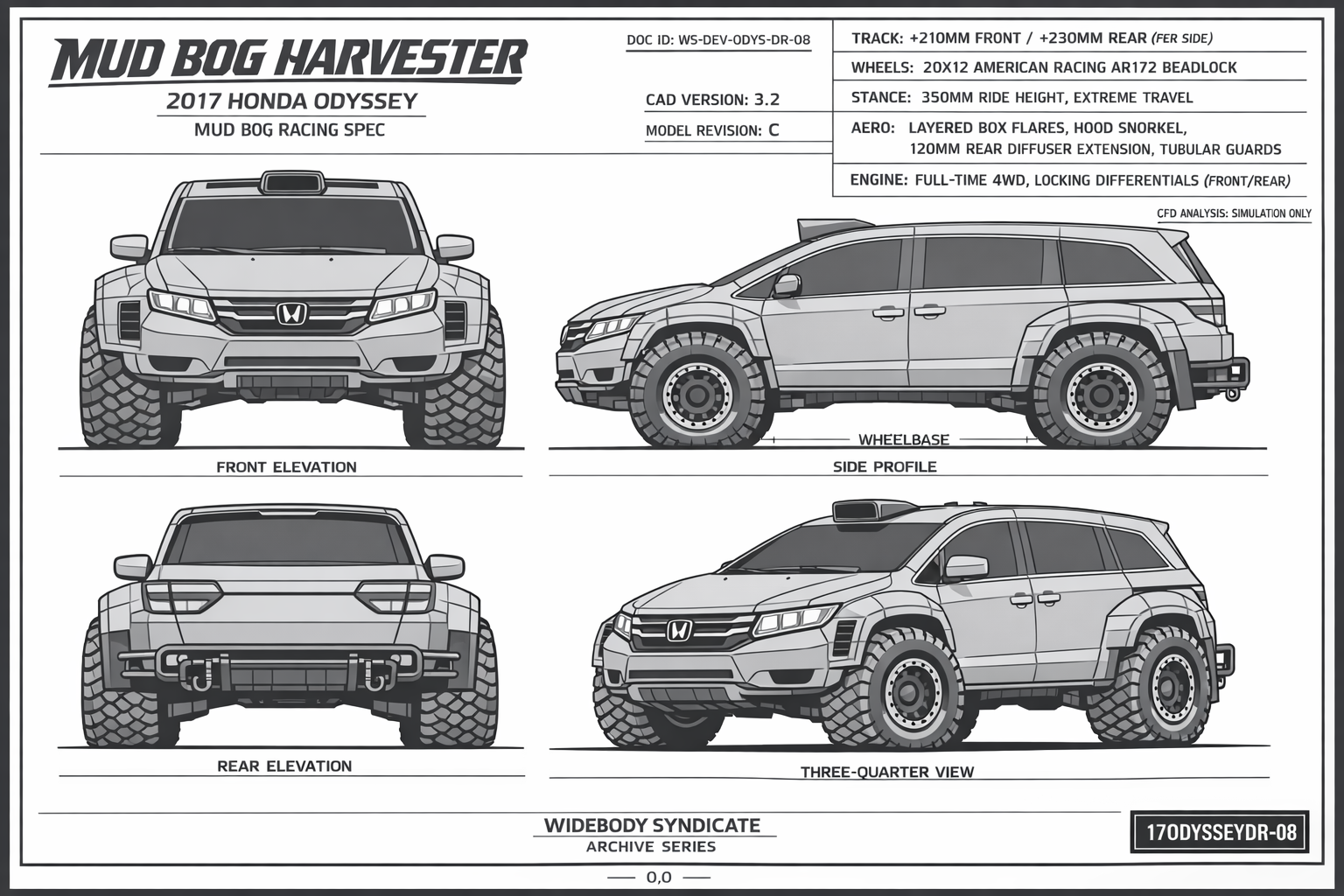
Blueprint / Collector Archive
Engineering Artifacts
The technical study and collectible interpretation of one build, preserved together.
A presentation-grade collector artifact created for this release and preserved as part of the Widebody Syndicate archive.
Selected archive goods are available for collectors.
Technical Dossier
Platform
2017 Honda Odyssey
The 2017 Honda Odyssey is a masterclass in versatile family motoring, merging practical space with refined engineering. Built on a unibody minivan platform with a smooth, car-like ride, it features a bold, aerodynamic silhouette that maximizes interior volume without sacrificing style or agility. Its architecture balances rigidity and comfort, providing a stable foundation for daily driving, road trips, and everything in between while integrating innovative safety features and efficient powertrains representative of Honda's reliability and engineering precision.
Aero Package
Rectangular wheelhouse extractor vents (300x150mm) ahead of the front door hinges for heat/pressure relief
Stepped flare lips designed to deflect spray outward and reduce cabin-side contamination
Rear extension/diffuser-shaped panel integrated into mud guards for cleaner underbody exit flow
No rear wing/spoiler to avoid clogging and preserve rear visibility and clearance
Chassis
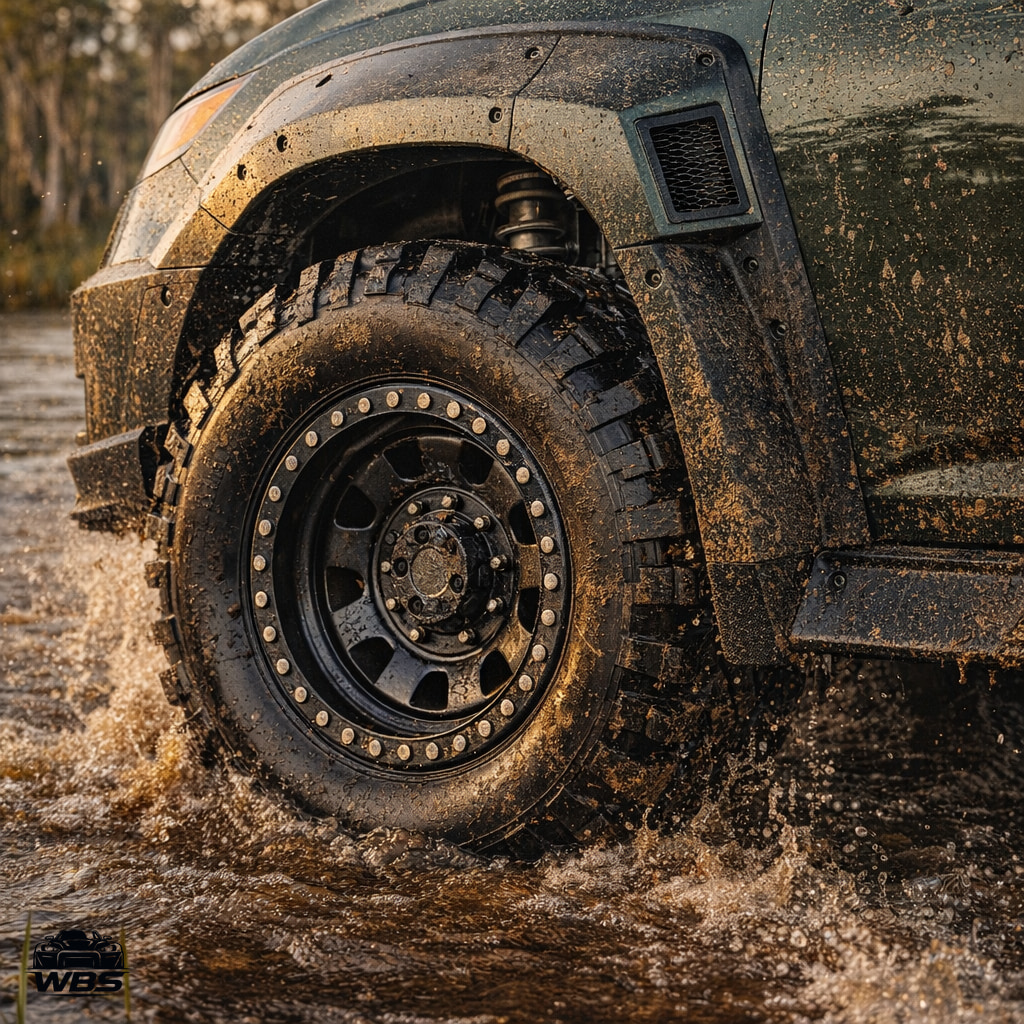
Set in a late-afternoon swamp course where the surface changes every lap—water, ruts, and heavy clay. The drone-view angle emphasizes how the widened track and 350mm ride height keep the van stable while the tires throw a full curtain of mud.
Wheels & Tires
20x12 steel wheels with beadlocks (American Racing AR172 style) for low-pressure retention
405/60R20 swamp traction tires (~40-inch diameter, ~15-inch section width) for flotation and bite
High-clearance offset matched to widened track to keep scrub manageable and protect steering components
Full-size spare strategy assumed for bog events (matching diameter and beadlock)
Powertrain
Reinforced full-time 4WD conversion with front and rear locking differentials
Sealed intake routing via raised hood snorkel feeding high-capacity filtration and water-resistant ducting
Charge-cooling concept using twin intercooler packaging with protected ducting for muddy conditions
Upgraded cooling stack with mud-tolerant airflow management and protected heat exchangers
Fabrication Notes
Widebody built as layered composite flare modules with internal bracing for tire strike resistance
Wheelhouse clearancing and re-tubbing to support full bump and steering lock on 40s
Tubular rear structure tied into recovery points; designed for winch/tow loads rather than cosmetics
Vent openings reinforced with framed edges to prevent cracking and maintain panel stiffness
Design Philosophy
Mud Bog Harvester is what happens when a 2017 Honda Odyssey gets treated like a purpose-built swamp racer instead of a family shuttle. The body is pushed out hard—210mm per side up front and 230mm per side in the rear—using layered composite box flares with stepped lips that do double duty: clearing 40s at full stuff and throwing mud away from the glass and door seals. Side skirts are deleted for honest ground clearance, and the rear is simplified into a flat, truncated hatch with steel tube protection where plastic bumpers used to be.
The engineering focus is flotation, cooling, and survivability. A raised center snorkel feeds sealed air filtration and charge cooling, while big rectangular extractor vents ahead of the front doors bleed heat and pressure from the wheelhouses when everything is packed with clay. Underneath, the concept leans on reinforced full-time 4WD with front and rear lockers, long travel, and beadlocked steel wheels—because in a bog, the only “aero” that matters is what keeps the tires turning and the drivetrain alive.
▧Platform+
2017 Honda Odyssey
The 2017 Honda Odyssey is a masterclass in versatile family motoring, merging practical space with refined engineering. Built on a unibody minivan platform with a smooth, car-like ride, it features a bold, aerodynamic silhouette that maximizes interior volume without sacrificing style or agility. Its architecture balances rigidity and comfort, providing a stable foundation for daily driving, road trips, and everything in between while integrating innovative safety features and efficient powertrains representative of Honda's reliability and engineering precision.
⌘Aero Package+
Rectangular wheelhouse extractor vents (300x150mm) ahead of the front door hinges for heat/pressure relief
Stepped flare lips designed to deflect spray outward and reduce cabin-side contamination
Rear extension/diffuser-shaped panel integrated into mud guards for cleaner underbody exit flow
No rear wing/spoiler to avoid clogging and preserve rear visibility and clearance
⟡Chassis+
Set in a late-afternoon swamp course where the surface changes every lap—water, ruts, and heavy clay. The drone-view angle emphasizes how the widened track and 350mm ride height keep the van stable while the tires throw a full curtain of mud.
◎Wheels & Tires+
20x12 steel wheels with beadlocks (American Racing AR172 style) for low-pressure retention
405/60R20 swamp traction tires (~40-inch diameter, ~15-inch section width) for flotation and bite
High-clearance offset matched to widened track to keep scrub manageable and protect steering components
Full-size spare strategy assumed for bog events (matching diameter and beadlock)
▤Powertrain+
Reinforced full-time 4WD conversion with front and rear locking differentials
Sealed intake routing via raised hood snorkel feeding high-capacity filtration and water-resistant ducting
Charge-cooling concept using twin intercooler packaging with protected ducting for muddy conditions
Upgraded cooling stack with mud-tolerant airflow management and protected heat exchangers
△Fabrication Notes+
Widebody built as layered composite flare modules with internal bracing for tire strike resistance
Wheelhouse clearancing and re-tubbing to support full bump and steering lock on 40s
Tubular rear structure tied into recovery points; designed for winch/tow loads rather than cosmetics
Vent openings reinforced with framed edges to prevent cracking and maintain panel stiffness
×Design Philosophy+
Mud Bog Harvester is what happens when a 2017 Honda Odyssey gets treated like a purpose-built swamp racer instead of a family shuttle. The body is pushed out hard—210mm per side up front and 230mm per side in the rear—using layered composite box flares with stepped lips that do double duty: clearing 40s at full stuff and throwing mud away from the glass and door seals. Side skirts are deleted for honest ground clearance, and the rear is simplified into a flat, truncated hatch with steel tube protection where plastic bumpers used to be.
The engineering focus is flotation, cooling, and survivability. A raised center snorkel feeds sealed air filtration and charge cooling, while big rectangular extractor vents ahead of the front doors bleed heat and pressure from the wheelhouses when everything is packed with clay. Underneath, the concept leans on reinforced full-time 4WD with front and rear lockers, long travel, and beadlocked steel wheels—because in a bog, the only “aero” that matters is what keeps the tires turning and the drivetrain alive.
Part of
Wave 27
Swamp Beasts: Vol. 1
We’ve just finished cooking up a batch of swamp-crawling, mud-flinging beasts that make your average SUV look like a city stroller. Our builds take forgotten and unlikely candidates — from the humble Chevy Celebrity to the nimble Ginetta G4 R — and shove them face-first into the murkiest, muddiest, most godforsaken wetlands you can imagine.
Explore Wave 27 → 5 BuildsKeep Exploring
The archive is always growing. New releases, waves, and blueprints added regularly.