WS Widebody Syndicate
Hilltop Sprint Reaver

R283

Hilltop Sprint Reaver

2026 Toyota Supra Mk5

Hilltop Sprint Reaver takes the 2026 Supra Mk5 and drags it out of the “don’t touch it” zone into the kind of short-course hillclimb tool that lives on throttle stabs, brake hits, and instant direction changes. The wheelbase is nudged shorter for a more eager rotation point, then backed up with a huge track increase and real tire under squared endurance-style box flares—because on a sprint hill, mechanical grip and response beat top-speed aero every time.

The aero is unapologetically functional: big, low-speed-effective devices up front, aggressive cooling everywhere, and a tall triple-element wing to keep the rear planted when the road falls away and the car goes light. It still reads as a Mk5—greenhouse, double-bubble silhouette, and tail signature intact—but every surface is pushed toward airflow control, heat rejection, and stability over broken pavement.
Share Release X FB

Image studies from every angle.

6 curated frames · swipe / tap to inspect

Comparison Shots

Engineering Artifacts

The technical study and collectible interpretation of one build, preserved together.

01
Technical DrawingBlueprint archive
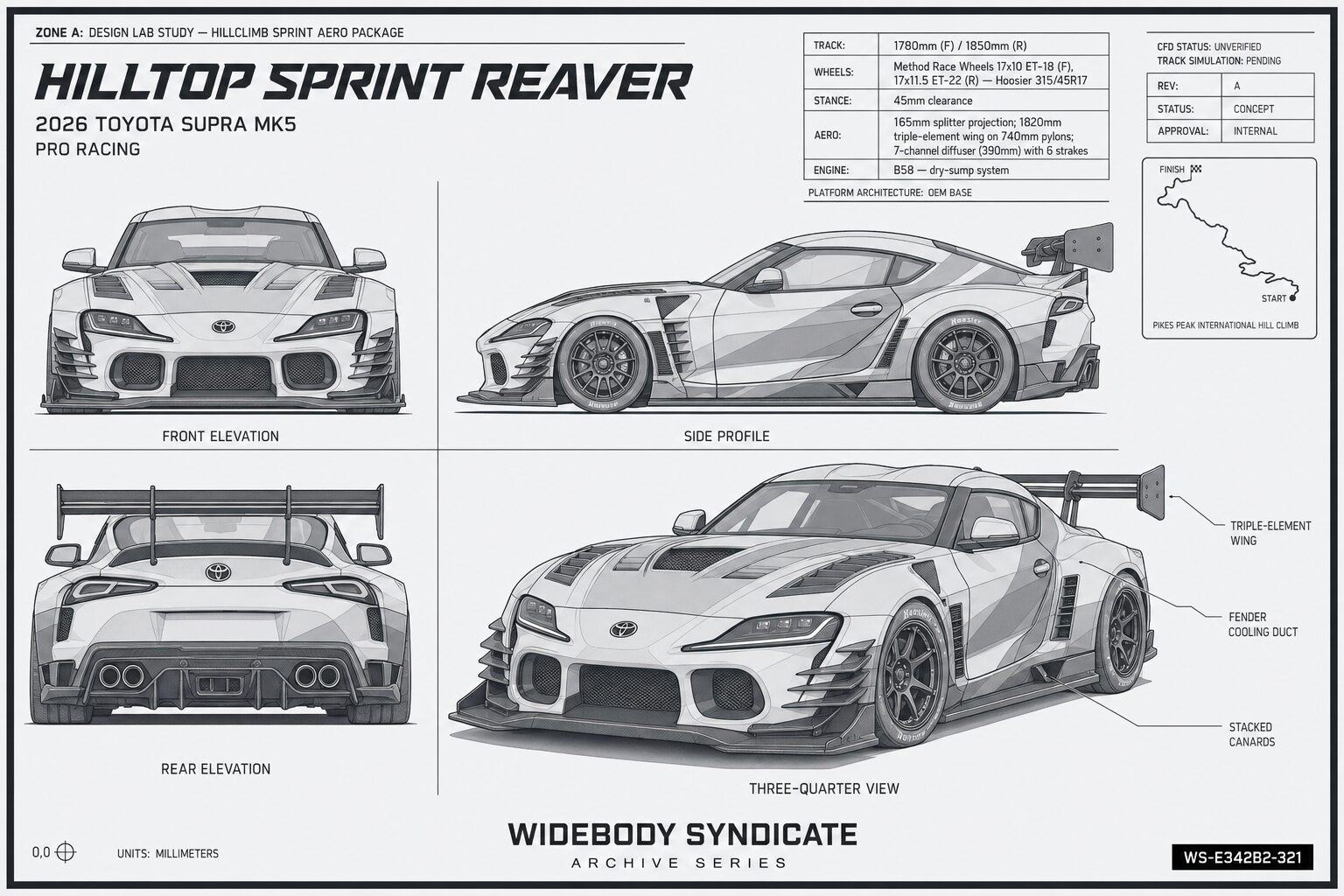
Hilltop Sprint Reaver blueprint
02
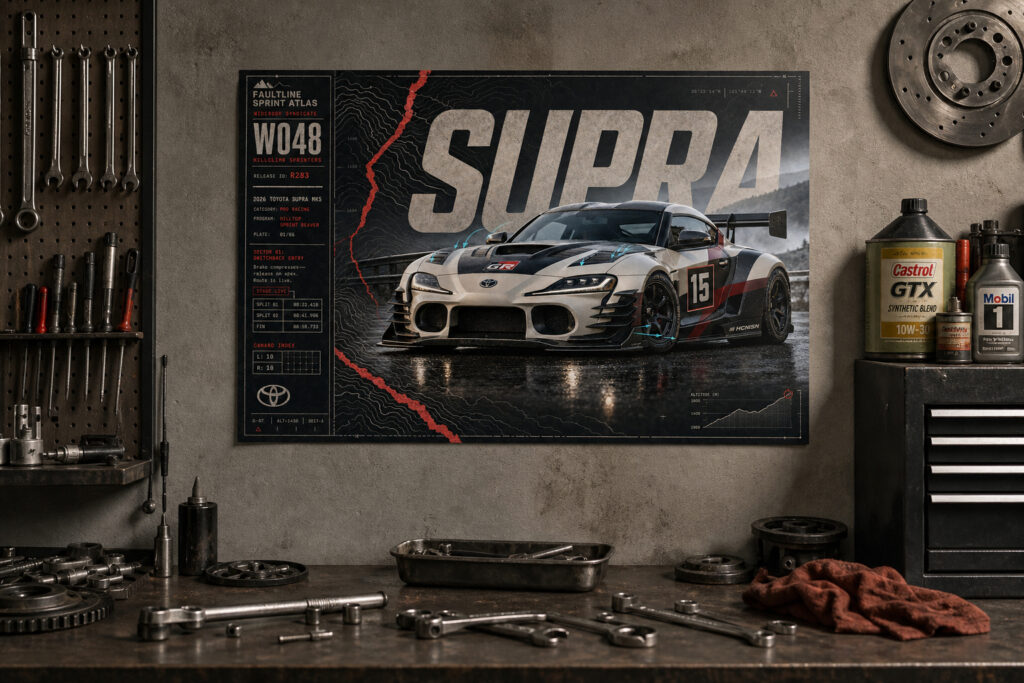
Hilltop Sprint Reaver Collector EditionCollector artifact
Hilltop Sprint Reaver Collector Edition

A presentation-grade collector artifact created for this release and preserved as part of the Widebody Syndicate archive.

Platform

2026 Toyota Supra Mk5

2026 Toyota Supra Mk5

By 2026, the A90/A91 Supra has settled into its role as Toyota’s modern halo coupe: compact, long-hooded, and unapologetically driver-first, with proportions that lean more GT than nostalgia piece. It’s the kind of platform that lives at the crossroads of OEM polish and tuner literacy—tight packaging, short overhangs, wide track, and a cabin that feels built around the act of driving rather than the spec sheet.

Under the skin, the Mk5’s appeal is how complete the base car feels before anyone touches it: rigid structure, serious cooling considerations, and a powertrain that responds with modern boost-fed urgency. It’s a contemporary Japanese sports car shaped by global engineering, and that blend is exactly what’s kept it at the center of today’s build culture—from street cars and canyon machines to track-day regulars that rack up laps like it’s nothing.

ToyotaSupra Mk52026
View Platform

Aero Package

165mm-projection composite splitter with corner dive planes set for low-speed front load
Stacked canard arrays feeding fender pressure management and brake duct priority
Carbon double-bubble hood with central NACA feed and louvered heat extraction
Seven-channel rear diffuser with strakes for underbody stability over pitch changes
1820mm triple-element rear wing on tall pylons for consistent rear load through crests

Chassis

This Supra is aimed at short hillclimb sprints: abrupt elevation changes, crests that unload the chassis, and corners that demand instant rotation. The setup favors platform control and yaw stability over smooth-circuit efficiency, keeping the car calm when the road surface and grade change faster than the driver can breathe.

Wheels & Tires

Method Race forged carbon 17x10 ET-18 front
Method Race forged carbon 17x11.5 ET-22 rear
Hoosier 315/45R17 hillclimb-spec tires front and rear
Target ride height ~45mm with bump-stop strategy to protect aero platform on uneven tarmac

Powertrain

B58 3.0T inline-six retained with hillclimb-focused boost response and thermal headroom
Dry-sump lubrication for sustained incline and lateral load control
Ducted oil/trans cooling fed by rocker inlets and managed exit paths to reduce heat soak
High-mounted
heat-shielded exhaust routing through the diffuser zone for packaging and clearance

Fabrication Notes

Fender inlet ducting routed to side-mounted front radiators with sealed shrouds and hood-exit pressure relief
Reinforced suspension architecture (double wishbone conversion concept) with corrected roll center after track widening
Composite bumper/splitter structure tied into chassis hardpoints for curb strikes and aero load durability
Wing pylon mounts back-plated into the rear structure to handle multi-element wing bending moments
×

Design Philosophy

Hilltop Sprint Reaver takes the 2026 Supra Mk5 and drags it out of the “don’t touch it” zone into the kind of short-course hillclimb tool that lives on throttle stabs, brake hits, and instant direction changes. The wheelbase is nudged shorter for a more eager rotation point, then backed up with a huge track increase and real tire under squared endurance-style box flares—because on a sprint hill, mechanical grip and response beat top-speed aero every time.

The aero is unapologetically functional: big, low-speed-effective devices up front, aggressive cooling everywhere, and a tall triple-element wing to keep the rear planted when the road falls away and the car goes light. It still reads as a Mk5—greenhouse, double-bubble silhouette, and tail signature intact—but every surface is pushed toward airflow control, heat rejection, and stability over broken pavement.

Platform+
2026 Toyota Supra Mk5

2026 Toyota Supra Mk5

By 2026, the A90/A91 Supra has settled into its role as Toyota’s modern halo coupe: compact, long-hooded, and unapologetically driver-first, with proportions that lean more GT than nostalgia piece. It’s the kind of platform that lives at the crossroads of OEM polish and tuner literacy—tight packaging, short overhangs, wide track, and a cabin that feels built around the act of driving rather than the spec sheet.

Under the skin, the Mk5’s appeal is how complete the base car feels before anyone touches it: rigid structure, serious cooling considerations, and a powertrain that responds with modern boost-fed urgency. It’s a contemporary Japanese sports car shaped by global engineering, and that blend is exactly what’s kept it at the center of today’s build culture—from street cars and canyon machines to track-day regulars that rack up laps like it’s nothing.

ToyotaSupra Mk52026
View Platform
Aero Package+

165mm-projection composite splitter with corner dive planes set for low-speed front load
Stacked canard arrays feeding fender pressure management and brake duct priority
Carbon double-bubble hood with central NACA feed and louvered heat extraction
Seven-channel rear diffuser with strakes for underbody stability over pitch changes
1820mm triple-element rear wing on tall pylons for consistent rear load through crests

Chassis+

This Supra is aimed at short hillclimb sprints: abrupt elevation changes, crests that unload the chassis, and corners that demand instant rotation. The setup favors platform control and yaw stability over smooth-circuit efficiency, keeping the car calm when the road surface and grade change faster than the driver can breathe.

Wheels & Tires+

Method Race forged carbon 17x10 ET-18 front
Method Race forged carbon 17x11.5 ET-22 rear
Hoosier 315/45R17 hillclimb-spec tires front and rear
Target ride height ~45mm with bump-stop strategy to protect aero platform on uneven tarmac

Powertrain+

B58 3.0T inline-six retained with hillclimb-focused boost response and thermal headroom
Dry-sump lubrication for sustained incline and lateral load control
Ducted oil/trans cooling fed by rocker inlets and managed exit paths to reduce heat soak
High-mounted
heat-shielded exhaust routing through the diffuser zone for packaging and clearance

Fabrication Notes+

Fender inlet ducting routed to side-mounted front radiators with sealed shrouds and hood-exit pressure relief
Reinforced suspension architecture (double wishbone conversion concept) with corrected roll center after track widening
Composite bumper/splitter structure tied into chassis hardpoints for curb strikes and aero load durability
Wing pylon mounts back-plated into the rear structure to handle multi-element wing bending moments

×Design Philosophy+

Hilltop Sprint Reaver takes the 2026 Supra Mk5 and drags it out of the “don’t touch it” zone into the kind of short-course hillclimb tool that lives on throttle stabs, brake hits, and instant direction changes. The wheelbase is nudged shorter for a more eager rotation point, then backed up with a huge track increase and real tire under squared endurance-style box flares—because on a sprint hill, mechanical grip and response beat top-speed aero every time.

The aero is unapologetically functional: big, low-speed-effective devices up front, aggressive cooling everywhere, and a tall triple-element wing to keep the rear planted when the road falls away and the car goes light. It still reads as a Mk5—greenhouse, double-bubble silhouette, and tail signature intact—but every surface is pushed toward airflow control, heat rejection, and stability over broken pavement.

Part of
Wave 48

Hillclimb Sprinters

This release is our answer to the hillclimb question nobody asked politely: what happens when you build for 60 to 90 seconds of terror instead of 20 minutes of elegance? Across coupes, a sedan, a pickup, and an SUV, the logic is the same: short-course sprint engineering where rotation matters more than top speed, and cooling is treated like ammunition.

Explore Wave 48 → 6 Builds

Keep Exploring

The archive is always growing. New releases, waves, and blueprints added regularly.